8
starter several times, the engine may be ooded with
excess fuel. Use following procedure to clear and
start a ooded engine.
1) Move the throttle level to STOP (Fig. I).
2) Remove the spark plug, dry it, then reinstall it.
NOTE: install the spark plug carefully by hand, to
avoid cross-threading. After the plug is seated,
tighten 1/8 to1/4 turn with socket spanner of spark
plug to compress the washer.
3) Move the throttle level to CHOKE position.
4) Operate the starter as described above.
7. STOPPING THE ENGINE
Move the throttle lever to the STOP position
(See Fig. G).
8. ADJUSTING THE CUTTING HEIGHT (SEE FIG. J)
WARNING! STOP THE ENGINE, AND WAIT
FOR BLADE TO COME TO A COMPLETE
STOP. The blades continue to rotate after the
machine is switched off, a rotating blade can cause
injury.
CAUTION: Do not touch rotating blades.
For the rst cutting of the season, a high cutting
adjustment should be selected.
The lawnmower can be set to 7 cutting heights
between 19mm and 70mm. For this purpose, move
the cutting height adjustment lever (14) outwards
then adjust to the preferred position.
Fig.I
1
2
9. MOWING
Always observe the strictest safety
procedures when using the lawnmower.
Carefully read the safety instructions of this
manual before using the lawn mower.
Start the engine and allow it run. See “Starting the
engine”.
When wish to start mowing, move the throttle lever
to its MAX position (Fig. G).
To stop the engine, move the throttle lever to the
STOP position (Fig. G).
Keep a rm grip on the upper handle and walk, never
run with the mower, be very careful when mowing
uneven or rough ground. Mow across slopes, never
up and down. Be careful when changing the direction
of the mower on a slope. Do not use the mower on a
steep slope of more than 20°.
The best result will be achieved if the grass is dry.
Wet grass will tend to clog the blade and the grass
collection system. Grass grows at different rates at
different time of the year.
Never use the lowest cutting height for the rst cut of
the season or in drought conditions. Only about one
thirds of the grass height should be cut.
If the lawnmower will not collect the cuttings
efciently, the grass discharge chute may be
blocked. The grass catcher may be full, or the
underside of the mower deck may be clogged.
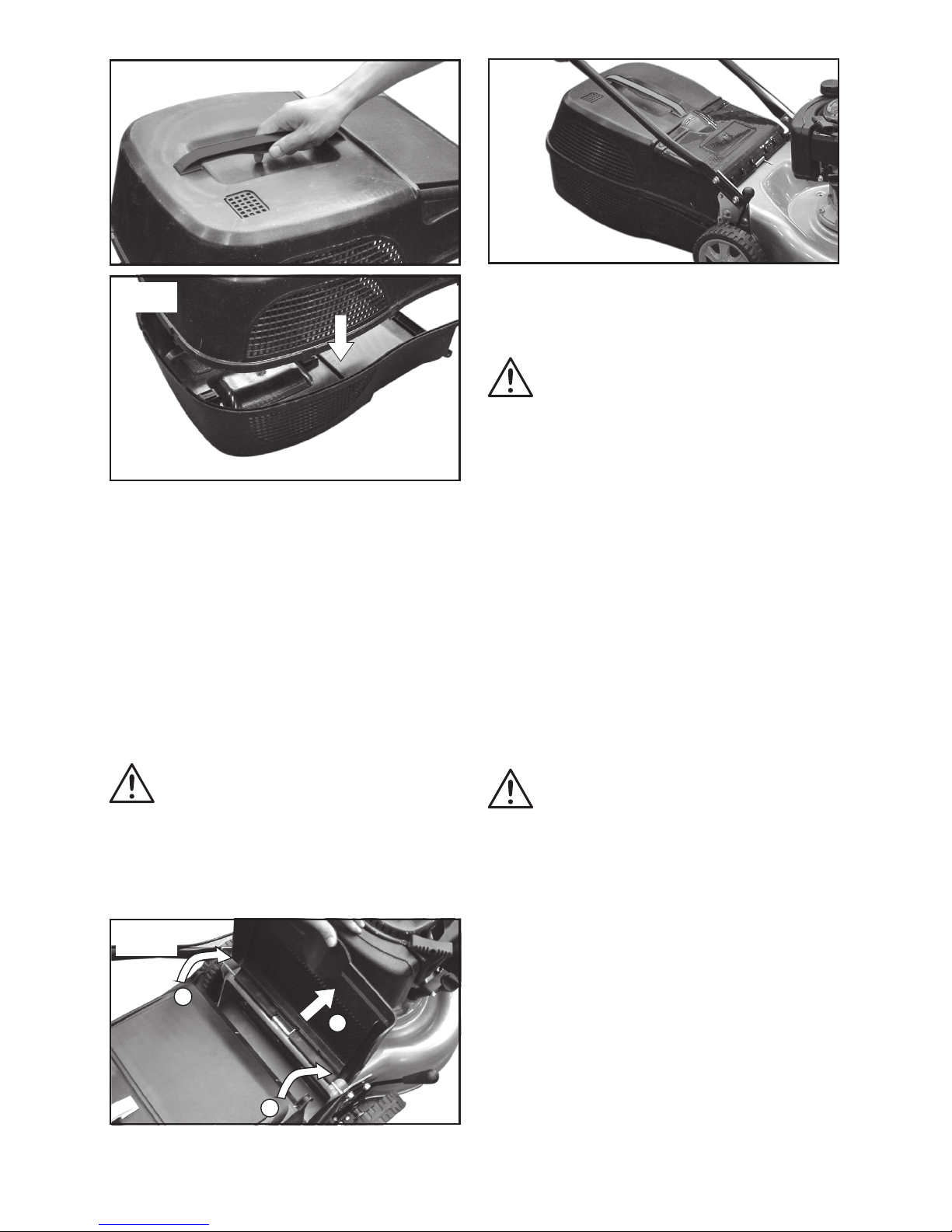
10. EMPTY/ATTACH THE GRASS COLLECTION CATCHER
As soon as you see mown grass debris on the lawn,
the grass catcher needs to be emptied.
IMPORTANT! Before you remove the grass catcher,
switch off the motor and wait until the blade
reaches a standstill.
1) To remove the grass catcher, raise the safety ap
with one hand and remove the grass catcher using
its handle with your other hand.
2) To maintain safety, the safety ap will close back
to cover the rear discharge opening, when you
release the ap.
3) Empty the grass debris in the glass collection
catcher, and ret glass catcher as above instruction.
4) If any grass residues are caught in the opening,
clean it using a pushing bar.
5) Do not remove grass debris in the mower casing
or on the blade by hand or with your feet. Instead use
suitable tools such as a brush or broom.
6) To ensure that the cutting grass can be blown into
glass catcher, the discharge opening and inside the
mower casing must be cleared of any blockage.
11. REPLACING THE BLADE (SEE FIG. J)
Maintain the sharpness of the blade when cutting
grass if the blade has worn excessively and becomes
pitted or blunt it should be replaced. The sharpness
of the blade will affect the performance of the lawn
mower.
For safety reasons we recommend that the blade
will only be changed by persons qualied and
authorized to do so.
WARNING! Before replacing the blade,
ensure that the engine is switched off and
the spark plug cap is disconnected and moved
away from the spark plug.
1) You will need garden gloves (not provided) and a
spanner wrench to remove the blade.
2) Hold the blade and unscrew the blade bolt