JVC EX-D5 User manual

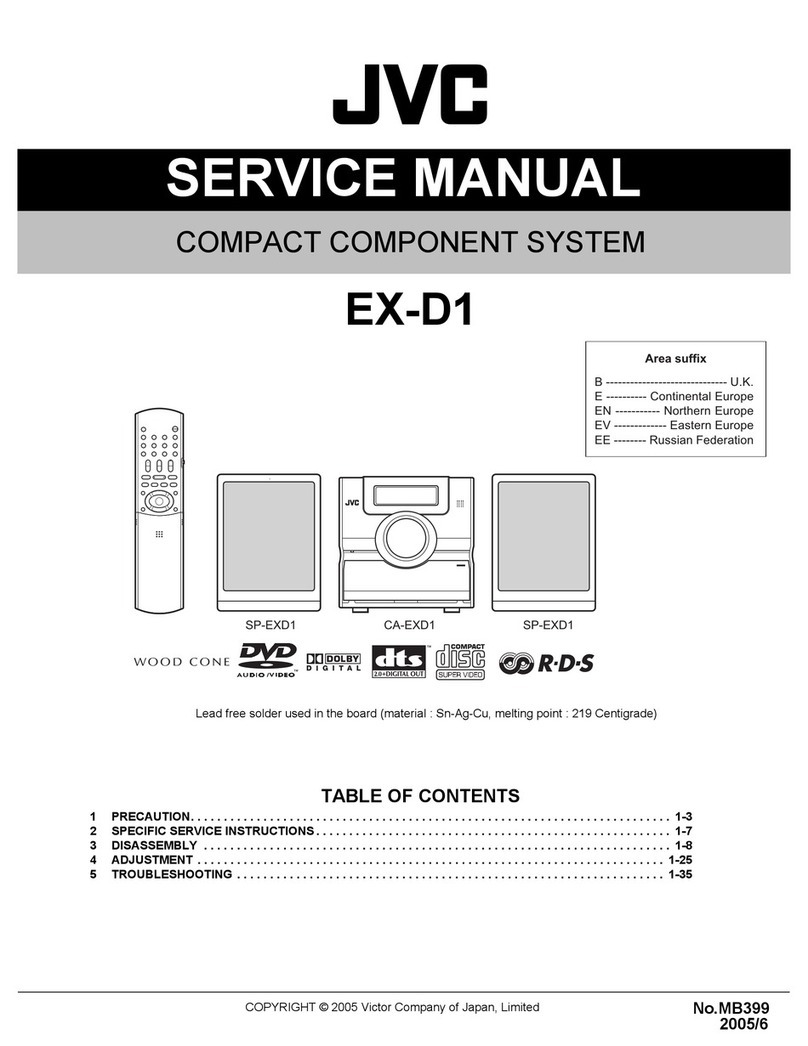
SERVICE MANUAL
COPYRIGHT © 2005 Victor Company of Japan, Limited No.MB433
2005/7
COMPACT COMPONENT SYSTEM
MB43320057
EX-D5
Lead free solder used in the board (material : Sn-Ag-Cu, melting point : 219 Centigrade)
TABLE OF CONTENTS
1 PRECAUTION. . . . . . . . . . . . . . . . . . . . . . . . . . . . . . . . . . . . . . . . . . . . . . . . . . . . . . . . . . . . . . . . . . . . . . . . . 1-3
2 SPECIFIC SERVICE INSTRUCTIONS . . . . . . . . . . . . . . . . . . . . . . . . . . . . . . . . . . . . . . . . . . . . . . . . . . . . . . 1-5
3 DISASSEMBLY . . . . . . . . . . . . . . . . . . . . . . . . . . . . . . . . . . . . . . . . . . . . . . . . . . . . . . . . . . . . . . . . . . . . . . . 1-6
4 ADJUSTMENT . . . . . . . . . . . . . . . . . . . . . . . . . . . . . . . . . . . . . . . . . . . . . . . . . . . . . . . . . . . . . . . . . . . . . . . 1-24
5 TROUBLESHOOTING . . . . . . . . . . . . . . . . . . . . . . . . . . . . . . . . . . . . . . . . . . . . . . . . . . . . . . . . . . . . . . . . . 1-35
CA-EXD5 SP-EXD1SP-EXD1
Area suffix
J ---------------------------- U.S.A.
C ------------------------- Canada

1-2 (No.MB433)
SPECIFICATION
Designs and specifications are subject to change without notice.
General Power source AC 120 V , 60 Hz
Power consumption 25 W (in operation)
1.0 W (on standby)
Weight 3.0 kg (6.7 lbs)
External dimensions (W ×H ×D) 150 mm ×152 mm ×246 mm (5-15/16 in. ×6 in. ×9-11/16 in.)
DVD player Playable discs DVD VIDEO, DVD AUDIO, VCD,SVCD, CD, CD-R/RW (CD, VCD,MP3,
WMA, JPEG format),DVD-R/-RW (video format)
Video output Color system NTSC
Horizontal resolution 500 lines
Composite ×1 1.0 V (p-p)/75 Ω, synchronization negative
S-video ×1 Y output: 1.0 V (p-p)/75 Ω, synchronization negative
C output: 0.286 V (p-p)/75 Ω
Component ×1 Y output: 1.0 V (p-p)/75 Ω
PB/PR output: 0.7 V (p-p)/75 Ω
Audio output Analog sound output Speakers ×2 Output power: 18 W per channel, min. RMS, at 4 Ωat 1 kHz with no more
than 10% total harmonic distortion.
Fitting impedance: 4 Ωto 16 Ω
Headphones ×1 11 mW/32 Ω
Fitting impedance: 16 Ωto 1 kΩ
Subwoofer ×1 500 mVrms/10 kΩ
Digital sound output Optical ×1 -21 dBm to -15 dBm
Audio input Sound input AUX ×1 400 mV/50 kΩ
USB Wireless Transmission The USB wireless transmitter supplied with this System supports Direct Se-
quence Spreading Spectrum (DSSS) using 2.4 GHz frequency band.
Tuner FM tuner Receiving frequency 87.5 MHz to 108.0 MHz
Antenna 75 Ω- Unbalanced type
AM tuner Receiving frequency 530 kHz to 1 710 kHz
Antenna External antenna jack (loop antenna)
Speaker Type Full range
1-way bass-reflex type
Magnetically shielded type
Speaker 8cm (3 3/16 inches) cone ×1
Frequency response 55 to 20 000 Hz
Power handling capacity 30 W
Impedance 4Ω
Sound pressure level 80 dB/W m
Dimension (W ×H ×D) 120 mm ×151 mm ×241 mm (4-3/4 in. ×6 in. ×9-1/2 in.)
Weight 1.8 kg (4.0 lbs) each

(No.MB433)1-3
SECTION 1
PRECAUTION
1.1 Safety Precautions
(1) This design of this product contains special hardware and
many circuits and components specially for safety purpos-
es. For continued protection, no changes should be made
to the original design unless authorized in writing by the
manufacturer. Replacement parts must be identical to
those used in the original circuits. Services should be per-
formed by qualified personnel only.
(2) Alterations of the design or circuitry of the product should
not be made. Any design alterations of the product should
not be made. Any design alterations or additions will void
the manufacturers warranty and will further relieve the
manufacture of responsibility for personal injury or property
damage resulting therefrom.
(3) Many electrical and mechanical parts in the products have
special safety-related characteristics. These characteris-
tics are often not evident from visual inspection nor can the
protection afforded by them necessarily be obtained by us-
ing replacement components rated for higher voltage, watt-
age, etc. Replacement parts which have these special
safety characteristics are identified in the Parts List of Ser-
vice Manual. Electrical components having such features
are identified by shading on the schematics and by ( ) on
the Parts List in the Service Manual. The use of a substitute
replacement which does not have the same safety charac-
teristics as the recommended replacement parts shown in
the Parts List of Service Manual may create shock, fire, or
other hazards.
(4) The leads in the products are routed and dressed with ties,
clamps, tubings, barriers and the like to be separated from
live parts, high temperature parts, moving parts and/or
sharp edges for the prevention of electric shock and fire
hazard. When service is required, the original lead routing
and dress should be observed, and it should be confirmed
that they have been returned to normal, after reassem-
bling.
(5) Leakage shock hazard testing
After reassembling the product, always perform an isola-
tion check on the exposed metal parts of the product (an-
tenna terminals, knobs, metal cabinet, screw heads,
headphone jack, control shafts, etc.) to be sure the product
is safe to operate without danger of electrical shock.Do not
use a line isolation transformer during this check.
• Plug the AC line cord directly into the AC outlet. Using a
"Leakage Current Tester", measure the leakage current
from each exposed metal parts of the cabinet, particular-
ly any exposed metal part having a return path to the
chassis, to a known good earth ground. Any leakage cur-
rent must not exceed 0.5mA AC (r.m.s.).
• Alternate check method
Plug the AC line cord directly into the AC outlet. Use an
AC voltmeter having, 1,000Ωper volt or more sensitivity
in the following manner. Connect a 1,500Ω10W resistor
paralleled by a 0.15µF AC-type capacitor between an ex-
posed metal part and a known good earth ground.
Measure the AC voltage across the resistor with the AC
voltmeter.
Move the resistor connection to each exposed metal
part, particularly any exposed metal part having a return
path to the chassis, and measure the AC voltage across
the resistor. Now, reverse the plug in the AC outlet and
repeat each measurement. Voltage measured any must
not exceed 0.75 V AC (r.m.s.). This corresponds to 0.5
mA AC (r.m.s.).
1.2 Warning
(1) This equipment has been designed and manufactured to
meet international safety standards.
(2) It is the legal responsibility of the repairer to ensure that
these safety standards are maintained.
(3) Repairs must be made in accordance with the relevant
safety standards.
(4) It is essential that safety critical components are replaced
by approved parts.
(5) If mains voltage selector is provided, check setting for local
voltage.
1.3 Caution
Burrs formed during molding may be left over on some parts
of the chassis.
Therefore, pay attention to such burrs in the case of pre-
forming repair of this system.
1.4 Critical parts for safety
In regard with component parts appearing on the silk-screen
printed side (parts side) of the PWB diagrams, the parts that are
printed over with black such as the resistor ( ), diode ( )
and ICP ( ) or identified by the " " mark nearby are critical
for safety. When replacing them, be sure to use the parts of the
same type and rating as specified by the manufacturer.
(This regulation dose not Except the J and C version)
Good earth ground
Place this
probe on
each exposed
metal part.
AC VOLTMETER
(Having 1000
ohms/volts,
or more sensitivity)
1500 10W
0.15 F AC TYPE

1-4 (No.MB433)
1.5 Preventing static electricity
Electrostatic discharge (ESD), which occurs when static electricity stored in the body, fabric, etc. is discharged, can destroy the laser
diode in the traverse unit (optical pickup). Take care to prevent this when performing repairs.
1.5.1 Grounding to prevent damage by static electricity
Static electricity in the work area can destroy the optical pickup (laser diode) in devices such as laser products.
Be careful to use proper grounding in the area where repairs are being performed.
(1) Ground the workbench
Ground the workbench by laying conductive material (such as a conductive sheet) or an iron plate over it before placing the
traverse unit (optical pickup) on it.
(2) Ground yourself
Use an anti-static wrist strap to release any static electricity built up in your body.
(3) Handling the optical pickup
• In order to maintain quality during transport and before installation, both sides of the laser diode on the replacement optical
pickup are shorted. After replacement, return the shorted parts to their original condition.
(Refer to the text.)
• Do not use a tester to check the condition of the laser diode in the optical pickup. The tester's internal power source can easily
destroy the laser diode.
1.6 Handling the traverse unit (optical pickup)
(1) Do not subject the traverse unit (optical pickup) to strong shocks, as it is a sensitive, complex unit.
(2) Cut off the shorted part of the flexible cable using nippers, etc. after replacing the optical pickup. For specific details, refer to the
replacement procedure in the text. Remove the anti-static pin when replacing the traverse unit. Be careful not to take too long a
time when attaching it to the connector.
(3) Handle the flexible cable carefully as it may break when subjected to strong force.
(4) I t is not possible to adjust the semi-fixed resistor that adjusts the laser power. Do not turn it.
1.7 Attention when traverse unit is decomposed
*Please refer to "Disassembly method" in the text for the pickup unit.
• Apply solder to the short land sections before the flexible wire is disconnected from the connecto on the servo board. (If the flexible
wire is disconnected without applying solder, the pickup may be destroyed by static electricity.)
• In the assembly, be sure to remove solder from the short land sections after connecting the flexible wire.
1M
Conductive material
(conductive sheet) or iron palate
(caption)
Anti-static wrist strap
Traverse mechanism assembly
Pickup
Short land section
Card wire
Connector

(No.MB433)1-5
SECTION 2
SPECIFIC SERVICE INSTRUCTIONS
This service manual does not describe SPECIFIC SERVICE INSTRUCTIONS.

1-6 (No.MB433)
SECTION 3
DISASSEMBLY
3.1 Main body section
3.1.1 Removing the side panel L and side panel R
(See Figs.1 to 4)
(1) From the back side of the main body, remove the four
screws Aattaching the side panels L/R. (See Fig.1.)
(2) From the bottom side of the main body, remove the four
screws Battaching the side panels L/R. (See Fig.2.)
(3) From the both sides of the main body, release the joint ain
the direction of the arrow and remove the side panels L/R
toward this side. (See Figs.3 and 4.)
Fig.1
Fig.2
Fig.3
Fig.4
A A
Side panel R Side panel L
B
B
Side panel R
Side panel L
Side panel R
a
a
Side panel L a
a

(No.MB433)1-7
3.1.2 Removing the top panel assembly
(See Figs.5 to 6)
• Remove the side panels L/R.
(1) From the front side of the main body, pull out the volume
knob assembly in the direction of the arrow. (See Fig.5.)
(2) Remove the two screws Cand remove the volume orna-
ment. (See Fig.5.)
(3) From the both sides of the main body, remove the two
screws D, two screws Eand screw F. (See Figs.5 and 6)
Reference:
When attaching the screw F, attach the earth wire with it.
(See Fig.6.)
(4) From the back side of the main body, remove the screw G
attaching the top panel assembly. (See Fig.6.)
(5) From the both sides of the main body, release the joints b
and remove the joints cin the direction of the arrow. (See
Figs.5 and 6.)
(6) Disconnect the card wire from the connector CN427 on the
micom board while lifting the top panel assembly. (See
Fig.5.)
Fig.5
Fig.6
Top panel assembly
CN427
c
Micom board
Volume ornament
C
C
DEb
Volume knob assembly
Top panel assembly
c
D
E
b
Top panel assembly
G
F
Earth wire

1-8 (No.MB433)
3.1.3 Removing the front panel assembly
(See Figs.7 to 9)
• Remove the side panels L/R and top panel assembly.
(1) From the bottom side of the main body, remove the two
screws Hattaching the front panel assembly. (See Fig.7.)
(2) From the forward side of the micom board, disconnect the
card wire from the connector CN426. (See Fig.8.)
(3) Disconnect the wire from the connector CN501 on the mi-
com board. (See Fig.8.)
(4) From the right side of the main body, remove the screw J
and remove the earth wire. (See Fig.8.)
Reference:
• When attaching the screw J, attach the earth wire with
it as before. (See Fig.8.)
• After attaching the earth wire, fix it with the spacer as
before. (See Fig.8.)
(5) From the bottom and both sides of the main body, release
the joints (d, e) of the front panel assembly and remove the
front panel assembly in the direction of the arrow. (See
Figs.7 to 9.)
Fig.7
Fig.8
Fig.9
Front panel assembly d
H
H
Front panel assembly CN426
CN501
e
Micom board
Earth wire
J
Spacer
Front panel assembly
e

(No.MB433)1-9
3.1.4 Removing the tuner
(See Figs.10 and 11)
• Remove the side panels L/R and top panel assembly.
(1) From the back side of the main body, remove the two
screws Kattaching the tuner to the rear panel. (See
Fig.10.)
(2) Disconnect the card wire from the connector CN1 on the
tuner. (See Fig.11.)
Fig.10
Fig.11
K
K
Tuner
Tuner
CN1

1-10 (No.MB433)
3.1.5 Removing the rear panel
(See Fig.12)
• Remove the side panels L/R and top panel assembly.
(1) From the back side of the main body, remove the ten
screws Mand screw Nattaching the rear panel.
(2) From the top side of the main body, disconnect the earth
wire from the rear panel in the direction of the arrow.
(3) From the both sides of the main body, release the joints f
and remove the rear panel.
Fig.12
M
M
N
M
Rear panel
ff
Rear panel
Earth wire
M
Other manuals for EX-D5
1
This manual suits for next models
2
Table of contents
Other JVC Micro System manuals