Levelling the Freezer
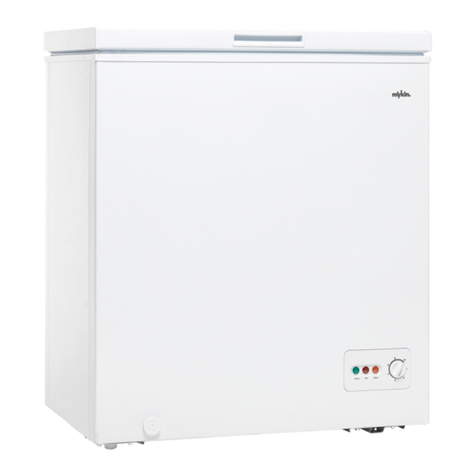
Once the freezer is sited in its final location, make sure it is level. To do this use the two levelling
feet at the front of the freezer. (If the freezer is not level, the doors and magnetic seal alignments
will be affected.)
Cleaning before use
Wipe the inside of the freezer with warm water using a soft cloth. Wipe completely dry before
replacing the shelves and baskets.
Before using your Freezer
Check that you have your power outlet is compatible with the plug supplied with the freezer. If
not, see the section called ELECTRICAL CONNECTION at the back of this booklet.
DO NOT SWITCH ON UNTIL TWO HOURS AFTER MOVING THE FREEZER to allow the coolant
fluid time to settle.
Before placing any food in your freezer, turn the freezer on and wait for 24 hours, to make sure it
is working properly and to allow the freezer to fall to the correct temperature.
Using Your Freezer
Switching on your freezer:
1) Before connecting the freezer to the mains supply make sure that the Thermostat
Control located inside the freezer is set just below 4, which is the correct setting for use
in a room of average temperature.
2) Wait 24 hours before placing food in the cabinet to allow for the freezer to fall to the
correct temperature.
Adjusting the temperature
The internal temperature of your freezer is controlled by the Temperature Control. There are 7
settings. Position 7 makes the freezer coldest. Position 1 makes it the warmest. To adjust the
temperature, turn the Temperature Control to the preferred setting. Position 0 will turn the freezer
off.
Noises inside the Freezer
If you have not owned a freezer before, you may notice that it makes some rather unusual noises.
Most of these are perfectly normal, but you should be aware of them!
GURGLING, WHOOSHING
These noises are caused by the circulation of the refrigerant liquid in the cooling system. It has
become more pronounced since the introduction of CFC free gases. This is not a fault and will not
affect the performance of your freezer.
HUMMING, PURRING OR PULSATING
This is the compressor motor working, as it pumps the refrigerant around the system.
Defrosting
After a period of time frost will build up in the freezer. As a temporary measure, this frost should
be scraped away using a plastic scraper. Complete defrosting will however become necessary
approximately once per year, or if the frost layer exceeds 5cm (2”) to maintain the efficiency of the
freezer.
This should be carried out if the frost build up cannot be scraped away, or if it begins to interfere
with the food storage. Choose a time when the stock of frozen food is low and proceed as follows:
1) Take out the frozen food, turn the freezer off at the mains supply and leave the door
open. Ideally the frozen food should be put into another freezer or refrigerator. If this is
not possible wrap the food, firstly in several sheets of newspaper or large towels and
then a thick rug or blanket and keep it in a cool place.
2) Remove the drainage whole plug to allow any water that is produced in the defrosting
process to escape. Place a container below the hole to collect the water.
3) Scrape away as much frost build up as possible using a plastic scraper. Thawing of the
remainder can be speeded up by placing bowls of hot water inside the freezer cabinet
and closing the door. As the solid frost loosens, prize it away with the plastic scraper and
remove.
4) When defrosting is completed, clean your freezer as described below.