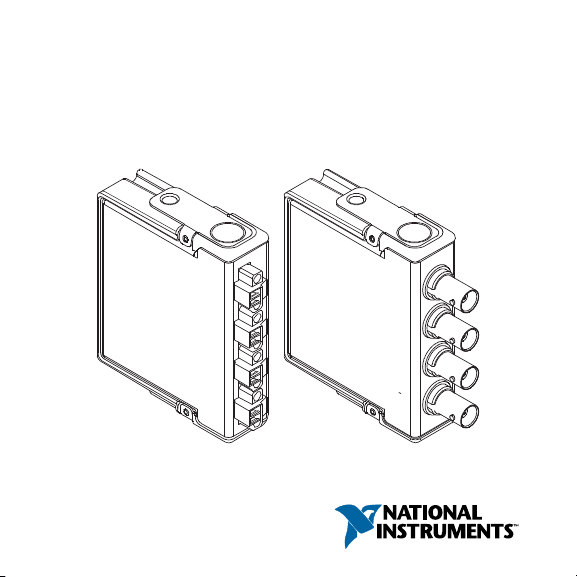
NI 9222 User manual

GETTING STARTED GUIDE
NI 9222
4 AI, ±10 V, 16 Bit, 500 kS/s/ch Simultaneous

This document explains how to connect to the NI 9222.
Note Before you begin, complete the software and
hardware installation procedures in your chassis
documentation.
Note The guidelines in this document are specific to
the NI 9222. The other components in the system might
not meet the same safety ratings. Refer to the
documentation for each component in the system to
determine the safety and EMC ratings for the entire
system.
Safety Guidelines
Operate the NI 9222 only as described in this document.
Caution Do not operate the NI 9222 in a manner not
specified in this document. Product misuse can result in
a hazard. You can compromise the safety protection
built into the product if the product is damaged in any
way. If the product is damaged, return it to NI for
repair.
2| ni.com | NI 9222 Getting Started Guide

Safety Voltages
Connect only voltages that are within the following limits:
Isolation
Channel-to-channel
Continuous 60 VDC,
Measurement Category I
Withstand 1000 Vrms, verified by a 5 s
dielectric withstand test
Channel-to-earth ground
Continuous 60 VDC,
Measurement Category I
Withstand 1000 Vrms, verified by a 5 s
dielectric withstand test
Measurement Category I is for measurements performed on
circuits not directly connected to the electrical distribution system
referred to as MAINS voltage. MAINS is a hazardous live
electrical supply system that powers equipment. This category is
for measurements of voltages from specially protected secondary
NI 9222 Getting Started Guide | © National Instruments | 3

circuits. Such voltage measurements include signal levels, special
equipment, limited-energy parts of equipment, circuits powered
by regulated low-voltage sources, and electronics.
Caution Do not connect the NI 9222 to signals or use
for measurements within Measurement Categories II,
III, or IV.
Note Measurement Categories CAT I and CAT O are
equivalent. These test and measurement circuits are not
intended for direct connection to the MAINS building
installations of Measurement Categories CAT II,
CAT III, or CAT IV.
Safety Guidelines for Hazardous Locations
The NI 9222 is suitable for use in Class I, Division 2, Groups A,
B, C, D, T4 hazardous locations; Class I, Zone 2, AEx nA IIC T4
and Ex nA IIC T4 hazardous locations; and nonhazardous
locations only. Follow these guidelines if you are installing the
NI 9222 in a potentially explosive environment. Not following
these guidelines may result in serious injury or death.
4| ni.com | NI 9222 Getting Started Guide

Caution Do not disconnect I/O-side wires or
connectors unless power has been switched off or the
area is known to be nonhazardous.
Caution Do not remove modules unless power has
been switched off or the area is known to be
nonhazardous.
Caution Substitution of components may impair
suitability for Class I, Division 2.
Caution For Division 2 and Zone 2 applications,
install the system in an enclosure rated to at least IP54
as defined by IEC/EN 60079-15.
Special Conditions for Hazardous Locations Use in
Europe and Internationally
The NI 9222 with screw terminal has been evaluated as Ex nA
IIC T4 Gc equipment under DEMKO Certificate No. 07 ATEX
0626664X and is IECEx UL 14.0089X certified. The NI 9222
with BNC has been evaluated as Ex nA IIC T4 Gc equipment
under DEMKO Certificate No. 12 ATEX 1202658X and is
IECEx UL 14.0089X certified. Each NI 9222 is marked II 3G
and is suitable for use in Zone 2 hazardous locations, in ambient
NI 9222 Getting Started Guide | © National Instruments | 5

temperatures of -40 °C ≤ Ta ≤ 70 °C. If you are using the NI 9222
in Gas Group IIC hazardous locations, you must use the device in
an NI chassis that has been evaluated as Ex nC IIC T4, Ex IIC
T4, Ex nA IIC T4, or Ex nL IIC T4 equipment.
Caution You must make sure that transient
disturbances do not exceed 140% of the rated voltage.
Caution The system shall only be used in an area of
not more than Pollution Degree 2, as defined in
IEC 60664-1.
Caution The system shall be mounted in an
ATEX/IECEx-certified enclosure with a minimum
ingress protection rating of at least IP54 as defined in
IEC/EN 60079-15.
Caution The enclosure must have a door or cover
accessible only by the use of a tool.
Electromagnetic Compatibility Guidelines
This product was tested and complies with the regulatory
requirements and limits for electromagnetic compatibility (EMC)
6| ni.com | NI 9222 Getting Started Guide

stated in the product specifications. These requirements and
limits provide reasonable protection against harmful interference
when the product is operated in the intended operational
electromagnetic environment.
This product is intended for use in industrial locations. However,
harmful interference may occur in some installations, when the
product is connected to a peripheral device or test object, or if the
product is used in residential or commercial areas. To minimize
interference with radio and television reception and prevent
unacceptable performance degradation, install and use this
product in strict accordance with the instructions in the product
documentation.
Furthermore, any changes or modifications to the product not
expressly approved by National Instruments could void your
authority to operate it under your local regulatory rules.
Caution To ensure the specified EMC performance,
operate this product only with shielded accessories.
Caution Electrostatic Discharge (ESD) can damage
the NI 9222 with screw terminal. To prevent damage,
use industry-standard ESD prevention measures during
installation, maintenance, and operation.
NI 9222 Getting Started Guide | © National Instruments | 7

Caution To ensure the specified EMC performance,
operate the NI 9222 with screw terminal only with
double-shielded, twisted pair cables.
Caution To ensure the specified EMC performance,
operate the NI 9222 with BNC only with shielded
cables.
Caution To ensure the specified EMC performance,
the length of all I/O cables must be no longer than 30 m
(100 ft).
Cable Requirements for EMC Compliance
Select and install cables for the NI 9222 with screw terminal in
accordance with the following requirements:
• Connect the cable shield to the chassis ground (grounding
screw of the chassis) using the shortest length of wire
possible.
• Use shielded, twisted-pair cables (Belden 9451 or
equivalent).
8| ni.com | NI 9222 Getting Started Guide

Figure 1. Cable Connections for NI 9222 with screw terminal for EMC
Compliance
NI 9222
Shield
AI0+
AI0–
Signal
Source
Shield
AI1+
AI1–
Signal
Source
Shield
AI2+
AI2–
Signal
Source
Shield
AI3+
AI3–
Signal
Source
NI 9222 Getting Started Guide | © National Instruments | 9

Special Conditions for Marine Applications
Some products are Lloyd’s Register (LR) Type Approved for
marine (shipboard) applications. To verify Lloyd’s Register
certification for a product, visit ni.com/certification and search
for the LR certificate, or look for the Lloyd’s Register mark on
the product.
Caution In order to meet the EMC requirements for
marine applications, install the product in a shielded
enclosure with shielded and/or filtered power and
input/output ports. In addition, take precautions when
designing, selecting, and installing measurement probes
and cables to ensure that the desired EMC performance
is attained.
10 | ni.com | NI 9222 Getting Started Guide
This manual suits for next models
1
Table of contents