3 of 6
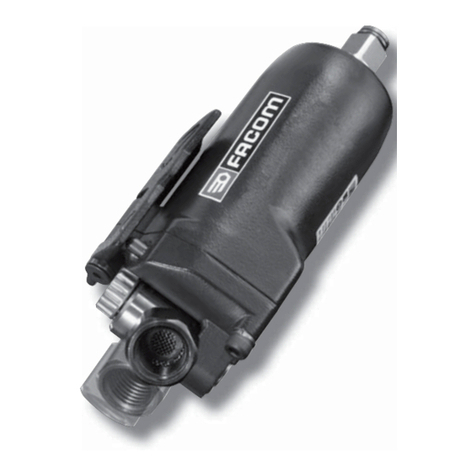
1.Install astandard 1/4"Air Connector (notincluded) to theAir Inlet.First wrap the
threaded portion ofthe 1/4" airconnector with pipethread seal tapebefore threading it
into theAir Inlet.Tighten securely.
2.Attach astandard quick connector(not included) toyour 3/8" airpressure source hose.
Then attach theair hose tothe AirImpact Wrench.
NOTE: If you arenot using anautomatic in-line oiler, add afew drops ofpneumatic oil to
the AirInlet before attachingthe air hose.Add afew more dropsof oil afterevery hour of
continual use.
3.Set theair pressure regulatoron your aircompressor at 90PSI.
WARNING:Do not exceedthe recommended pressureof 90 PSI.Damage to your
tool and possiblepersonal injury and/orproperty damage mayresult.
4.Check theair line andits connections forair leaks. Makenote of these,and repair them
before using thistool.
NOTE: Turn offyour air compressorand disconnect theair pressure hosebefore
changing sockets ormaking any adjustmentsto this tool.Severe injury orproperty
damage may otherwiseresult.
WARNING:This tool generatesconsiderable torque whenin use.Always hold the
tool with bothhands when using,and brace yourselfto resist thetorque which willbe
delivered to theworkpiece.
5.Select theappropriate size 3/8"square drive impactsocket (not included)for your
needs. Push andsnap the socketonto the anvil.
Note: Impact Sockets mustbe rated for10,000 RPM orgreater.
6.Set thedirection of theAir ImpactWrench to"FORWARD" or"REVERSE". By moving
the ThrottleLever "Butterfly" tothe right, youare setting thetool to operateFORWARD.
Youmay control theamount of torqueto be appliedby rotating theRegulator.There are
settings from 1through 8, indicatingincreasing torque. Rockthe ThrottleLever "Butterfly"
to the leftto REVERSE thedirection of thetool.
NOTE: In thismanual, "FORWARD"refers to clockwiserotation, and "REVERSE"refers
to counterclockwise rotationof theAnvil. Alwaysbe aware ofthe direction ofthe threading
of the fasteneryou are workingon. While mostfasteners install withclockwise rotation,
some threads areintentionally the reverse.REVERSE FORWARDThrottle Lever
"Butterfly."
NOTE: The actual torquedelivered at eachof the eightsettings will dependon the air
pressure supplied tothe tool. We suggest thatyou test theactual torque bytightening a
nut or boltat each setting,then observing theresultant torque byusing a mechanical
torque wrench (notsupplied).
7.If installinga nut orbolt, set itas tight aspossible by handbefore tightening withthe Air
Impact Wrench.
8.Place thesocket (not included)over the fastener.
9.Grip theAir ImpactWrench tightlywith both hands,and rock theThrottle Lever
"Butterfly" to theright. Thetool will operateand tighten thefastener.
10.When thefastener is tightened,release theThrottle Lever "Butterfly"and remove the
tool from thefastener.
11.If possible, checkthe actual torqueapplied to thefastener with amechanical torque
wrench (not supplied).
12.If removinga fastener,grip theAir Impact Wrench tightly withboth hands androck the
Throttle Lever "Butterfly"to the left.The toolwill operate andloosen the fastener
(assuming that thefastener is astandard right-hand thread).
NOTE: Always check tobe sure ofthe thread directionof any fastenerbefore attempting
to install orremove it. Ifthe fastener isa left-hand thread,rock theThrottle Lever
"Butterfly" to theright for removal.
WARNING:If the fastenerwill not comeoff, first checkthe direction ofthe
thread. If youhave the threaddirection correct andthe fastener willstill not come
off, DO NOTINCREASE THEAIR PRESSURE tothe tool beyond90 PSI. This
2 of 6
WARNING:The warnings, cautions,and instructions discussedin this instruction
manual cannot coverall possible conditionsand situations thatmay occur.It must be
understood by theoperator that commonsense and cautionare factors whichcannot be
built into thisproduct, but mustbe supplied bythe operator.
WARNING:The brass componentsof this productcontain lead, achemical
known to theState of Californiato cause birthdefects (or otherreproductive harm).
(California Health &Safety code 25249.5,et seq.)
ASSEMBLYAND OPERATING INSTRUCTIONS
9.Maintain toolswith care. Keep toolsclean and ingood condition forbetter and safer
performance. Follow instructionsfor lubricating andchanging accessories. Inspecttool
fittings and hosesperiodically and, ifdamaged, have themrepaired by anauthorized
technician. Thehandles must bekept clean, dry, and freefrom oil andgrease at alltimes.
10.Disconnect power. Disconnect fromair pressure sourcewhen not inuse.
11.Removeadjusting keys andwrenches. Check thatkeys and adjustingwrenches are
removed from thetool or machinework surface beforeconnecting it.
12.Avoidunintentional starting. Be surethe ButterflyThrottle Switch isin the neutral,
OFF position whennot in useand before connectingto pressure source.Do not carryany
tool with yourfinger on theButterfly ThrottleSwitch, whether itis attached ornot.
13.Check fordamaged parts. Before usingany tool, anypart that appearsdamaged
should be carefullychecked to determinethat it willoperate properly andperform its
intended function. Checkfor alignment andbinding of movingparts; any brokenparts or
mounting fixtures; andany other conditionthat may affect proper operation.Any partthat
is damaged shouldbe properly repairedor replaced bya qualified technician.Do not use
the tool ifthe ButterflyThrottle Switch doesnot function properly.
14.Guard againstelectric shock whenworking on electricalequipment, such as
your air compressor. Prevent body contactwith grounded surfacessuch as pipes,
radiators, ranges, andrefrigerator enclosures.
15.Replacement partsand accessories. When servicing,use only identical
replacement parts. Useof any otherparts will voidthe warranty. Only useaccessories
intended for usewith this tool.
16.Do notoperate tool ifunder the influenceof alcohol ordrugs, or ifyou are tired.
This may resultin serious injury.
17.Use propersize and typeair pressure lineand fittings. Therecommended air line
for this toolis 3/8" deliveringno more than90 PSI. Recommendedair inlet sizeis 1/4" -18
NPT.
18.Maintenance. For yoursafety,service and maintenanceshould be performed
regularly by aqualified technician.
19.You should maintaina proper regulatorand moisture trapin your airline at all
times.
Note: Performance ofthis tool mayvary depending onvariations in localair pressure.
Fig. 1