INSTALLATION & MAINTENANCE INSTRUCTIONS
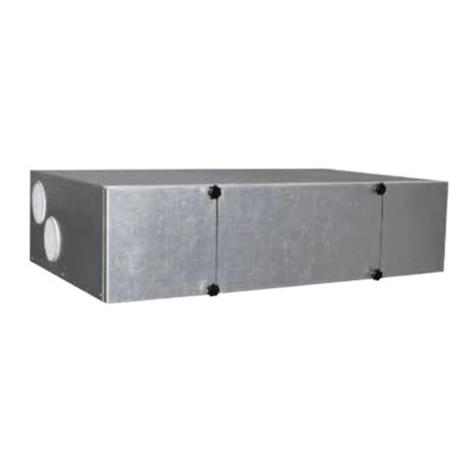
PREMA CEILING VOID ENERGY RECOVERY VENTILATION UNITS
4
Maintenance Regulations
Personnel responsible for maintenance must work in accordance with any accident prevention (safety) regulations that are
in force in your area. In particular the following recommendations should be complied with:
• Wear suitable safety clothing and protection to minimise the risk of accident
• Ensure that a safety interlock is off and locked so that the units may not be started by non-authorised personnel
Disassembly and Re-assembly
Before starting any disassembly or re-assembly operation, please ensure that the product is isolated from its mains
electrical supply in order to ensure that fans cannot be run. As disassembly and re-assembly are not part of routine
maintenance, these should be carried out by qualified personnel.
Disposal
Please ensure that products are dismantled and disposed of, in an environmentally friendly way, in
accordance with the Waste Electrical and Electronic Equipment (WEEE) Directive 2012/19/EU together with
the RoHS Directive 2002/95/EC, where applicable.
Handling and Offloading
Before offloading products, please ensure that the means of
transport / lifting is suitable to accommodate the required
weight and size. The units are shipped on a pallet; a forklift
truck should be used. Lift the unit into position by passing the
forks of a forklift truck through the pallet.
Alternatively, the equipment may be lifted from above using
a crane. Lifting beams should be passed through the pallet
in the same way as the forks of a forklift truck would be
inserted. When lifting, spreaders must be used to avoid
damage to the casing. Care must be taken to ensure that
slings are correctly positioned.
CAUTION: Handles, controls enclosures, duct connectors or pipework connectors are NOT designed to be load-bearing,
and under no circumstances must these be used to support or move the equipment during installation. Failure to observe
this may result in severe damage to the equipment.
Storage
The equipment must be stored in a dry internal location. Ductwork connection apertures must be sealed against the
ingress of dust, water and vermin. Do not stack units.
Whenever any access panels are removed for inspection purposes they must be replaced and made secure.
Filters
All filters must be suitably wrapped and sealed to prevent damp and ingress of dust or foreign bodies, and must be held in
a dry store.
Introduction, General, Safety, Maintenance Regulations, Other Risks, Warning labels
Introduction
The information contained in this document provides details
of installation, operation and maintenance for installers and
users. The PREMA CEILING VOID ENERGY RECOVERY
VENTILATION range comprises a combination of high
efficiency centrifugal fans with EC motors, a counter flow
design plate heat exchanger, and a casing with acoustic
treatment.
General information regarding performance and
specifications for the equipment may be obtained from our
Technical Literature, and/or project specific documentation
General
All maintenance procedures shall only be carried out whilst the
product is isolated from electrical supplies. In order to minimise
the risk of a fan motor unit being started accidentally during
maintenance, it is recommended that central control panels
/
switchboards are clearly marked with a suitable warning sign.
In addition, before connecting an electrical supply cable to any
terminal board, please ensure that the line voltage matches that
stated on the product label. Should product labels become
illegible over time it is recommended that these be replaced
Delivery
All equipment is inspected prior to dispatch and leaves the
factory in good condition. Upon receipt of the equipment an
inspection should be made and any damage indicated on the
delivery note. No responsibility will be accepted for damage
sustained during the offloading from the vehicle or on the site
thereafter. All claims for damage and/or incomplete delivery must
be reported within two days of receipt of the equipment.
The usual method of packing for these products is to be
loaded onto pallets, with a shrink wrap protective added
to minimise water ingress.
Safety standards and “CE” Marking
In-line with our policy of continuous product improvement, we are
constantly striving to deliver more efficient products that comply
with current safety standards. The standards and guidance
contained within this documentation therefore reflect compliance
with these safety standards and regulations. In addition to the
advice given within this document, we strongly recommend that
all personnel, who may be exposed to risks during the
installation, use or maintenance of our equipment, should ensure
that they comply with all relevant safety regulations that are in
force within their respective countries.
Elta Group Building services does not accept responsibility for
personal injury or damage caused to property resulting from non-
compliance with these safety standards, or as a result of any
none approved product modifications.
Warning / danger Labels
All internal cabling is situated within the bypass channel, behind the
Isolator panel. No drilling into this unit is permissible, as any such
action may result in an electric shock and will void the external L2
leakage rating. (
This applies to all the panels and controls area
)
The units can have a number of different warning labels or
symbols affixed to it, which should not be removed.
Product risks have been analysed in accordance with Machinery
Directive 2006/42/CE. The associated directive handbook contains
information and advice for all responsible personnel and is designed
to minimise possible risks of personal injury or damage to property.
Maintenance Regulations
Personnel responsible for maintenance must work in accordance
with any accident prevention (safety) regulations that are in force in
your area. In particular the following recommendations should be
complied with:
-
Wear suitable safety clothing and protection to
minimise the accident risk.
-
Ensure that a safety interlock is off and locked, so that the
units may not be started by non-authorized personnel.
Disassembly and Re-assembly
Before starting any disassembly or re-assembly operation, please
ensure that the product is isolated from its mains electrical supply,
in order to ensure that fans cannot be run. As disassembly and re-
assembly are not part of routine maintenance, these should be
carried out by qualified personnel.
Disposal
Please ensure that products are dismantled and
disposed of, in an environmentally friendly way,
in accordance with the Waste Electrical and
Electronic Equipment (WEEE) Directive
2012/19/EU together with the RoHS Directive
2002/95/EC, where applicable.
HANDLING AND OFF LOADING
Before off-loading products, please ensure that the means of
transport/ lifting is suitable to accommodate the required
weight and size. The units are shipped on a pallet; a forklift
truck should be used. Lift the unit into position by passing the
forks of a forklift truck through the pallet.
Alternatively, the equipment may be lifted from above using a
crane. Lifting beams should be passed through the pallet in
the same way as the forks of a forklift truck would be
inserted. When lifting spreaders must be used to avoid
damage to the casing. Care must be taken to ensure that
slings are correctly positioned.
CAUTION:
Handles, controls enclosures, duct connectors or
pipework connectors are NOT designed to be load
bearing, and under no circumstances must these be used
to support or move the equipment during installation.
Failure to observe this may result in severe damage to
the equipment.
STORAGE
The equipment must be stored in a dry internal location.
Ductwork connection apertures must be sealed against
the ingress of dust, water and vermin. Do not stack
units.
Whenever any access panels are removed for
inspection purposes they must be replaced and made
secure.
Filters
All filters must be suitably wrapped and sealed to
prevent damp and ingress of dust or foreign bodies,
and must be held in a dry store.
EQUIPMENT START-UP
Before operating the following checks must be made:
• Ensure that inlet/outlet connections are free from obstruction
• Check that all product components are securely fastened in
their associated sealing gaskets
• Manually rotate each fan impeller to ensure that it does not
rub or bind onto the inlet cone.
• Ensure that any inspection or access doors are closed.
CAUTION:
If fan inlets or discharges are not connected to duct
work, please ensure suitable guards are fitted for
protection before the unit is started. Check that
electrical connections have been made correctly,
especially the earth connection.
IMPORTANT:
Electrical connections must be made by qualified
personnel.