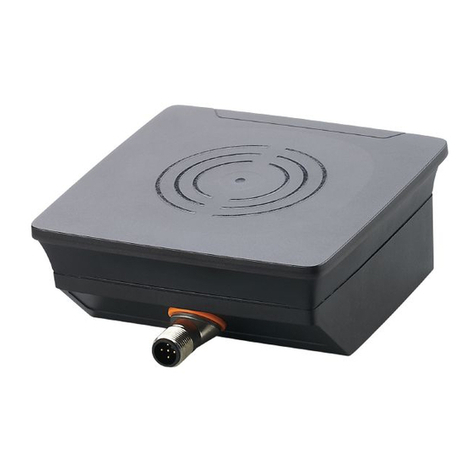
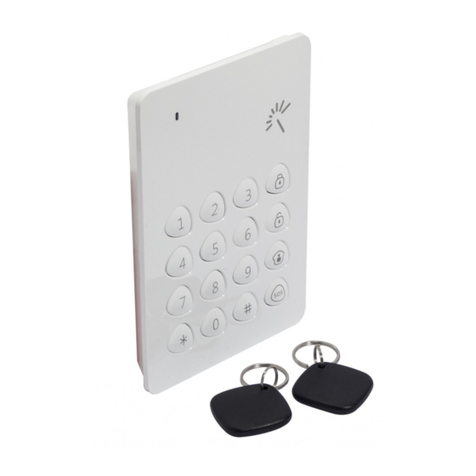
Single Gang Reader
Single Gang Reader with Keypad
The ADC-AC-ET20/25 Single Gang Reader offers a
modern aesthetic and a state-of-the-art feature set.
Standard technologies include Proximity (125 kHz), NFC
(13.56 MHz), and Bluetooth®. The ADC-AC-ET20/25 is fully
OSDP™ compliant and are enabled for Secure Channel.
Additionally, the reader offers a patented feature called
OSDP Auto-Detect. The reader communicates OSDP and
Wiegand over the same wires to automatically detect and
convert to OSDP Secure Channel protocol, eliminating the
need to rewire or reconfigure the reader.
❶
Mount the wall plate
Connect the wall plate to
the single gang box using
the provided #6 screws.
Alternatively, the reader
can be mounted using the
provided #4 screws in the
four outer holes for other
installation requirements.
Drywall installations will
require molly bolts.
❷Wire the reader ❸
Secure the reader
to the wall plate
❶
Align the reader so that the
tabs of the base plate slide
into the slots on the wall plate.
❷
Slide the reader into position.
❸
Secure the reader to the
mounting plate using the
supplied #4-40 screw or
pin-in-Torx.
❹
Power and test the reader
Power the reader and wait for the power up LED beep
sequence to complete. Present a valid credential to the
reader and the light-bar will turn green. If the test fails,
check the wiring.
Installation tips
❶When connecting the reader to a Wiegand panel connect
the Green wire to Data 0 and the White wire to Data 1.
❷When connecting the reader to an OSDP panel connect the
Green wire to RS485A, and the White wire to RS485B.
❸For an OSDP system, verify that the panel is successfully
communicating with the reader prior to reading a badge
or pressing a key.
Wiegand/OSDP Tips
❶By default, the reader will transmit credential and keypad
data in Wiegand communication mode.
❷Upon each power up, and before the reader reads a credential
or a key is pressed, the reader will be listening for an incoming OSDP
message. If a message is received during this period, the reader will
automatically switch to OSDP-only communication mode.
❸To return to OSDP auto-detect mode (default mode), tilt the reader
45 degrees to simulate tamper and cycle power in this state. The power
up sequence should indicate OSDP auto-detect with 4 beeps.
Reader Startup Sequence
Upon a power reset, the Alarm.com Readers provide a reset
sequence using the LED indicator and the beeper, to provide
information about the reader type and its communication
mode. The first sequence (sequence A) describes the credential
technologies built in the reader: First, a silent LED sequence
will indicate the supported RF protocols. Both LEDs turn off
for 250 milliseconds.
After the above sequence identifies the supported RF protocols,
the reader will then indicate the supported host communication
using beep/flash sequences. Then beeper and both LEDs turn off
for 250 milliseconds.
* These wires are only used in Wiegand readers.
** All wiring methods used shall be in accordance
with the National Electrical Code, ANSI/NFPA 70
Max Length to Panel
Wiegand
Length AWG
200' (60 m) 22
300' 20
500' 18
OSDP 9600 Baud Power 12 VDC
1000' 22 AWG
Twisted Pair
Current @ 12 V and 25 C
Avg. mA Max. mA
ADC-AC-ET20: 118 ADC-AC-ET20: 169
ADC-AC-ET25: 143 ADC-AC-ET25: 193
Bluetooth NFC Prox
Beeper Silent,
Red LED on for
500 milliseconds
Beeper Silent,
Green LED on for
500 milliseconds
Beeper Silent,
Amber LED on for
500 milliseconds
Wiegand OSDP Auto-Detect
Beep and Blink
Red LED once for 200
milliseconds
Beep and Blink Green
LED twice for 200
milliseconds each
Beep and Blink Green
LED 4 times for 200
milliseconds each
Common Cable Connections
Red
Power In
Black
Ground
Shield
Shield Ground
Brown*
Tamper Out
Yellow*
Beeper Control
Blue*
Green LED Control
Orange*
Red LED Control
Wiegand OSDP
White CLK/Data 1/TR+ DAT/Data 0/ TR-
Green DAT/Data 0/TR- CLK/Data 1/TR+