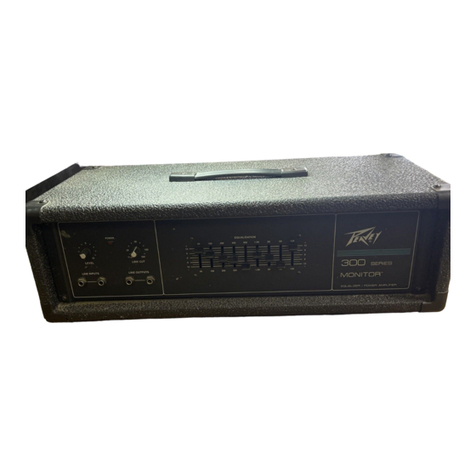
CHANNEL AMPLIFIER CONTROLS AND GENERAL COMPONENT LAYOUT
Controls
All controls requiring adjustment during preliminary setting up or the
normal operation of the equipment are on the front panel of the unit.
Two preset controls are mounted on the rear panel and their functions
are as follows:
1) HI/LO Microphone Input
This is asmall toggle switch which selects either high or
.low level impedance at the primary of microphone input
transformer Tl. The line input at T2 is taken directly to
the sensitivity switch via the yellow and grey wires.
?) Fader Preset Equalisation
The small preset potentiometer in series with the equalisation
iN/OUT switch enables compensation to be inserted to allow for
small resistive variations between channel faders.
The sensitivity switch shown in detail on drawing EK20046 has 23
positions. Of these, positions 1to 9are wired to vary the attenuation
required for high level inputs, the attenuation being varied from -20 dB
to +15 dB in 5dB steps. The transition point between the high level and
the low level attenuation occurs between switch positions 8and 9the
difference being 25 dB from +15 dB to -10 dB. The low level attenuation
is switchable in 5dB steps from -5 dB to -80 dB. For details, see
drawing JCK20046.
3) Treble Switch Assembly EK20047
This is adual concentric control comprising asix position switch
selecting the high frequency roll-off points at 3.3 kHz, 4.7 kHz,
6.8 kHz and 15 kHz, the sixth position being an OFF position.
The lOK potentiometer varies the high frequency response above
or below the normal position. Mounted on the front panel
immediately above the switch potentiometer control is apush-
button switch which introduces apeak as an alternative to the
normal shelf characteristic (boost condition only).
Upper/Lower Presence Switch Assemblies
Separate switch/potentiometer controls are employed, each having
an associated Hi Qswitch, the latter being mounted between the
two controls on the front panel. The effect of the Hi Qswitch
when operated is to increase the resistive damping of the tuned
circuit at the presence frequency selected, thereby, substituting
aless acute rise and fall to the boost characteristic. As a
general rule the use of alow Qresponse at the presence boost
frequency is preferred on orchestral music, the high Qbeing
reserved for other types of popular music.
As the upper and lower presence circuits are similar, asingle
circuit diagram is used with the appropriate resistor values
shown
.
Iss. 13.