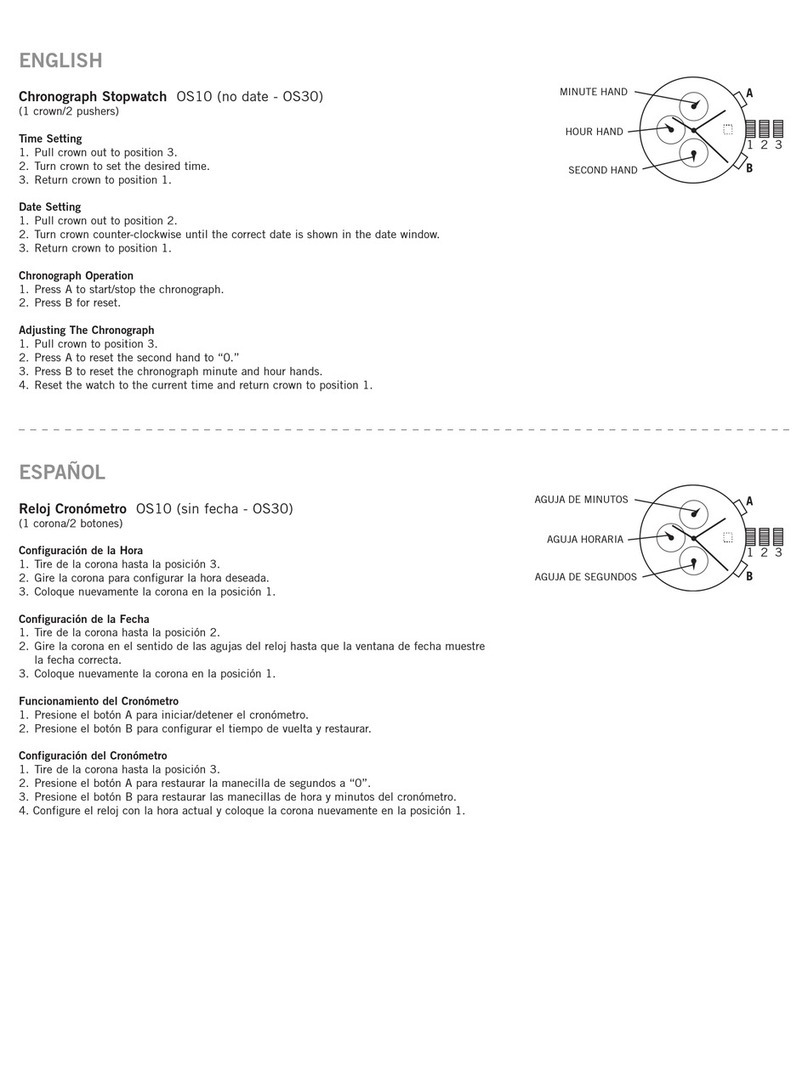
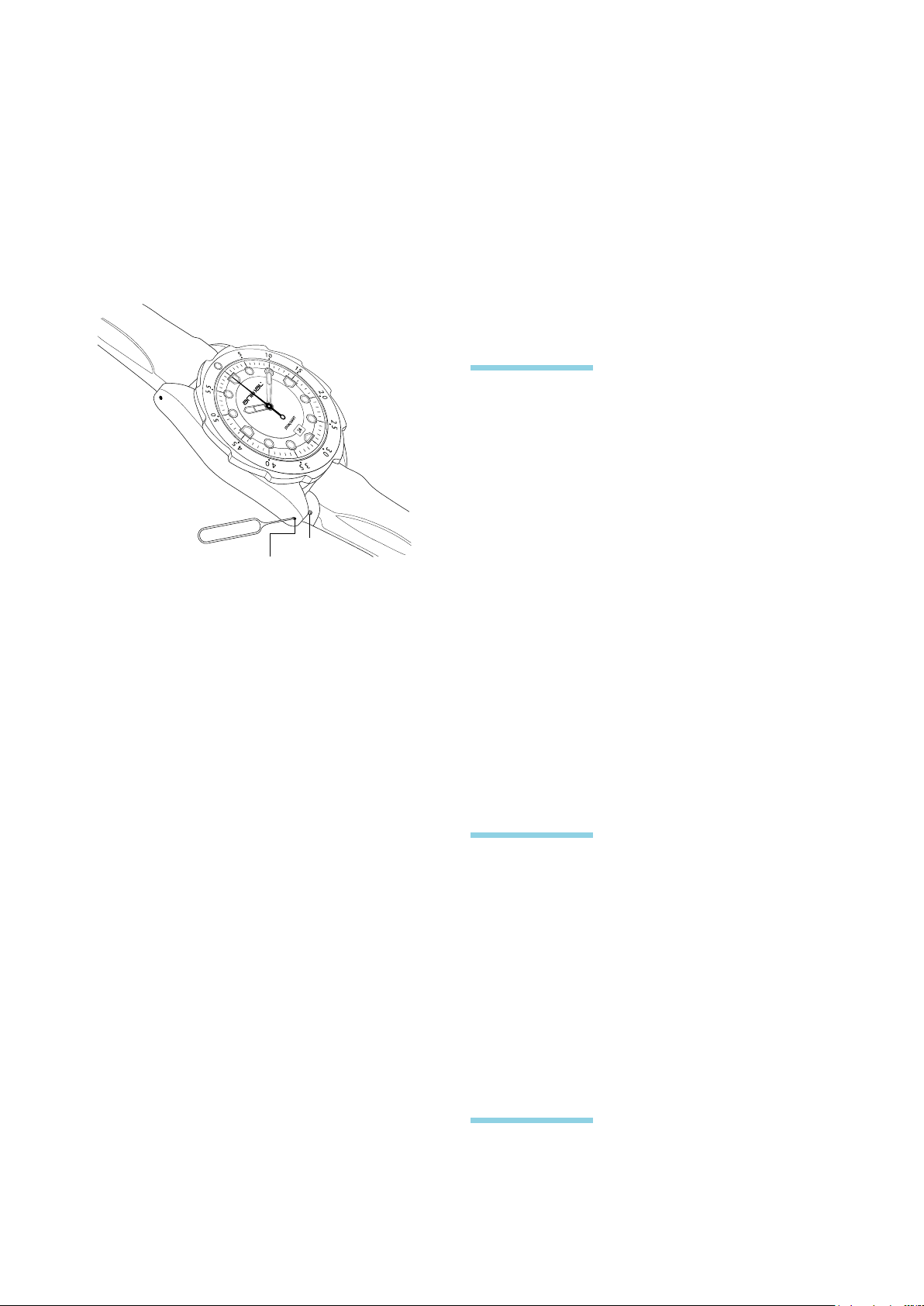
Changing the strap:
First you need to release the spring-bars. This can be done using
something like a straightened-out paperclip or an iPhone SIM-card tool.
Gently push the tip of your spring-bar tool through the hole in the shoulder
of your watch to release the strap-bars from the case, being careful not to
ping the spring-bars across the room.
The metal bracelets are a snug fit between the shoulders and will
need both ends of each spring-bar releasing before the bracelet
can be removed.
To reattach the strap; thread the spring-bar through the strap, line-up
one end of the pin in the shoulder hole of your watch and then use your
straightened-out paperclip (or similar) to depress the opposite end of
the pin and guide the spring-bar into the second shoulder hole.
To set the tidal amplitude (the right side dial):
•Find the current phase of the moon at your location and the tidal
amplitude accordingly.
•When the HI-LO hand is pointing vertically upwards, it represents the
state of the tide during the full moon, and when it’s pointing vertically
downwards it represents the state of the tide during a new moon
(i.e. no moon is visible).
•When the HI-LO hand is on the right-hand side of the dial, the moon is
waxing; when it’s on the left-hand side, it’s waning.
•Press and hold the bottom pusher for approximately 2 seconds until you
hear a beep; then release the pusher.
•Press the bottom pusher repeatedly to advance the HI-LO hand
to the appropriate phase.
•If no pushers are pressed, your watch will beep and exit the setting mode
after 3 seconds.
•The HI-LO hand makes one rotation every 29 days, 12 hours and
44 minutes.
To set the central high/low tide indicator hand:
Wait until exactly high tide or exactly low tide in order to set the central
high/low tide indicator hand. Refer to a tide chart for your local area to
find the time of high or low tide for today.
•At exactly high tide or exactly low tide, press and hold the top pusher for
approximately 2 seconds until you hear a beep; then release it.
•Press the top pusher to advance the central tide indicator hand to either
the high tide (12:00 position) or low tide (6:00 position), depending on the
present tide. To advance the hand more quickly, press and hold the top
pusher.
•If no pushers are pressed, your watch will beep and exit the setting mode
after 3 seconds.
Once you’ve set the central tide indicator hand, you can track the
approximate state of the tide in your location.
The central tide indicator hand makes one rotation every 12 hours, 25
minutes and 14 seconds. During this time period, your watch will indicate
one high tide and one low tide.
When the central tide indicator hand is on the left side of the dial, the tide
is rising or ‘flooding’ and when it’s on the right side of the dial, the tide is
falling or ‘ebbing.’
Depending on your location, you may have to reset your watch to keep
your tide reading accurate.
Changing the strap:
First you need to release the spring-bars. This can be done using
something like a straightened-out paperclip or an iPhone SIM-card tool.
Gently push the tip of your spring-bar tool through the hole in the shoulder
of your watch to release the strap-bars from the case, being careful not to
ping the spring-bars across the room.
The metal bracelets are a snug fit between the shoulders and will need
both ends of each spring-bar releasing before the bracelet can
be removed.
To reattach the strap; thread the spring-bar through the strap, line-up
one end of the pin in the shoulder hole of your watch and then use your
straightened paperclip (or similar) to depress the opposite end of the pin
and guide the spring-bar into the second shoulder hole.
Care of your Animal watch:
All Animal watches have a screw-down crown, which acts like a submarine
hatch, sealing the case against dust and moisture. Before the time or date
can be adjusted on these models, the crown must be unscrewed by turning
it anti-clockwise until it springs out away from the case. Once the time/date
is correct, the crown must be resealed by simultaneously pushing it inwards
whilst turning it clockwise gently until it locks.
Never leave the crown unlocked, or adjust the time or date
whilst the watch is submerged.
Although your watch was designed and built for freesports use, it isn’t
indestructible; following a few simple rules will help prolong its life.
•Your watch contains a precision electronic movement, therefore don’t open
the watch, or attempt to remove the caseback. Any work required within the
guarantee period (including battery replacement) must be carried out by
Animal, or an Animal authorised representative, otherwise your warranty will
be invalidated.
•The Animal Watch Service Department offers a battery replacement
service. Go to www.animal.co.uk/animal-watch-servicing for details.
•The rubber seals, used to seal the case against dust and water, can be
affected by certain chemicals. It is therefore important to have the watch
pressure-tested annually. The seals should also be replaced every few years
to ensure that the watch remains watertight.
•Should water or condensation appear in the watch, it is important to have
the watch checked immediately, as water can irreparably damage the
electronic components.
•Don’t expose your watch to either extremes of temperature or rapid
changes in temperature.
•Although your watch is designed to withstand impact under normal use,
do not subject it to severe impacts, or drop it onto hard surfaces.
•Don’t expose your watch to strong chemicals such as insect repellent,
perfume, petrol, solvents or adhesives, as these can seriously damage both
the waterproof seals and the finish of your watch.
•After use in salt water, immediately rinse your watch in fresh running
water. If your watch has a rotating bezel, turn the bezel several times
whilst rinsing it, as this will prevent salt build-up underneath the
bezel ring.
Case shoulder hole
Spring-bar