manuals.online logo
Brands
  1. Home
  2. •
  3. Brands
  4. •
  5. Black & Decker
  6. •
  7. Chainsaw
  8. •
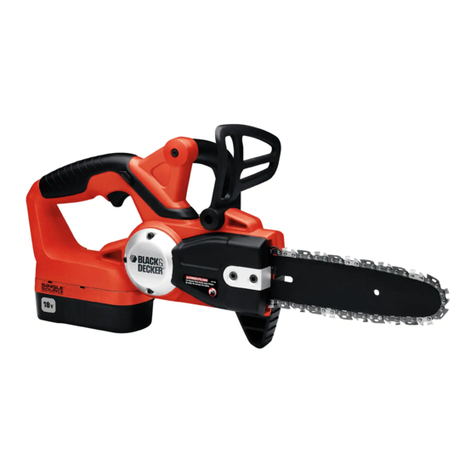
  9. Black & Decker LCS120 User manual

Black & Decker LCS120 User manual

Other manuals for LCS120

3

Other Black & Decker Chainsaw manuals

Black & Decker GGK45 User manual

Black & Decker

Black & Decker GGK45 User manual

Black & Decker GK1330 User manual

Black & Decker

Black & Decker GK1330 User manual

Black & Decker GKC1825 User manual

Black & Decker

Black & Decker GKC1825 User manual

Black & Decker CCS818 User manual

Black & Decker

Black & Decker CCS818 User manual

Black & Decker LCS1020 User manual

Black & Decker

Black & Decker LCS1020 User manual

Black & Decker 90559281 User manual

Black & Decker

Black & Decker 90559281 User manual

Black & Decker CCS818 User manual

Black & Decker

Black & Decker CCS818 User manual

Black & Decker Saw User manual

Black & Decker

Black & Decker Saw User manual

Black & Decker BCCS320 User manual

Black & Decker

Black & Decker BCCS320 User manual

Black & Decker GKC1820L20 User manual

Black & Decker

Black & Decker GKC1820L20 User manual

Black & Decker LCS120 User manual

Black & Decker

Black & Decker LCS120 User manual

Black & Decker GK1935T User manual

Black & Decker

Black & Decker GK1935T User manual

Black & Decker CCS818 User manual

Black & Decker

Black & Decker CCS818 User manual

Black & Decker GK1730 User manual

Black & Decker

Black & Decker GK1730 User manual

Black & Decker Powerufl Solutions 90559283 User manual

Black & Decker

Black & Decker Powerufl Solutions 90559283 User manual

Black & Decker GK1630T User manual

Black & Decker

Black & Decker GK1630T User manual

Black & Decker GK1940T User manual

Black & Decker

Black & Decker GK1940T User manual

Black & Decker CS1835 User manual

Black & Decker

Black & Decker CS1835 User manual

Black & Decker CCS818 User manual

Black & Decker

Black & Decker CCS818 User manual

Black & Decker CS1518 User manual

Black & Decker

Black & Decker CS1518 User manual

Black & Decker CS1835 User manual

Black & Decker

Black & Decker CS1835 User manual

Black & Decker KX1693-QS User manual

Black & Decker

Black & Decker KX1693-QS User manual

Black & Decker LCS120 User manual

Black & Decker

Black & Decker LCS120 User manual

Black & Decker CS2040 User manual

Black & Decker

Black & Decker CS2040 User manual

Popular Chainsaw manuals by other brands

Husqvarna 435 Workshop manual

Husqvarna

Husqvarna 435 Workshop manual

Husqvarna 42, 242XP, 246 Operator's manual

Husqvarna

Husqvarna 42, 242XP, 246 Operator's manual

Makita EA3601FG instruction manual

Makita

Makita EA3601FG instruction manual

Premier MS-4815 instruction manual

Premier

Premier MS-4815 instruction manual

Echo CS-6703 parts catalog

Echo

Echo CS-6703 parts catalog

Husqvarna 1151338-95 Operator's manual

Husqvarna

Husqvarna 1151338-95 Operator's manual

Poulan Pro 380 Operator's manual

Poulan Pro

Poulan Pro 380 Operator's manual

Elem Garden Technic TRE2042SO-OR Original instructions

Elem Garden Technic

Elem Garden Technic TRE2042SO-OR Original instructions

Royal RPC 3835 Original operating instructions

Royal

Royal RPC 3835 Original operating instructions

Famastil F-Power instruction manual

Famastil

Famastil F-Power instruction manual

McCulloch M3816 instruction manual

McCulloch

McCulloch M3816 instruction manual

Echo CS-8000 TYPE1-E instruction manual

Echo

Echo CS-8000 TYPE1-E instruction manual

Echo CS-346 instruction manual

Echo

Echo CS-346 instruction manual

SNOWJOE sunjoe SWJ807E Operator's manual

SNOWJOE

SNOWJOE sunjoe SWJ807E Operator's manual

Husqvarna 555 Workshop manual

Husqvarna

Husqvarna 555 Workshop manual

Stiga A 305 Operator's manual

Stiga

Stiga A 305 Operator's manual

Bosch Ake 40 s Original instructions

Bosch

Bosch Ake 40 s Original instructions

Dolmar AS-3626 instruction manual

Dolmar

Dolmar AS-3626 instruction manual

manuals.online logo
manuals.online logoBrands
  • About & Mission
  • Contact us
  • Privacy Policy
  • Terms and Conditions

Copyright 2025 Manuals.Online. All Rights Reserved.

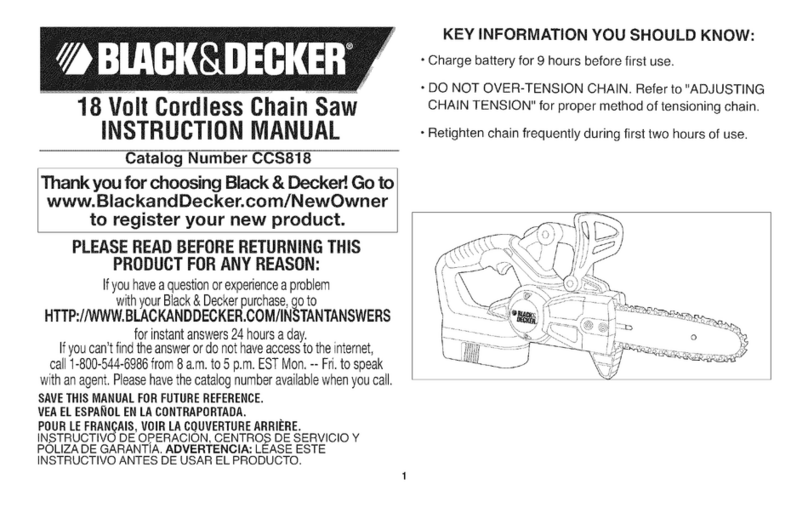
KEY INFORMATION YOU SHOULD KNOW:
• DO NOT OVER-TENSION CHAIN. Refer to "ADJUSTING
CHAIN TENSION" for proper method of tensioning chain.
• Retighten chain frequently during first two hours of use.
20V MAX* LITHIUM CORDLESS
CHAIN SAW INSTRUCTION MANUAL
*Maximum initial battery pack voltage
(measured without a workload) is 20
volts. Measured under a workload,
nominal voltage is 18.
Model # LCS120
Model Number LCS120
SAVE THIS MANUAL FOR FUTURE REFERENCE.
VEA EL ESPAÑOL EN LA CONTRAPORTADA.
POUR LE FRANÇAIS, VOIR LA COUVERTURE ARRIÈRE.
INSTRUCTIVO DE OPERACIÓN, CENTROS DE SERVICIO Y
PÓLIZA DE GARANTÍA. ADVERTENCIA: LÉASE ESTE
INSTRUCTIVO ANTES DE USAR EL PRODUCTO.
Thank you for choosing Black & Decker! o
to www.BlackandDecker.com/NewOwner
to register your new product.
PLEASE READ BEFORE RETURNIN
THIS PRODUCT FOR ANY REASON:
If you have a question or experience a problem with your
Black & Decker purchase, go to
WWW.BLACKANDDECKER.COM/INSTANTANSWERS
for instant answers 24 hours a day.
If you canʼt find the answer or do not have access to the internet,
call 1-800-544-6986 from 8 a.m. to 5 p.m. EST Mon. - ri
to speak with an agent.
Please have the catalog number available when you call.
TABLE OF CONTENTS
Safety Guidelines - Definitions.................................................2
Chain Saw Terms.....................................................................2
Important Safety Instructions ...................................................3
Components.............................................................................6
Important Safety Instructions for Battery Chargers..................6
Important Safety Instructions for Battery Packs.......................7
Charging Procedure.................................................................8
Preparing Chain Saw for Use ..................................................10
Assembly .................................................................................10
Operating the Chain Saw.........................................................12
Maintenance ............................................................................15
Service Information ..................................................................16
ull Two-Year Home Use Warranty..........................................16
Troubleshooting .......................................................................17
SAFETY UIDELINES - DEFINITIONS
It is important for you to read and understand this manual. The
information it contains relates to protecting YOUR SA ETY and
PREVENTING PROBLEMS. The symbols below are used to help
you recognize this information.
DAN ER: Indicates an imminently hazardous situation which,
if not avoided, will result in death or serious injury.
WARNIN : Indicates a potentially hazardous situation which,
if not avoided, could result in death or serious injury.
CAUTION: Indicates a potentially hazardous situation which,
if not avoided, may result in minor or moderate injury.
CAUTION: Used without the safety alert symbol indicates a
potentially hazardous situation which, if not avoided, may result in
property damage.
INTENDED USE
Your Black & Decker Cordless Chain Saw is ideal for pruning
applications and cutting small logs up to 8 inches (203 mm) in
diameter. This tool is intended for consumer use only.
CHAIN SAW NAMES AND TERMS
• Bucking - The process of cross cutting a felled tree or log into
lengths.
• Motor Brake - A device used to stop the saw chain when the
trigger is released.
• Chain Saw Powerhead - A chain saw without the saw chain and
guide bar.
• Drive Sprocket or Sprocket - The toothed part that drives the
saw chain.
• Felling - The process of cutting down a tree.
• Felling Back Cut - The final cut in a tree felling operation made
on the opposite side of the tree from the notching cut.
• Front Handle - The support handle located at or toward the front
of the chain saw.
• Front Hand uard - A structural barrier between the front handle
of a chain saw and the guide bar, typically located close to the
hand position on the front handle and sometimes employed as an
activating lever for a chain brake.
• uide Bar - A solid railed structure that supports and guides the
saw chain.
• uide Bar Scabbard - Enclosure fitted over guide bar to prevent
tooth contact when saw is not in use.
• Kickback - The backward or upward motion, or both of the guide
bar occurring when the saw chain near the nose of the top area of
the guide bar contacts any object such as a log or branch, or
when the wood closes in and pinches the saw chain in the cut.
• Kickback, Pinch - The rapid pushback of the saw which can
occur when the wood closes in and pinches the moving saw chain
in the cut along the top of the guide bar.
• Kickback, Rotational - The rapid upward and backward motion
of the saw which can occur when the moving saw chain near the
2
SAFETY INSTRUCTIONS AND
WARNIN S FOR CHAIN SAWS
• Keep Work Area Clean -Cluttered areas invite injuries. Do not
start cutting until you have a clear work area, secure footing, and a
planned retreat path from the falling tree.
• Consider Work Area Environment - Use extreme caution when
cutting small size brush and saplings because the slender material
may catch the saw chain and be whipped toward you or pull you off
balance. When cutting a limb that is under tension be alert for spring
back so that you will not be struck when the tension in the wood
fibers is released. Do not expose chain saw to rain or snow. Do not
use chain saw in damp or wet locations or while it is raining or
snowing. Do not use chain saw in the presence of flammable liquids
or gases or enclosed concentrations of dust. Cut only when visibility
and light are sufficient to see clearly
• Keep Children, Bystanders, Visitors and Animals Away - Do
not let visitors contact chain saw. All visitors should be kept away
from work area.
• Store Idle Chain Saw - When not in use, chain saws should be
stored in a dry, and high or locked-up place - out of the reach of
children. When storing saw, always remove battery and use a
scabbard or carrying case.
• Don't Force Chain Saw - It will do the job better and safer at the
rate for which it was intended.
• Use Right Tool - Cut wood only. Don't use chain saw for purpose
not intended - for example - Don't use chain saw for cutting plastic,
metal, masonry, non-wood building materials.
• Dress Properly - Do not wear loose clothing or jewelry. Keep your
hair, clothing, and gloves away from moving parts. Loose clothing,
jewelry, or long hair can be caught in moving parts. Wear protective
hair covering to contain long hair. Air vents cover moving parts and
should be avoided. Protective non-slip gloves and non-skid footwear
are recommended when working outdoors. Always wear heavy,
long pants or other protection for your legs.
• Use Safety lasses - Also use safety footwear; snug fitting
clothing; protective gloves; proper hearing, respiratory, and head
protection.
• Carrying Saw - Carry the chain saw by the front handle with the
upper portion of the tip of the guide bar contacts an object, such
as a log or branch.
• Limbing - Removing the branches from a fallen tree
• Low-Kickback Chain - A chain that complies with the kickback
performance requirements of ANSI B175.1-1991 (when tested on
a representative sample of chain saws.)
• Normal Cutting Position - Those positions assumed in
performing the bucking and felling cuts.
• Notching Undercut - A notch cut in a tree that directs the treeʼs fall.
• Oiler Control - A system for oiling the guide bar and saw chain.
• Rear Handle - The support handle located at or toward the rear
of the saw.
• Reduced Kickback uide Bar - A guide bar which has been
demonstrated to reduce kickback significantly.
• Replacement Saw Chain - A chain that complies with kickback
performance requirements of ANSI B175.1-2000 when tested
with specific chain saws. It may not meet the ANSI performance
requirements when used with other saws.
• Saw Chain - A loop of chain having cutting teeth, that cut the
wood,and that is driven by the motor and is supported by the
guide bar.
• Ribbed Bumper - The ribs used when felling or bucking to pivot
the saw and maintain position while sawing.
• Switch - A device that when operated will complete or interrupt
an electrical power circuit to the motor of the chain saw.
• Switch Linkage - The mechanism that transmits motion from a
trigger to the switch.
• Switch Lockout - A movable stop that prevents the unintentional
operation of the switch until manually actuated.
IMPORTANT SAFETY INSTRUCTIONS
WARNIN : When using a battery operated chain saw, basic
safety precautions should always be followed to reduce risk of fire,
electric shock, and personal injury, including the following:
READ ALL INSTRUCTIONS
3
The following precautions should be followed to minimize
kickback:
(1.) Grip Saw irmly. Hold the chain saw firmly with both hands
when the motor is running. Use a firm grip with thumbs and fingers
encircling the chain saw handles. Chain saw will pull forward when
cutting on the bottom edge of the bar, and push backward when
cutting along the top edge of the bar.
(2.) Do not over reach.
(3.) Keep proper footing and balance at all times.
(4.) Don't let the nose of the guide bar contact a log, branch, ground
or other obstruction.
(5.) Don't cut above shoulder height.
(6.) Use devices such as low kickback chain and reduced kickback
guide bars that reduce the risks associated with kickback.
(7.) Only use replacement bars and chains specified by the
manufacturer or the equivalent.
(8.) Never let the moving chain contact any object at the tip of the
guide bar.
(9.) Keep the working area free from obstructions such as other
trees, branches, rocks, fences, stumps, etc. Eliminate or avoid any
obstruction that your saw chain could hit while you are cutting
through a particular log or branch.
(10.) Keep your saw chain sharp and properly tensioned. A loose or
dull chain can increase the chance of kickback. Check tension at
regular intervals with the motor stopped and battery removed, never
with the motor running.
(11.) Begin and continue cutting only with the chain moving at full
speed. If the chain is moving at a slower speed, there is a greater
chance for kickback to occur.
(12.) Cut one log at a time.
(13.) Use extreme caution when re-entering a previous cut. Engage
ribbed bumpers into wood and allow chain to reach full speed
before proceeding with cut.
(14.) Do not attempt plunge cuts or bore cuts.
(15.) Watch for shifting logs or other forces that could close a cut
and pinch or fall into chain.
• Power Supply - Connect chain saw battery charger to correct
voltage, that is, be sure that the voltage supplied is the same as that
specified on the nameplate of the tool.
saw stopped, finger off the switch, the guide bar and saw chain to
the rear. Remove battery and use scabbard when transporting saw.
• Maintain Chain Saw With Care - Keep tools sharp and clean for
better and safer performance. ollow instructions for lubricating and
changing accessories. Keep handles dry, clean, and free from oil
and grease.
• Disconnect Battery - Disconnect battery from chain saw when
not in use, before servicing, when tensioning chain, and when
changing accessories and attachments, such as saw chain.
• Stay Alert - Watch what you are doing. Use common sense. Do
not operate chain saw when you are tired, ill, or under the influence
of alcohol, drugs, or medication. Keep all parts of the body away
from the saw chain when the motor is operating. Before you start
the saw, make sure the saw chain is not contacting anything. When
cutting through wood, remember the chain saw cuts quickly and will
continue its downward or upward path. Stay out of its path.
• Check Damaged Parts - Before further use of the chain saw, any
part that is damaged should be carefully checked to determine that
it will operate properly and perform its intended function. Check for
alignment of moving parts, binding of moving parts, breakage of
parts, mounting, and any other conditions that may affect its
operation. A guard or other part that is damaged should be properly
repaired or replaced by an authorized service center unless
otherwise indicated elsewhere in this instruction manual. Have
defective switches replaced by authorized service center. Do not
use chain saw if switch does not turn it on and off. Do not operate a
chain saw that is damaged, improperly adjusted, or is not
completely and securely assembled. Be sure that the saw chain
stops moving when the trigger is released.
• uard Against Kickback
WARNIN : KICKBACK may occur when the nose or tip
of the guide bar touches an object, or when the wood closes
in and pinches the saw chain in the cut. Tip contact in some
cases may cause a lightning fast reverse reaction, kicking the
guide bar up and back towards the operator. Pinching the saw
chain along the top of the guide bar may push the guide bar
rapidly back towards the operator. Either of these reactions
may cause you to lose control of the saw which could result in
serious injury to user.
4

Kickback Safety Features
WARNIN : The following features are included on your saw
to help reduce the hazard of kickback; however such features
will not totally eliminate this dangerous reaction. As a chain saw
user do not rely only on safety devices. You must follow all safety
precautions, instructions, and maintenance in this manual to help
avoid kickback and other forces which can result in serious injury.
•Reduced-Kickback uide Bar, designed with a small radius tip
which reduces the size of the kickback danger zone on bar tip. A
reduced - kickback guide bar is one which has been demonstrated
to significantly reduce the number and seriousness of kickbacks
when tested in accordance with safety requirements for electric
chain saws.
•Low-Kickback Chain, designed with a contoured depth gauge and
guard link which deflect kickback force and allow wood to gradually
ride into the cutter. A low-kickback chain is a chain which has met
kickback performance requirements of ANSI B175.1-1991.
•Do not operate chain saw while in a tree, on a ladder, on a
scaffold, or from any unstable surface.
•Hold tool by insulated gripping surfaces when performing an
operation where the cutting tool may contact hidden wiring.
Contact with a "live" wire will make exposed metal parts of the tool
"live" and shock the operator.
•Do not attempt operations beyond your capacity or
experience. Read thoroughly and understand completely all
instructions in this manual.
•Before you start chain saw, make sure saw chain is not
contacting any object.
•Do not operate a chain saw with one hand! Serious injury to
the operator, helpers, or bystanders may result from one
handed operation. Achain saw is intended for two-handed use only.
•Keep the handles dry, clean, and free of oil or grease.
•Do not allow dirt, debris, or sawdust to build up on the motor
or outside air vents.
•Stop the chain saw before setting it down.
•Do not cut vines and/or small under brush.
5
•Use extreme caution when cutting small size brush and
saplings because slender material may catch the saw chain and
be whipped toward you or pull you off balance.
WARNING: Some dust created by power sanding, sawing,
grinding, drilling, and other construction activities contains chemicals
known to the State of California to cause cancer, birth defects or
other reproductive harm. Some examples of these chemicals are:
• lead from lead-based paints,
• crystalline silica from bricks and cement and other masonry
products, and
• arsenic and chromium from chemically-treated lumber.
Your risk from these exposures varies, depending on how often
you do this type of work. To reduce your exposure to these
chemicals: work in a well ventilated area, and work with approved
safety equipment, such as those dust masks that are specially
designed to filter out microscopic particles.
•Avoid prolonged contact with dust from power sanding,
sawing, grinding, drilling, and other construction activities.
Wear protective clothing and wash exposed areas with soap
and water. Allowing dust to get into your mouth, eyes, or lay on the
skin may promote absorption of harmful chemicals.
WARNING: Use of this tool can generate and/or disburse
dust, which may cause serious and permanent respiratory or
other injury. Always use NIOSH/OSHA approved respiratory
protection appropriate for the dust exposure. Direct particles away
from face and body.
SAVE THESE INSTRUCTIONS
SYMBOLS
The label on your tool may include the following symbols.
V................volts A ....................amperes
Hz..............hertz ..................watts
min ............minutes ..................alternating current
..........direct current no ..................no load speed
..............Class II Construction ....................earthing terminal
............safety alert symbol .../min ............revolutions per
minute
6
COMPONENTS
Before using your Chain Saw familiarize yourself with all operating
and safety features.
3
2
1
5
6
1. Trigger Switch
2. Lock Off Button
3. Oil Reservoir
4. Oil Reservoir Cap
5. ront Hand Guard
6. Battery
7. Ribbed Bumper
8. Guide Bar
4
79
8
9. Saw Chain
10. Sprocket Cover
11. Allen Head Screws
12. Guide Bar Scabbard
13. Wrench
14. Charger
15. Rear Handle
16. ront Handle
10 11
12
13
14
15
16
IMPORTANT SAFETY INSTRUCTIONS
FOR BATTERY CHAR ERS
SAVE THESE INSTRUCTIONS: This manual contains important
safety instructions for battery chargers.
• Before using charger, read all instructions and cautionary markings
on charger, battery pack, and product using battery pack.
WARNIN : Shock hazard. Do not allow any liquid to get
inside charger.
CAUTION: Burn hazard. To reduce the risk of injury, charge
only designated Black & Decker batteries. Other types of batteries
may burst causing personal injury and damage.
CAUTION: Under certain conditions, with the charger plugged
in to the power supply, the charger can be shorted by foreign
material. oreign materials of a conductive nature such as, but not
limited to, steel wool, aluminum foil, or any buildup of metallic
particles should be kept away from charger cavities. Always unplug
the charger from the power supply when there is no battery pack in
the cavity. Unplug charger before attempting to clean.
•The charger supplied with this product is intended to be
plugged in such that it is correctly orientated in a vertical or
floor mount position.
•DO NOT attempt to charge the battery pack with any chargers
other than the ones in this manual. The charger and battery
pack are specifically designed to work together.
•These chargers are not intended for any uses other than
charging designated Black & Decker rechargeable batteries.
Any other uses may result in risk of fire, electric shock or electrocution.
•Do not expose charger to rain or snow.
•Pull by plug rather than cord when disconnecting charger.
This will reduce risk of damage to electric plug and cord.
•Make sure that cord is located so that it will not be stepped
on, tripped over, or otherwise subjected to damage or stress.
7
•Do not use an extension cord unless it is absolutely
necessary. Use of improper extension cord could result in risk of
fire, electric shock, or electrocution.
•An extension cord must have adequate wire size (AW or
American Wire auge) for safety. The smaller the gauge number
of the wire, the greater the capacity of the cable, that is 16 gauge
has more capacity than 18 gauge. hen using more than one
extension to make up the total length, be sure each individual
extension contains at least the minimum wire size.
Recommended Minimum Wire Size for Extension Cords
•Do not place any object on top of charger or place the charger
on a soft surface that might block the ventilation slots and
result in excessive internal heat. Place the charger in a
position away from any heat source. The charger is ventilated
through slots in the top and the bottom of the housing.
•Do not mount charger on wall or permanently affix charger to
any surface. The charger is intended to use on a flat, stable
surface (i.e., table top, bench top).
•Do not operate charger with damaged cord or plug — have
them replaced immediately.
•Do not operate charger if it has received a sharp blow, been
dropped, or otherwise damaged in any way. Take it to an
authorized service center.
•Do not disassemble charger; take it to an authorized service
center when service or repair is required. Incorrect reassembly
may result in a risk of electric shock, electrocution or fire.
•Disconnect the charger from the outlet before attempting any
cleaning. This will reduce the risk of electric shock. Removing the
battery pack will not reduce this risk.
•NEVER attempt to connect 2 chargers together.
•The charger is designed to operate on standard household
electrical power (120 Volts). Do not attempt to use it on any
other voltage.
SAVE THESE INSTRUCTIONS
IMPORTANT SAFETY WARNIN S
FOR BATTERY PACKS
WARNIN : For safe operation, read this manual and manuals
originally supplied with tool before using the charger.
The battery pack is not fully charged out of the carton. Before using
the battery pack and charger, read the safety instructions below.
Then follow charging procedures outlined.
READ ALL INSTRUCTIONS
•Do not incinerate the battery pack even if it is severely
damaged or is completely worn out. The battery pack can
explode in a fire. Toxic fumes and materials are created when
battery packs are burned.
•Do not charge or use battery in explosive atmospheres, such
as in the presence of flammable liquids, gases or dust. Inserting
or removing the battery from the charger may ignite the dust or fumes.
•If battery contents come into contact with the skin, immediately
wash area with mild soap and water. If battery liquid gets into the
eye, rinse water over the open eye for 15 minutes or until irritation
ceases. If medical attention is needed, the battery electrolyte for Li-
ion batteries is composed of a mixture of liquid organic carbonates
and lithium salts.
Minimum Gauge for Cord Sets
Volts Total ength of Cord in Feet
120V 0-25 26-50 51-100 101-150
240V 0-50 51-100 101-200 201-300
Ampere Rating
More ot more American Wire Gauge
Than Than
0-6 18 16 16 14
6-10 18 16 14 12
10 - 12 16 16 14 12
12 - 16 14 12 ot Recommended
8
CHAR IN PROCEDURE
The standard charger provided will charge a fully depeleted battery
in about 8 hours.
1. Plug the charger into an appropriate outlet before inserting the
battery pack.
2. Insert the battery pack into the
charger as shown in figure A.
3. The green LED will flash
indicating that the battery is
being charged.
4. The completion of charge
is indicated by the green
LED remaining on
continuously. The pack is
fully charged and may be
used at this time or left on
the charger.
Recharge discharged batteries as soon as possible after use or
battery life may be greatly diminished. It is recommended that the
batteries be recharged after each use.
CHAR ER DIA NOSTICS
This charger is designed to detect certain problems that can arise
with the battery packs or the power source. Problems are indicated
by one LED flashing in different patterns.
BAD BATTERY
The charger can detect a weak or damaged battery. The red
LED flashes in the pattern indicated on the label. If you see
this bad battery blink pattern, do not continue to charge the
battery. Return it to a service center or a collection site for
recycling.
HOT/COLD PACK DELAY
When the charger detects a battery that is excessively hot or
excessively cold, it automatically starts a Hot/Cold Pack
•Contents of opened battery cells may cause respiratory
irritation. Provide fresh air. If symptoms persist, seek medical attention.
WARNIN : Burn hazard. Battery liquid may be flammable if
exposed to spark or flame.
•Charge the battery packs only in Black & Decker chargers.
•DO NOT splash or immerse in water or other liquids. This may
cause premature cell failure.
•Do not store or use the tool and battery pack in locations where
the temperature may reach or exceed 105°F (40˚C) (such as
outside sheds or metal buildings in summer).
WARNIN : Never attempt to open the battery pack for any
reason. If battery pack case is cracked or damaged, do not insert into
charger. Do not crush, drop or damage battery pack. Do not use a
battery pack or charger that has received a sharp blow, been
dropped, run over or damaged in any way (i.e., pierced with a nail, hit
with a hammer, stepped on). Damaged battery packs should be
returned to service center for recycling.
WARNIN : Fire hazard. Do not store or carry battery so that
metal objects can contact exposed battery terminals. For
example, do not place battery in aprons, pockets, tool boxes, product
kit boxes, drawers, etc., with loose nails, screws, keys, etc.
Transporting batteries can possibly cause fires if the battery
terminals inadvertently come in contact with conductive materials
such as keys, coins, hand tools and the like. The US Department
of Transportation Hazardous Material Regulations (HMR) actually
prohibit transporting batteries in commerce or on airplanes (i.e.,
packed in suitcases and carry-on luggage) UNLESS they are properly
protected from short circuits. So when transporting individual batteries,
make sure that the battery terminals are protected and well insulated
from materials that could contact them and cause a short circuit.
NOTE: LI-ION batteries should not be put in checked baggage.
STORA E RECOMMENDATIONS
1. The best storage place is one that is cool and dry away from
direct sunlight and excess heat or cold.
2. Long storage will not harm the battery pack or charger.
A
9
Delay, suspending charging until the battery has normalized. After
this happens, the charger automatically switches to the Pack
Charging mode. This feature ensures maximum battery life. The red
LED flashes in the pattern indicated on the label when the hot / cold
pack delay is detected.
LEAVIN THE BATTERY IN THE CHAR ER
The charger and battery pack can be left connected with the green
LED glowing indefinitely. The charger will keep the battery pack
fresh and fully charged.
IMPORTANT CHAR IN NOTES
1. Longest life and best performance can be obtained if the battery
pack is charged when the air temperature is between 60° and
80° (16°- 27°C). DO NOT charge the battery pack in an air
temperature below +40° (+4.5°C), or above +105° (+40.5°C).
This is important and will prevent serious damage to the battery
pack.
2. The charger and battery pack may become warm to touch while
charging. This is a normal condition, and does not indicate a
problem. To facilitate the cooling of the battery pack after use, avoid
placing the charger or battery pack in a warm environment such as
in a metal shed, or an uninsulated trailer.
3. If the battery pack does not charge properly:
a. Check current at receptacle by plugging in a lamp or other
appliance
b. Check to see if receptacle is connected to a light switch
which turns power off when you turn out the lights.
c. Move charger and battery pack to a location where the
surrounding air temperature is approximately 60° and 80°
(16°- 27°C)
d. If charging problems persist, take the tool, battery pack and
charger to your local service center.
4. The battery pack should be recharged when it fails to produce
sufficient power on jobs which were easily done previously. DO
NOT CONTINUE to use under these conditions. ollow the
charging procedure. You may also charge a partially used pack
whenever you desire with no adverse affect on the battery pack.
5. oreign materials of a conductive nature such as, but not limited
to, steel wool, aluminum foil, or any buildup of metallic particles
should be kept away from charger cavities. Always unplug the
charger from the power supply when there is no battery pack in the
cavity. Unplug charger before attempting to clean.
6. Do not freeze or immerse charger in water or any other liquid.
WARNIN : Shock hazard. Do not allow any liquid to get
inside charger. Never attempt to open the battery pack for any
reason. If the plastic housing of the battery pack breaks or cracks,
return to a service center for recycling.
INSTALLIN / REMOVIN BATTERY PACK
WARNIN : Make certain
the lock-off button is engaged to
prevent switch actuation before
removing or installing battery.
TO INSTALL BATTERY PACK:
Insert battery pack into tool until
an audible click is heard
(figure B/C).
TO REMOVE BATTERY PACK:
Depress the battery release
button in the back of the battery pack and pull battery pack out of
tool (figure B/C).
B/C
10
PREPARIN YOUR CHAIN SAW FOR USE
WARNIN : Read and understand all instructions. ailure to
follow all instructions listed below may result in electric shock, fire
and/or serious personal injury.
ASSEMBLY
Installing the uide Bar and Saw Chain
CAUTION: Sharp chain. Always wear protective gloves when
handling the chain. The chain is sharp and can cut you when it is not
running.
WARNIN : Sharp moving chain. To prevent accidental
operation, insure that battery is disconnected from the tool
before performing the following operations. ailure to do this
could result in serious personal
injury.
The saw chain and guide bar are
packed separately in the carton
inside the scabbard. The chain has
been placed on the guide bar at the
factory to insure that the teeth are
facing in the proper direction when
you first attach it. Should the chain
come off of the guide bar, refer to the
section “Replacing the Chain” for proper tooth orientation.
• Place the saw on a firm surface.
Rotate the two allen head screws
(11) counterclockwise with the
wrench (13) provided as shown in
figure D.
• Remove sprocket cover (10) and
allen head screws (11).
• Cut the plastic wire tie holding the
guide bar scabbard (12) to the
guide bar (8). Be sure to cut away
from yourself to prevent injury if cutting instrument should slip.
• Wearing protective gloves, grasp the saw chain (9) and guide bar
(8) with one hand and pull the guide bar scabbard (12) off with your
free hand.
• Place the saw chain and guide bar assembly around the sprocket
(19). Check to make sure that the slot (20) in the guide bar (8) is
over the two location pins (21)
shown in figure E and that the hole
below the slot is located over the
adjustment pin (22).
• Replace sprocket cover (10) and
thread allen head screws (11) in
with wrench until snug, then back
wrench off one full turn.
• Cut the plastic wire tie holding the
saw chain to the guide bar. Be sure
to cut away from yourself to prevent injury if cutting instrument
should slip.
• Pull bar nose up and keep it up as you adjust tension.
• With the flat screwdriver end of the wrench provided rotate the
tension adjustment screw (23) in the front of the housing clockwise
to increase the chain tension as in figure F.
•Follow instructions in “Adjusting Chain Tension” section.
• While still holding the bar nose up, tighten the rear allen screw first,
then tighten the front allen screw. Make sure both allen screws are
securely tightened. Do not overtighten.
• When the chain is new check the tension frequently (after
disconnecting battery) during the first 2 hours of use as a new chain
stretches slightly.
Replacing the Saw Chain
CAUTION: Sharp chain. Always wear protective gloves when
handling the chain. The chain is sharp and can cut you when it is not
running.
WARNIN : Sharp moving chain. To prevent accidental
operation, insure that battery is disconnected from the tool
before performing the following operations. ailure to do this could
result in serious personal injury.
D
11
13
10
E
21 21
20
19
22
23
13