Dell Latitude E5570 User manual

Dell Latitude E5570
Owner's Manual
Regulatory Model: P48F
Regulatory Type: P48F001

Notes, cautions, and warnings
NOTE: A NOTE indicates important information that helps you make better use of your computer.
CAUTION: A CAUTION indicates either potential damage to hardware or loss of data and tells you
how to avoid the problem.
WARNING: A WARNING indicates a potential for property damage, personal injury, or death.
Copyright ©2015 Dell Inc. All rights reserved. This product is protected by U.S. and international copyright and
intellectual property laws. Dell™and the Dell logo are trademarks of Dell Inc. in the United States and/or other
jurisdictions. All other marks and names mentioned herein may be trademarks of their respective companies.
2015 - 12
Rev. A00

1
Working on your computer
Safety instructions
Use the following safety guidelines to help protect your computer from potential damage and to help to
ensure your personal safety. Unless otherwise noted, each procedure included in this document assumes
that the following conditions exist:
• You have read the safety information that shipped with your computer.
• A component can be replaced or--if purchased separately--installed by performing the removal
procedure in reverse order.
WARNING: Disconnect all power sources before opening the computer cover or panels. After you
finish working inside the computer, replace all covers, panels, and screws before connecting to
the power source.
WARNING: Before working inside your computer, read the safety information that shipped with
your computer. For additional safety best practices information, see the Regulatory Compliance
Homepage at www.dell.com/regulatory_compliance
CAUTION: Many repairs may only be done by a certified service technician. You should only
perform troubleshooting and simple repairs as authorized in your product documentation, or as
directed by the online or telephone service and support team. Damage due to servicing that is
not authorized by Dell is not covered by your warranty. Read and follow the safety instructions
that came with the product.
CAUTION: To avoid electrostatic discharge, ground yourself by using a wrist grounding strap or
by periodically touching an unpainted metal surface, such as a connector on the back of the
computer.
CAUTION: Handle components and cards with care. Do not touch the components or contacts
on a card. Hold a card by its edges or by its metal mounting bracket. Hold a component such as a
processor by its edges, not by its pins.
CAUTION: When you disconnect a cable, pull on its connector or on its pull-tab, not on the cable
itself. Some cables have connectors with locking tabs; if you are disconnecting this type of cable,
press in on the locking tabs before you disconnect the cable. As you pull connectors apart, keep
them evenly aligned to avoid bending any connector pins. Also, before you connect a cable,
ensure that both connectors are correctly oriented and aligned.
NOTE: The color of your computer and certain components may appear differently than shown in
this document.
3

Before working inside your computer
To avoid damaging your computer, perform the following steps before you begin working inside the
computer.
1. Ensure that you follow the Safety instructions.
2. Ensure that your work surface is flat and clean to prevent the computer cover from being scratched.
3. Turn off your computer, see Turning off your computer.
CAUTION: To disconnect a network cable, first unplug the cable from your computer and
then unplug the cable from the network device.
4. Disconnect all the network cables from the computer.
5. Disconnect your computer and all attached devices from the electrical outlets.
6. Press and hold the power button while the computer is unplugged to ground the system board.
7. Remove the cover.
CAUTION: Before touching anything inside your computer, ground yourself by touching an
unpainted metal surface, such as the metal at the back of the computer. While you work,
periodically touch an unpainted metal surface to dissipate static electricity, which could
harm internal components.
Turning off your computer
CAUTION: To avoid losing data, save and close all open files and exit all open programs before
you turn off your computer.
1. Turning off your computer:
• In Windows 10 (using a touch enabled device or mouse):
1. Click or tap .
2. Click or tap and then click or touch Shut down.
• In Windows 8 (using a touch enabled device):
1. Swipe in from the right edge of the screen, opening the Charms menu and select Settings.
2. Tap and then tap Shut down
• In Windows 8 (using a mouse):
1. Point to upper-right corner of the screen and click Settings.
2. Click and then click Shut down.
• In Windows 7:
1. Click Start.
2. Click Shut Down.
2. Ensure that the computer and all attached devices are turned off. If your computer and attached
devices did not automatically turn off when you shut down your operating system, press and hold
the power button for about 6 seconds to turn them off.
4

After working inside your computer
After you complete any replacement procedure, ensure you connect any external devices, cards, and
cables before turning on your computer.
CAUTION: To avoid damage to the computer, use only the battery designed for this particular
Dell computer. Do not use batteries designed for other Dell computers.
1. Connect any external devices, such as a port replicator or media base, and replace any cards, such as
an ExpressCard.
2. Connect any telephone or network cables to your computer.
CAUTION: To connect a network cable, first plug the cable into the network device and then
plug it into the computer.
3. Replace the battery.
4. Replace the base cover.
5. Connect your computer and all attached devices to their electrical outlets.
6. Turn on your computer.
5

2
Removing and installing components
This section provides detailed information on how to remove or install the components from your
computer.
Recommended tools
The procedures in this document require the following tools:
• Small flat blade screwdriver
• Phillips #0 screwdriver
• Phillips #1 screwdriver
• Small plastic scribe
Installing the Subscriber Identification Module (SIM) card
CAUTION: Removing the SIM card when the computer is on may cause data loss or damage the
card. Ensure your computer is turned off or the network connections are disabled.
1. Follow the procedure in Before working inside your computer.
2. Insert a paperclip or a SIM card removal tool to remove the SIM card tray from the computer [1].
3. Place the SIM card on the SIM card tray [2].
4. Push the SIM card tray with the SIM card into the slot on the computer until it clicks into place.
6

Removing the Subscriber Identification Module (SIM) card
CAUTION: Removing the SIM card when the computer is on may cause data loss or damage the
card. Ensure your computer is turned off or the network connections are disabled.
1. Insert a paperclip or a SIM card removal tool to remove the SIM card tray from the computer.
2. Remove the SIM card from the SIM card tray.
3. Push the SIM card tray into the slot on the computer until it clicks into place.
Removing the base cover
1. Follow the procedure in Before working inside your computer.
2. To remove the base cover:
a. Loosen the screws that secure the base cover to the computer [1].
b. Lift the base cover from the edge and remove it from the computer [2, 3].
NOTE: You may need a plastic scribe to lift the base cover from the edges.
Installing the base cover
1. Align the base cover with the screw holders on the computer.
2. Press the edges of the cover until it clicks into place.
3. Tighten the screws to secure the base cover to the computer.
4. Follow the procedure in After working inside your computer.
7

Removing the battery
NOTE: If your computer supports the 6-cell battery, it will not support a hard drive.
1. Follow the procedure in Before working inside your computer.
2. Remove the base cover.
3. To remove the battery:
a. Disconnect the battery cable from the connector on the system board [1].
b. Remove the screws that secure the battery to the computer [2].
c. Lift the battery away from the computer [3].
4. Unroute the cable from the routing channel [1] and remove the cable from the battery [2].
NOTE: This step is applicable only for a 4-cell battery.
8

Installing the battery
NOTE: If your computer supports the 6-cell battery, it will not support a hard drive.
1. Connect the battery cable to the connector on the battery.
2. Route the battery cable through the routing channel on the battery.
NOTE: This step is applicable only for a 4-cell battery.
3. Insert the battery into the slot on the computer.
4. Tighten the screws to secure the battery to the computer.
5. Connect the battery cable to the connector on the system board.
6. Install the base cover.
7. Follow the procedure in After working inside your computer.
Removing the hard drive assembly
1. Follow the procedure in Before working inside your computer.
2. Remove the:
a. base cover
b. battery
3. To remove the hard drive assembly:
a. Disconnect the hard drive cable from the connector on the system board [1] .
b. Remove the screws that secure the hard drive assembly to the computer [2].
c. Lift the hard drive assembly away from the computer [3].
9

Removing the hard drive from the hard drive bracket
1. Follow the procedure in Before working inside your computer.
2. Remove the:
a. base cover
b. battery
c. hard drive assembly
3. Pull the hard drive cable to remove it from the connector.
4. Remove the screws that secure the hard drive bracket to the hard drive [1] and lift the hard drive from
the hard drive bracket [2].
10
Other manuals for Latitude E5570
2
This manual suits for next models
2
Table of contents
Other Dell Notebook manuals
Dell
Dell latitude e5270 User manual
Dell
Dell Inspiron 17 5755 User manual

Dell
Dell Inspiron 15 5000 Series Operation and maintenance manual
Dell
Dell XPS L702X User manual
Dell
Dell Latitude E5410 User manual
Dell
Dell Latitude E7240 Series Owner's manual
Dell
Dell Inspiron 5452 User manual
Dell
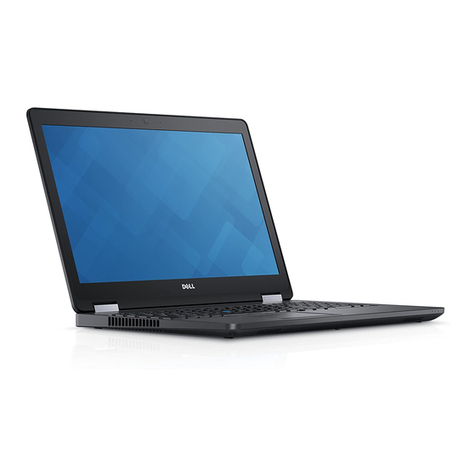
Dell Latitude E5570 User manual