3
HOMEOWNERS INFORMATION
SERIES
Power Cord Protection—Power supply cords should be routed so that they are not likely to be walked on or pinched by items
placed upon or against them, paying particular attention to cords at plugs, convenience receptacles, and the point where they exit from the
appliances.
Do not damage or deform the power supply cord.If it is damaged or deformed, it may cause electric shock or fire when used.When removing
from the wall outlet, be sure to remove by holding the plug attachment and not by pulling the cord.
Telephones—Avoid using a telephone (other than a cordless type) during an electrical storm. There may be a remote risk of electrical
shock from lightning. Do not use a telephone to report a gas leak if the leak is in the vicinity of the ELAN electronic equipment because of risk
of fire or explosion.
Cleaning—Unplug this audio product from the wall outlet before cleaning. Do not use liquid or aerosol cleaners. Use a damp cloth for
cleaning.
Power Lines—An outdoor antenna should be located away from power lines.When installing an outside antenna system, extreme care
should be taken to avoid touching power lines or circuits, as contact with them may be fatal.
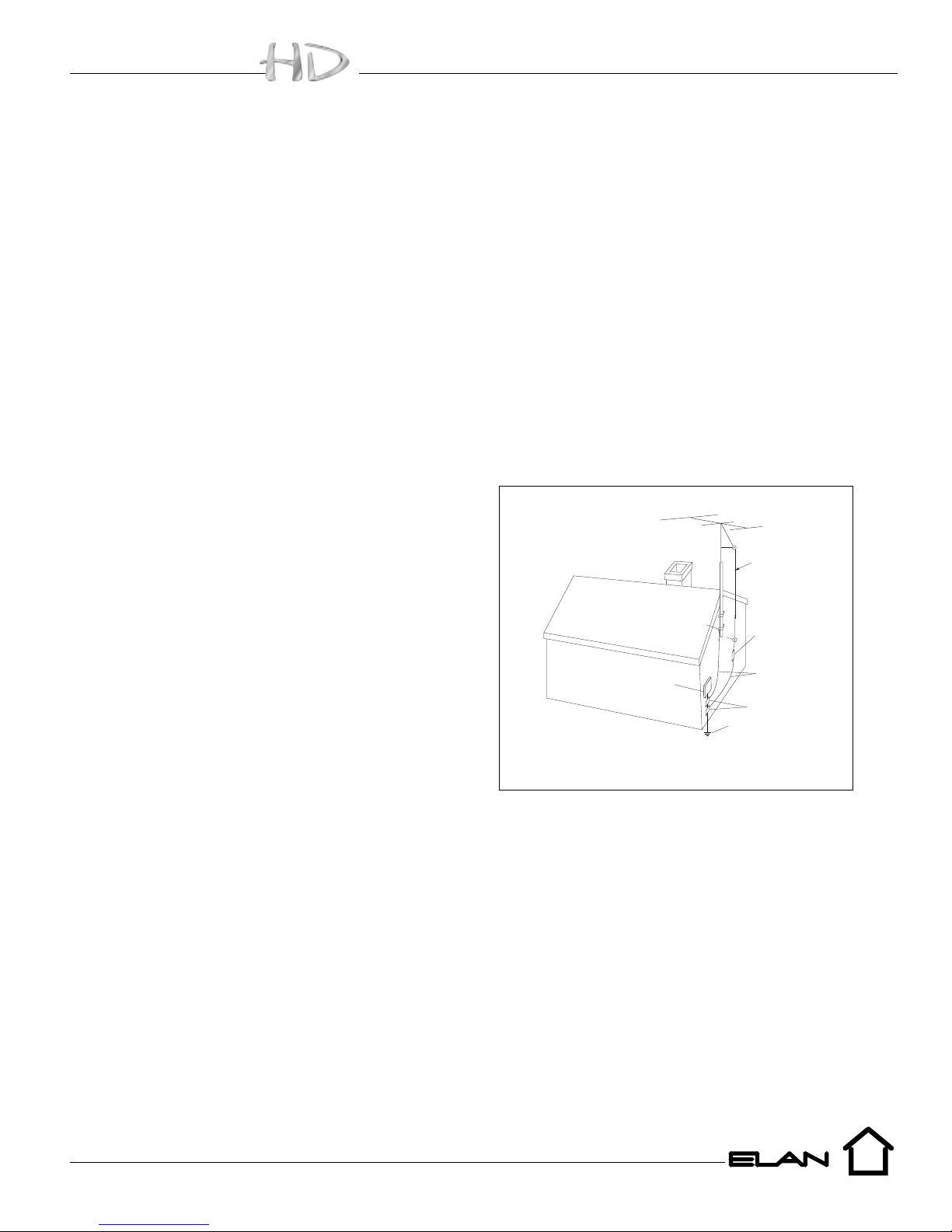
Outdoor Antenna Grounding—If an outside antenna or cable system is connected to these audio products, be sure the anten-
na or cable system is grounded so as to provide some protection against voltage surges and built-up static charges. Section 810 of the U.S.
National Electrical Code, and Section 54 of the Canadian Electrical Code, provide information with respect to proper grounding of the mast and
supporting structure, grounding of the lead-in wire to an antenna discharge unit, size of grounding conductors, location of antenna-discharge
unit, connection to grounding electrodes, and requirements for the grounding electrode. See the grounding diagram (below).
Overloading—Do not overload wall outlets and extension cords, as
this could result in fire or electric shock.
Object and Liquid Entry—Never insert objects of any kind
through the openings of these appliances, as they may touch dangerous
voltage points or short-out parts that could result in a fire or electric shock.
Care should be taken so that objects do not fall and liquids are not spilled
into the appliance through openings in the enclosure.
Servicing—Do not attempt to service these appliances yourself, as
opening or removing covers may expose you to dangerous voltage or other
hazards. Refer all servicing to qualified service personnel.
Damage Requiring Service—These appliances should be
serviced by qualified service personnel when:
• A power supply cord or a plug has been damaged or
• If liquid has been spilled into the appliance or objects have fallen into
the appliance or
• The appliance has been exposed to water or moisture or
• The appliance does not appear to operate normally or exhibits a marked change in performance or
• The appliance has been dropped or the enclosure damaged.
Replacement Parts—When replacement parts are required, be sure the service technician has used replacement parts specified
by the manufacturer or that have the same characteristics as the original part. Unauthorized substitutions may result in fire, electric shock, or
other hazards.The Master Control Unit battery should be replaced only after turning the power off and only by an authorized installer.
Safety Check—Upon completion of any service or repairs to this audio product, ask the service technician to perform safety checks to
determine that the audio product is in proper operating condition.
Lightning—For added protection for these audio products during an electrical storm, or when they are left unattended and unused for
long periods of time, unplug them from the wall outlet and disconnect the antenna or cable system. This will prevent damage to the audio
products due to lightning and power-line surges.