OPERATING INSTRUCTION:
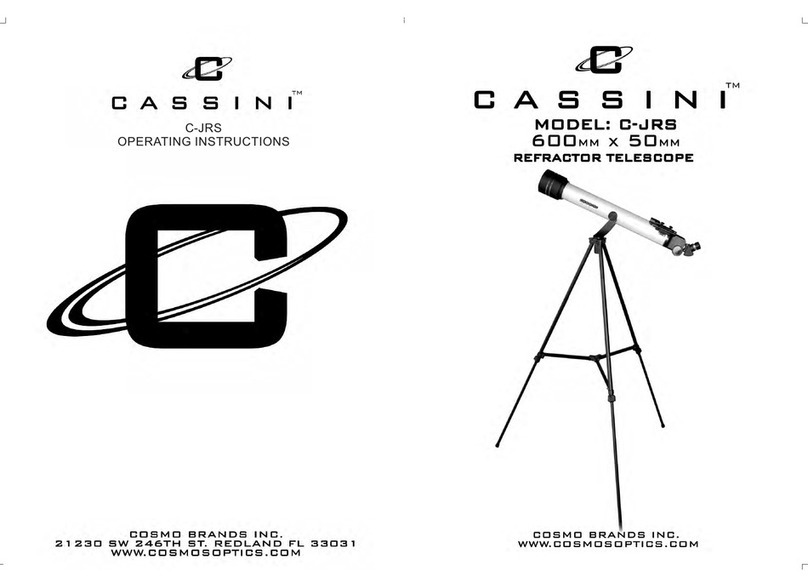
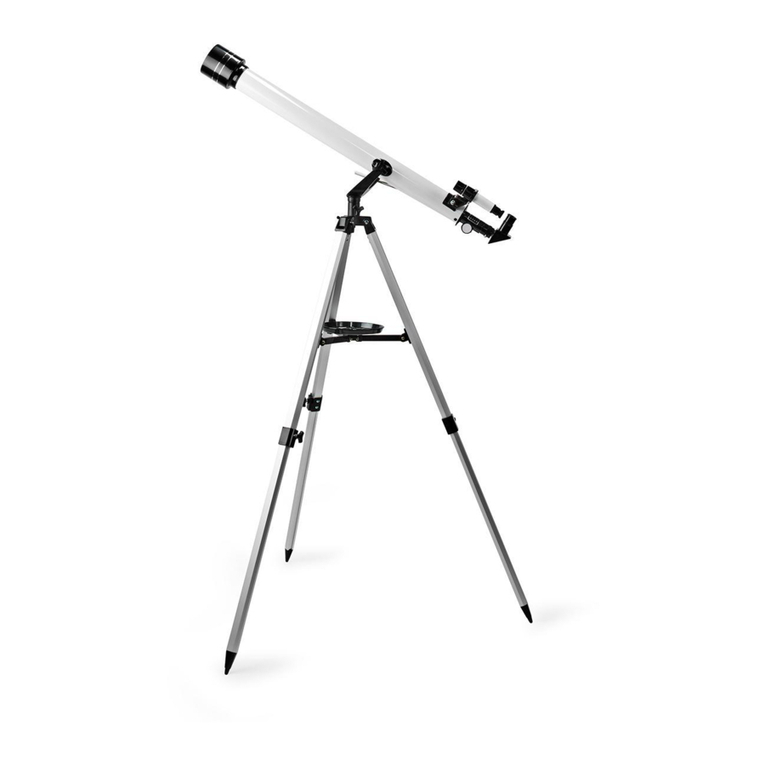
1. Secure the main tube (1) in the azimuthally mount (6) and adjust it
with the securing screw (7)
2. Insert the angle prism (2) into the tube (4) and secure it with the
screw.
If the Erecting Eyepiece is used together with the exchangeable 1.5X
eyepieces, the following
Magnifications can be achieved:
Eyepieces and theoretical maximum magnification:
Eyepiece Magnification Magnification with
1.5x
Erecting Eyepiece
6mm 60X 90X
20mm 18X 27X
ALTITUDE - AZIMUTH MOUNTING:
The telescope is equipped with an altitude-azimuth mounting (N), i.e.
it can be moved vertically
(Altitude) and horizontally (azimuth).
WHICH MAGNIFICATION?-SELECTING THE CORRECT EYEPIECE:
The magnification is the ability of the telescope to make the image
seem larger or to seem closer to the viewer.
Example:
Focal length 360mm/eyepiece focal length 6mm=magnification 60X
The optimum magnification depends on what you are looking at. As a
rule of thumb, the best image
Results from using a magnification, which is not more than 1.5X-2.0X
the diameter of the objective lens. For observation of most heavenly
bodies, a magnification of 75X-100X can be achieved with a 50mm
objective lens.
A lower magnification should be used for the observation of the stars.
This provides a wider field of view and simplifies aiming the telescope
at the desired object.
The maximum magnification should be used only for particularly clear
objects such as the moon, which is relatively close to the Earth and
very bright, permitting good resolution of details at high magnification.
ERECTING EYEPIECE:
The 1.5X Erecting Eyepiece not only increases the magnification of
telescope but also correct the
Direction of the image. For example, a telescope, which has a
magnification of 60X, will have a magnification of 90X when a 1.5X
Eyepiece is used. Moreover, when the telescope is used to view
landscape, the erecting eyepiece can straighten out the image. This
erecting eyepiece is to be inserted in the eyepiece tube (3) of the
telescope.
GENERAL NOTES:
Avoiding exposing the telescope to sudden temperature changes, as
this can result in fogging of the
Objective lens (as moistures condenses on it) If this should happen,
place the object lens close, but not too close, to a source of heat and
wait for the moisture to evaporate.
CAUTION:
TO AVOID DAMAGE TO YOUR EYES, NEVER VIEW THE SUN OR
ANY OTHER OPTICAL DEVICE WITH THE TELESCOPE
WARRANTY:
No guarantee or liability can be accepted for any changes and
modifications of the product or damage caused due to incorrect use of
this product.
GENERAL:
Designs and specifications are subject to change without notice.