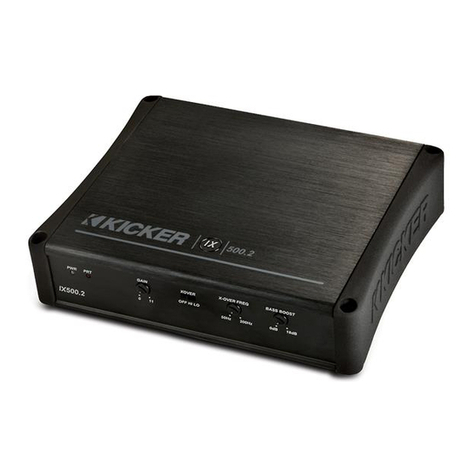
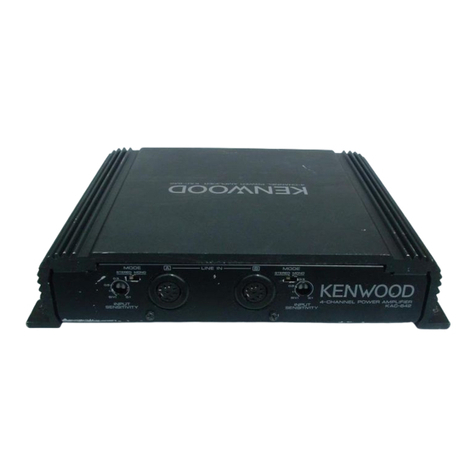
Crossover Control: The variable crossover
on
the front of the amplifier allows you to adjust the crossover
frequency from 50-200Hz. The setting for this control
is
subjective; 80Hz
is
a good place to start.
Bass Boost Control: The variable bass boost control on the front of the amplifier
is
designed to give you
increased
output
0-18dB,
at
40Hz. The setting for this control
is
subjective.
If
you turn
it
up, you must readjust
the input gain control to avoid clipping the amplifier.
TROUBLESHOOTING
If
your amplifier does not appear to be working, check the obvious things first such
as
blown fuses, poor or
incorrect wiring connections, incorrect setting of crossover switch and gain controls, etc. There
is
an
illuminated
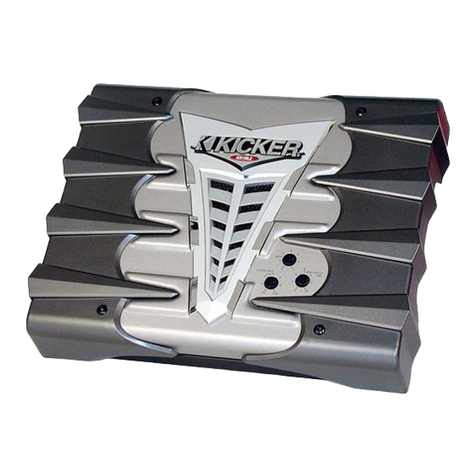
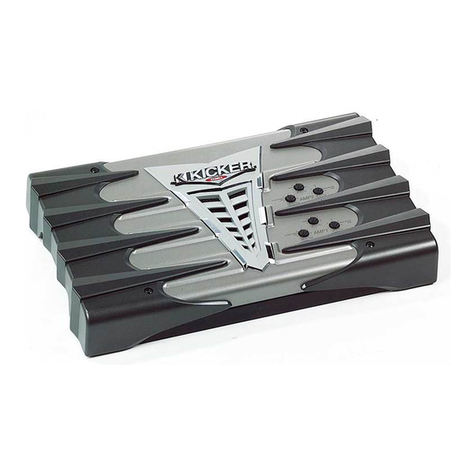
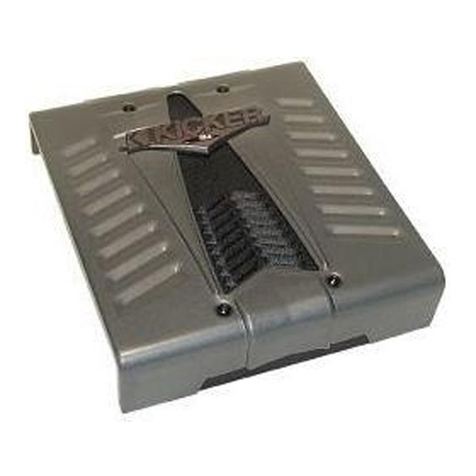
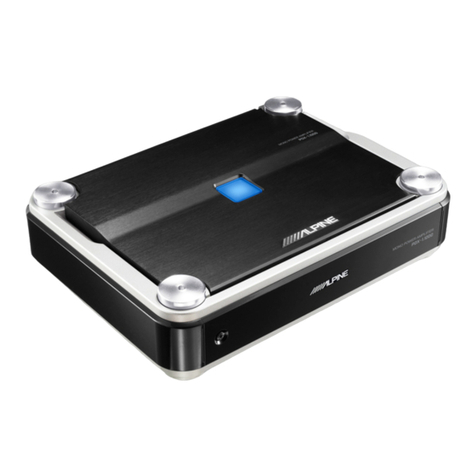
blue badge on top of the amplifier denoting the power state of the amp
in
addition to the Protection
LEO
on the
end panel of your
KICKER
IX
series amplifier. When the blue badge
is
lit,
this indicates the amplifier
is
turned
on
and the amplifier
is
functioning properly.
BLUE Badge Light off, no output? With a Volt Ohm Meter
(VOM)
check the following:
0+
12 volt power
terminal (should read +12V
to+
16V)
@Remote turn-on terminal (should read +12V
to+
16V)
@)Check for
reversed power and ground connections.
0Ground
terminal, for proper conductivity.
0Check
for blown fuses.
BLUE Badge Light on, no output? Check the following:
ORCA
connections @Test speaker outputs with
a "known" good speaker. @)Substitute source unit with a "known" good source unit.
0Check
for a signal
in
the RCA cable feeding the amplifier with the VOM meter set to measure
"AC"
voltage.
0Check
polarity of the
amplifier inputs
if
using a bridged configuration.
Protection LED flashing with loud music? The
red
LEO
indicates low battery voltage. Check
all
the
connections
in
your vehicle's charging system.
It
may be necessary to replace or charge your vehicle's battery or
replace your vehicle's alternator.
Protection LED on, no output?
0Amplifier
is
very
hot=
thermal protection
is
engaged. Test for proper
impedance
at
the speaker terminals with a VOM meter (see the diagrams
in
this manual for minimum
recommended impedance and multiple speaker wiring suggestions). Also check for adequate airflow around
the amplifier. @Amplifier shuts down only while vehicle
is
running= voltage protection circuitry
is
engaged.
Voltage to the amplifier
is
not within the
10-16
volt operating range. Have the vehicle's charging and electrical
system inspected. @)Amplifier
will
only play
at
low volume levels= short circuit protection
is
engaged. Check
for speaker wires shorted to each other or to the vehicle chassis. Check for damaged speakers or speaker(s)
operating below the minimum recommended impedance.
No output from one channel?
0Check
the balance control on source unit
@Check
the RCA
(or
speaker
input) and speaker output connections for the channel @)Swap the RCA
(or
speaker input) cable from left to
right.
If
the problem changes sides then you have a bad RCA
(or
speaker input) cable or source unit problem.
0Swap
the speaker output wire from left to right.
If
the problem changes sides then you have a bad speaker
cable, passive crossover network and/or speaker.
Alternator noise-whining sound with engine's RPM?
0Check
for damaged RCA
(or
speaker input) cable
@Check
the routing of RCA
(or
speaker input) cable @)Check the source unit for proper grounding
0Check
the gain settings and turn them down
if
they
are
set too high.
Poor stereo image or reduced bass response? Check system phasing by turning the balance control from
left to right.
If
there
is
more bass output when turned to either side, then check your speaker wiring, passive
crossover networks and speaker terminals for proper positive and negative connections. Reverse a speaker
connection from positive to negative
on
the stereo/subwoofer channel(s);
if
the bass improves, the speaker was
out of phase.
No Fader? When using both sets of low-level
(RCA)
or high-level (speaker
wire)
inputs, the fader button must
be pushed
in.
Ground Noise?
KICKER
amplifiers
are
engineered to be fully compatible with
all
manufacturers' head units.
Some head units may require additional grounding to prevent noise from entering the audio signal.
If
you are
experiencing this problem with your head unit,
in
most cases running a ground wire from the RCA outputs
on
the
head unit to the chassis
will
remedy this issue.
6
IX
AMPLIFIERS