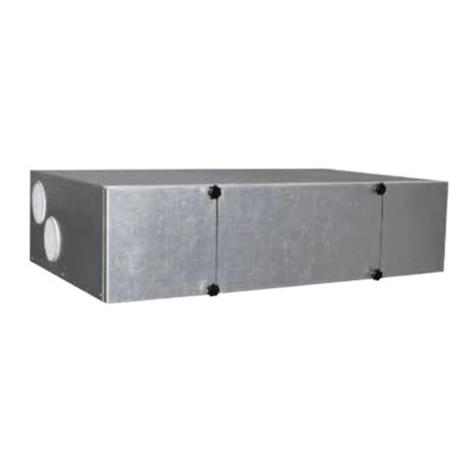
8BIA Single room ventilation unit iconVent Mono and iconVent Duo
4.3. CROSS VENTILATION
Sample installation
1Single-room ventilation units
2Regulation
3Cross ventilation
4Supply air room, for example, living room and
dining room
5Supply air room, for example, bedroom
6Supply air room, for example, guest room
7Supply air room, for example, bathroom with window
8Exhaust air room, for example, kitchen with window
9Overflow area, for example, corridor or hall
Thus the single-room ventilation units (1) can be controlled
by the regulation (2), so that a sufficient cross ventilation (3)
of the entire utilization unit is guaranteed.
For the realisation of cross ventilation (3) the supply air
volume flows in this sample installation, for example, in the
living room and dining room (4), must be increased by +5 %.
In the opposite rooms, for example, in the bedroom (5) and
guest rooms (6), the exhaust air volume flows must by
higher by +5 %. Additionally suitable overflow openings, for
example, door undercuts are necessary.
In exhaust air rooms with windows, for example,
bathroom (7) and kitchen (8), no cross ventilation is neces-
sary. Here the single-room ventilation units (1) must be op-
erated in balance according to the DIBt-approval. This
means they run independently with regard to air tech-
nology, independent from the settings of the supply air
rooms. In such a case either two single-room ventilation
units iconVent Mono or one single-room ventilation unit
iconVent Duo must be installed.
In the overflow sector, for example, corridor or hall (9), an
own single-room ventilation unit can be renounced, be-
cause, as a rule, the cross ventilation (3) is sufficient, in
order to achieve a sufficient air exchange in these rooms.