7
Tips:
•Keep the cable between the GPSdome and the GPS receiver short.
•Locate the GPS antennas as far away from other RF jamming sources as possible.
•There are large variations in the performance of GPS receivers supplied by different manufacturers.
GPSdome adds an anti-jam capability to all receivers, but the overall anti-jam performance of the
combined system will depend on performance characteristics of the receiver.
•GPSdome reduces jamming signals that enter the receiver through the antenna port. However, a
poorly - designed receiver can also absorb the jamming signal through the body of the receiver itself.
A good receiver will have EMC shielding to prevent leakage of RF radiation through its sides; if this
is not the case, and a better receiver can’t be used, install the receiver in a shielded case.
•If possible, increase the distance between the GPSdome antennas and any jamming source. For
example, if there is a jammer operating from the cigarette lighter socket in a car, locate the antennas
towards the rear of the vehicle.
•If GPSdome is installed in a complex environment, such as a vehicle, experiment with the placement
and orientation of the antennas for best results. Due to the complex propagation environments within
vehicles, different installation options may produce a higher or lower performance.
Step 4. Coax cabling
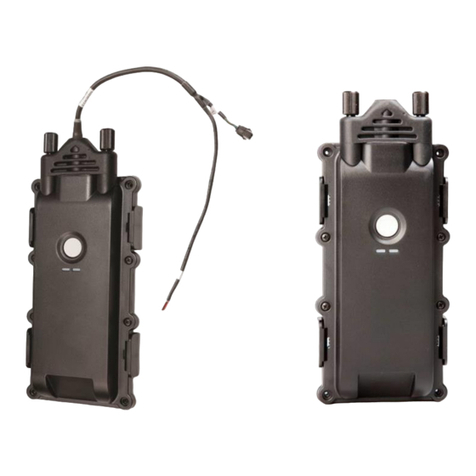
Connect and secure the following cables to the GPSdome module using an SMA torque spanner set to 1Nm
(8.85 in-lbs):
a) Antenna 1 cable connector to the auxiliary antenna input ‘A’ connector.
b) Antenna 2 cable connector to the primary antenna input ‘P’ connector.
c) The RF output to receiver ‘R’ connector using a locally sourced cable fitted with high quality sealed
SMA connectors. The other end connected into the GPS receiver RF antenna input.
Step 5. External power supply
Verify that the DC provided on the receiver cable is 3.3VDC - 32VDC and can provide at least 800mW of
power.
a) Connect the red wire to +V (3.3VDC – 32VDC)
b) Connect the black to common (GND).
c) When interference indication is required, use the brown wire (and the same common – black), in
accordance with interference indication
Caution: Make sure you connect the DC + to the red wire and
the common/ground to the black
Step 6. Coil and secure any excess of antenna cable and power wires into a hidden location, such as under
the carpet, using wire ties (not supplied).
General Operation
The GPS DOME module operates without manual intervention.
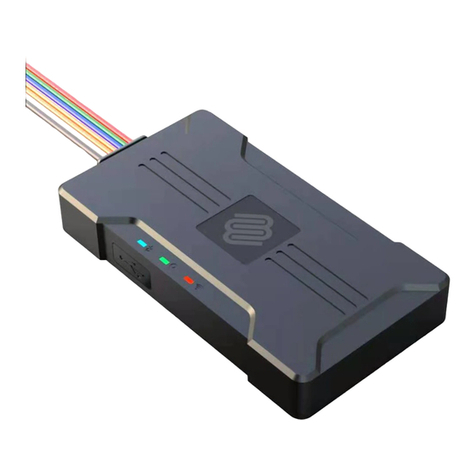
Two LEDs located on the GPS DOME module, provide the following indications:
LED 1 - When the module is powered ON and operating correctly, a green LED is steady on.
LED 2 –When the presence of a jamming event is detected, a red LED is steady on.