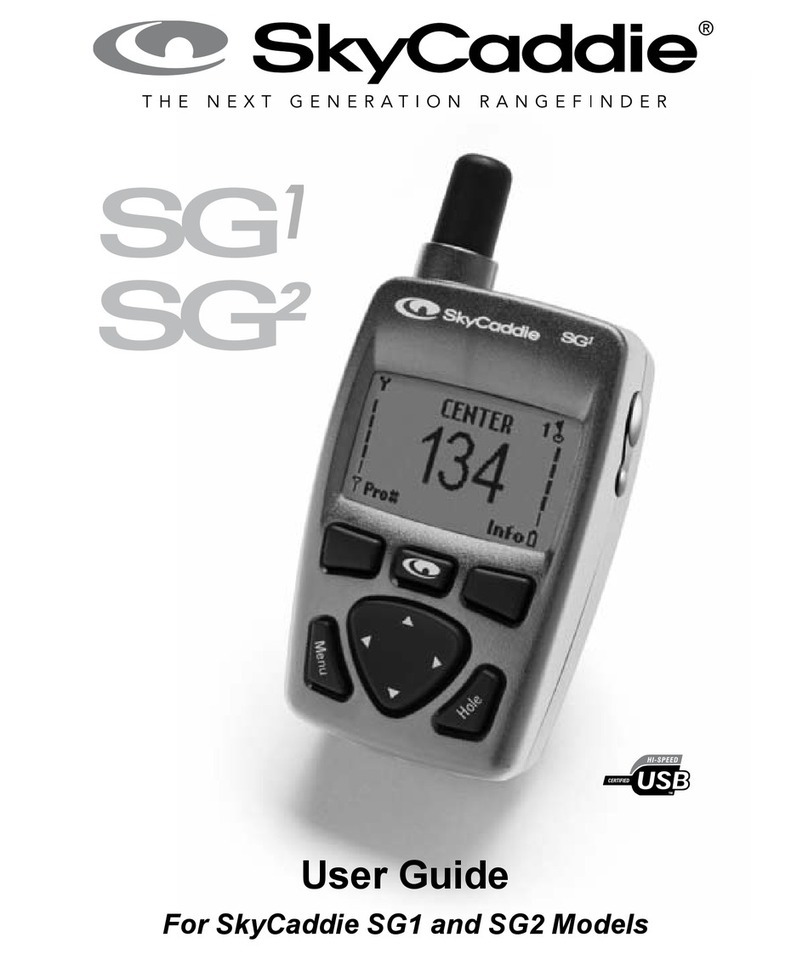
Voyager Trail Tech User manual

MOTO-GPS

Main Tab Main Tab 2
Map Tab
Duel Map Screens
Pan/Zoom Mode
Engine
Temperature
Tab
Engine
Temperature
Review
Altitude Tab Altitude
Review
User Tab User Tab 2
Navigation
Tab
Quick-Start » Screens
Use the
navigation switch
to move up and
down between
screens.

3Trail Tech Voyager
UP
Navigate tab screens and menus.
Quick-Start
ENTER
Conrm
changes or
switch to next
screen.
BACK
Backs out of
any screen or
menu. Press
2-3 times to
return to main
tab.
MENU/POWER
Enter or exit
menu. Hold to
power off.
Quick-Start » Buttons
DOWN
Navigate tab screens and menus.
RIGHT
Conrm, select, or change screens.
LEFT
Cancel, back, or change screens.

4Trail Tech Voyager
Trail Tech brings functionality and life to your
motor vehicle with high quality and innovation.
To ensure long and trouble-free operation, this
User’s Manual contains valuable information
about how to operate and maintain your digital
gauge properly.
Please read this manual carefully.
Introduction
Introduction
PURCHASE DATE
DEALER NAME
DEALER ADDRESS
DEALER PHONE
Keep this book and sales slip together for
future reference.
If you call to request service for your Voyager
digital gauge, you need the date of purchase,
dealer’s name, address, and telephone number.
Warranty service requires proof of purchase.

5Trail Tech Voyager
• In order to change Voyager using a wall outlet,
Trail Tech’s wall charger (9000-ACA) is required.
Attempting to charge Voyager directly off an
outlet will result in failure of your Voyager Moto
GPS.
• Read all instructions before using Voyager.
• Avoid contact with gasoline, degreasers or
other chemical cleaners.
• Do not wash with pressure washer.
• When installing Voyager, disconnect the
vehicle battery.
• When installing radiator hose temperature
sensors, make sure it ts BEFORE cutting the
radiator hose.
PAY ATTENTION TO THE TRAIL!
Precautions
WARNING:
• Check gap between wheel sensor and magnet
periodically to ensure correct measurements and
reading on Voyager.
• Do not bend, twist, kink or abuse the sensor
cables.
• Do not disassemble Voyager or its
accessories.
• Do not operate Voyager while driving/riding.
• Do not rely on Voyager for operations requiring
absolutely precise measurements of distance
or direction. All GPS devices inherently contain
some amount of error. Use the wheel sensor for
the most precise data.
Precautions

6Trail Tech Voyager
FAQ
Frequently Asked Questions
1. Voyager will not turn on: The internal
battery may need to be charged before use,
connect to vehicle power or use the wall charger
(wall charger sold separately.)
2. How long does the internal battery take to
charge fully? No need to pre-charge; connect
and ride. Voyager takes 3-8 hours to fully
charge depending on charge mode.
3. How do I get the best reception? The
internal antenna is designed for optimum
reception potential. If Voyager is mounted with
metal blocking the internal antenna, consider
purchasing the external antenna (9000-EAA).
4. How do I mount Voyager to my machine?
Vehicles with handlebars can use the included
handlebar mounting hardware. There are also
protective accessory mounts available, or utilize
the two mounting holes in the back of Voyager to
x to a at surface.
5. What kind of power does Voyager need for
proper operation? Voyager is intended to work
on regulated DC motorcycle power systems.
The DC input range is 12V to 65V.
DC power systems with a failing vehicle battery
may produce too low a system voltage (<11.5V)
to allow for proper operation.
6. Voyager kits include physical sensors,
magnets, and other cables. Why does
the unit need this if it’s a GPS? You can
use Voyager handheld without any sensors
connected. However, physically bolting Voyager
to your vehicle provides many advantages over
a conventional handheld GPS.
A. Power from the machine enables several
integration features, such as extended run-time
and maintenance-free charging.
B. The engine temperature sensor monitors
the health of your machine and enables two
major features: engine temperature diagnostics

7Trail Tech Voyager
Frequently Asked Questions
and over-temp warning LEDs.
C. The ignition sensor tells Voyager when the
engine is running. This enables logging of tracks
only when engine is running and tachometer
display features.
D. The wheel sensor can also control when
to log, and provides a more accurate odometer
than GPS.
7. Do I really need a wheel sensor? My other
GPS unit gets along just ne without one. All
speed/distance data can be gathered from either
GPS or the wheel sensor. Voyager kits provide a
wheel sensor for several reasons:
A. When using a wheel sensor, Voyager knows
to stop logging when the vehicle stops moving.
When you start rolling again, the wheel sensor
tells Voyager which starts logging again (without
a GPS induced lag.)
B. The wheel sensor will track distance
regardless of GPS conditions. This is important
under several circumstances:
a. GPS cannot tell the difference between
a motorcycle moving under its own power or in
the back of a truck.
b. The GPS signal can be lost, especially
around metal structures or in tunnels. With no
signal, speed and distance accuracy is lost.
c. GPS cannot see small changes in
elevation (i.e. whoops and ruts.) Over time this
will create signicant odometer error.
d. GPS is accurate while travelling in
straight lines at constant velocity. However, tight,
fast corners will cause the GPS to skip over part
of your path. Over time this will contribute to
odometer error.
C. Trail Tech believes an accurate odometer
and hour meter are critical features. To maintain
this accuracy, kits are provided with a wheel
sensor included.
8. Can Voyager use GPX les? GPX (GPS
exchange format) is Voyager’s native format.
Import/export between the MicroSD and dozens
of software programs and web services.

8Trail Tech Voyager
Frequently Asked Questions
If the machine is within the acceptable range,
follow Trail Tech’s instructions for connect to
vehicle power (e.g. at the CDI input.)
9. Can Voyager be turned on and off
manually? Yes. Hold down the upper left
button to power Voyager off. Note that Voyager
has two types of sleep mode.
The rst sleep mode shows the clock on
the screen. Some features are turned off to
conserve power, but Voyager is still alert to
come back on quickly when you are ready to
continue riding.
The second sleep mode turns Voyager off
completely to conserve as much power as
possible. You can alter the sleep mode timers in
Set > Power Settings > Power-Save >.
10. How do I run Voyager without connecting
it to a vehicle? Voyager provides an easy way
to change unit settings to accommodate a wide
variety of user needs. There are few menu
options to change when Voyager is used without
external power: See the “Sensor Notes” section
for details on the settings that need to change in
order to use Voyager without connecting one or
more of its sensors to a vehicle.

9Trail Tech Voyager
Feature
Geodetic Datum
GPS Chipset
Joystick
Wheel Sensor
Temperature Sensors
Backlight
Screen
Product Dimensions
Product Weight
Operation Temperature
Storage Temeprature
Critical Engine Enviro.
Max Waypoints
Max Track Points
Max Route Points
Max Tracks/Routes
Specications
Specications
Function
Speed
Distance
Altitude
Temperature
Accum. Run Time
GPS Sample Rate
Display
SPD
DST
ALT
ENG
CLOCK
TIME
DISTANCE
Description
WGS84
MediaTek MT3329
5-Position High-Tactile
Non-contact Magnet Sensor
External Ambient and
Engine Thermistor Sensors
LED Group
400x240 WQVGA LCD
68.6mm (2.7”) Diagonal
58.8x35.3mm (2.3x1.4”)
113x62x28.2mm
(4.5x2.5x1.1”) WxHxD
6.1 oz. (172g) (0.38lbs.)
0-60ºC (32-140ºF)
-20-80ºC (0-175ºF)
Amber/Red LED Alerts
300 waypoints
72,500 points
72,500 points
300 each
Range
0-999 MPH
0-250,000 mi
59,000 ft
0-260ºC
(32-499 ºF)
0-1,000,000 hr
1-5 sec
1-15 m
Power
External Power Input
Internal Battery
Power Wire
Battery Life (typical use)
Battery Life (100% backlight)
Battery Charge Time
Description
12V-60V DC
3.7V 900 mAh Li-Ion
Red/Black Power Wire
11 hours
6 hours
3-8 hours

10 Trail Tech Voyager
Physical Features
Physical Features » Front of Unit
Yellow LED
Internal GPS Antenna
Red LED
Navigation
Switch (UP,
LEFT, RIGHT,
DOWN)
ENTER ButtonBACK Button
MENU Button
MicroSD Card
Ignition Sensor
Ambient Temperature Sensor
Engine Temperature Sensor
Wheel Sensor
Connection Power
Other manuals for Trail Tech
1
Table of contents
Other Voyager GPS manuals