File: CM130_r5 - April 2017 - Technical note: CM 130 page 9 of 16
CM 130
Operating controls
The CM130 operation is controlled by an external command
at +24 Vdc (nominal): the voltage range may vary from 8 to
24 Vdc, common to ground, Z=5 kOhm. The command signal
must be wired to pin 9 of the Connector #2: if the user doesn’t
have a suitable voltage generator for this signal, then the
equipment’s internal voltage generator is available at pin 8 of
Connector #2. In this case, to enable the equipment operation,
the user must provide an external contact closing the circuit
between pin 8 and pin 9.
Refer to wiring diagram on page 14.
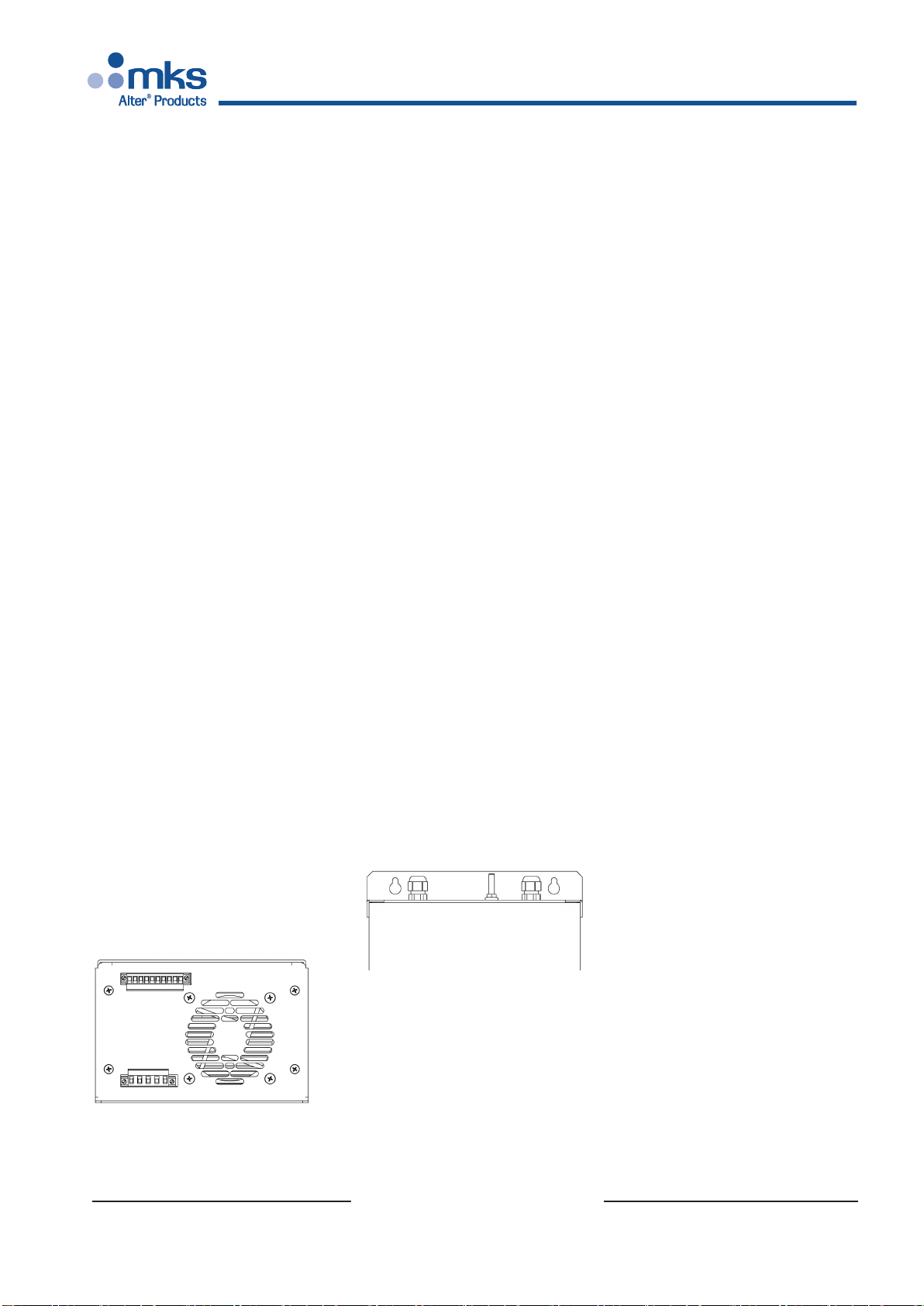
Pin-out description for CONN# 1 and CONN# 2
(Note: in the next paragraph the annotation “#1/x” means pin
“x” of CONN# 1, and “#2/x” means pin “x” of CONN# 2)
#1/1: Line input phase, range 140 ÷ 250 Vac
#1/2: Line input phase (or neutral) like the above
#1/3: Ground
The above connection must have wires with minimal section of
1.5 mm2(or AWG 16), the max section of 2.5 mm2(AWG 10)
#2/1 & 2/2: User’s signal ground. Ground reference for the
opto insulated interface. (It is insulated from
CONN#1, pin 3)
#2/3: Voltage generator output, 15V 100mAmax
#2/4: Microwave ON (Enabling) input, value ON/OFF
Range 8 ÷ 24V = ON, Z=5 kOhm.
#2/5: Reference signal, input, value 0 ÷ 10V = 0 ÷ 100%,
Z=100 kOhm.
#2/6: Current output monitor 1V = 18mA,
Range 0 ÷ 10 Vdc
#2/7: Low power scale signal, input, value ON/OFF
Range 8 ÷ 24V = ON, Z=5 kOhm
When this signal is ON the full scale of the equipment is
reduced to 1/3 of its max: it may be useful to control, preci-
sely, very low level of power.
#2/8 & 2/9: Alarm contacts
Contact load: max 24V, 100mA
Unit power ON, alarm status: contact open
Unit power OFF: contact open
Unit power ON, no alarm: contact closed
Low power scale [ #2/7 ] OFF ON
Reference signal [ #2/5 ] 0 ÷ 10 V 0 ÷ 10 V
Output current [ FA ] 0 ÷ 180mA 0 ÷ 60mA
Current monitor [ #2/6 ] 0 ÷ 10 V 0 ÷ 3 V
Messa in funzione
Il CM130 è controllato da comando esterno +24Vdc
(nominale): la tensione può variare in un range tra 8 e 24 Vdc,
comune a terra, Z=5 kOhm. Il segnale di comando deve essere
collegato al pin 9 del Connettore# 2: se l’utilizzatore non ha a
disposizione un generatore di tensione per questo segnale può
utilizzare il generatore interno all’apparecchiatura collegando il
pin 8 del Connettore#2. In questo caso, per mettere in funzione
l’apparecchiatura, l’utilizzatore deve fornire un contatto esterno
chiudendo il circuito tra il pin 8 e il pin 9. Vedere schema di
collegamento a pag. 14
Descrizione dei pin del CONN# 1 e CONN# 2
(Nota: nel paragrafo che segue la dicitura “#1/x” signica pin
“x” del CONN# 1, e “#2/x” signica pin “x” del CONN# 2)
#1/1: Ingresso fase, range 140 ÷ 250 Vac
#1/2: Ingresso fase (o neutro) come sopra
#1/3: Terra
I cavi per il collegamento sopra descritto devono avere una
sezione minima di 1.5 mm2(o AWG 16), e massima di 2.5 mm2
(AWG 10)
#2/1 & 2/2: Segnale di terra. Riferimento di terra dell’interfac
cia opto isolata. (Isolato dal pin 3 del CONN#1)
#2/3: Tensione in uscita, 15V 100mA max
#2/4: Abilitazione (Microonde ON), valore ON/OFF
Range 8 ÷ 24V = ON, Z=5 kOhm.
#2/5: Segnale di riferimento, valore 0 ÷ 10V = 0 ÷ 100%,
Z=100 kOhm.
#2/6: Corrente in uscita 1V = 18mA,
Range 0 ÷ 10 Vdc
#2/7: Segnale di bassa potenza, valore ON/OFF
Range 8 ÷ 24V = ON, Z=5 kOhm.
Quando è attivo (ON), il fondo scala viene diminuito e
l’alimentatore eroga una potenza che è 1/3 della massima:
può essere utilizzato ove occorra regolare con molta
precisione bassi valori di potenza.
#2/8 & 2/9: Contatti di allarme
Portata del contatto: max 24V, 100mA
Alimentatore acceso ON, allarme: contatto aperto
Alimentatore spento OFF: contatto aperto
Aliment. acceso ON, no allarme: contatto chiuso
Scala di bassa potenza [ #2/7 ] OFF ON
Segnale di riferimento [ #2/5 ] 0 ÷ 10 V 0 ÷ 10 V
Corrente in uscita [ FA ] 0 ÷ 180mA 0 ÷ 60mA
Corrente rilevata [ #2/6 ] 0 ÷ 10 V 0 ÷ 3 V