16 17
RO Buddie®75 GPD
Model: 540714
Installation, Operation & Maintenance Guide www.aquaticlife.com
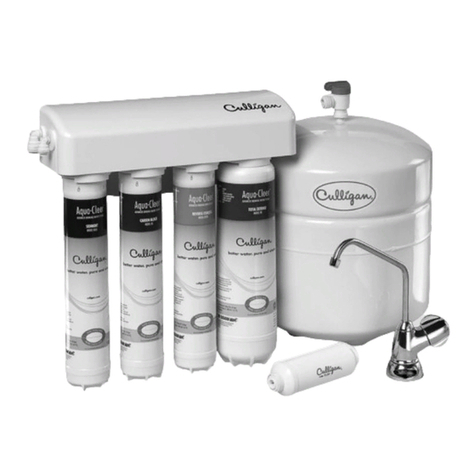
REVERSE OSMOSIS FILTER
BASICS
The membrane does most of the work by
removing up to 96-98% of the TDS from your
water. The other two included filters protect
the membrane from the many malicious
elements that shorten its life. The sediment
cartridge removes suspended particles larger
than 5 micron. The carbon block removes
chlorine. Timely replacement of the cartridges
will increase the membrane’s life.
The carbon cartridge is the most important
cartridge to change frequently. The carbon
cartridge can filter about 1,500 gallons of water
before being replaced IF your chlorine level
is 1 ppm. With a 2 ppm you should filter 750
gallons of water before needing to change, with
a 3 ppm you should get 500 gallons, and so on.
Any chlorine not absorbed by a spent carbon
cartridge will break down your Membrane, thus
greatly shortening its life.
When the sediment cartridge needs to be
changed, the production of water will reduce.
Even with reduced water production, the
cartridge will not allow anything larger than
five micron to pass through the chamber. On
average the sediment cartridge should be
changed at every other carbon change.
With proper filter changes, the membrane
could last up to two years. The membrane’s
water production rating is based on 77°F water
at 65 PSI. Any deviation from this will aect the
water production. Reference the conversion
table at right. You will notice that the warmer
the water, the better the production. It is not
advised that you introduce water from your
water heater to increase water temperature.
The membrane can't handle temps over 100°F.
UNIT MAINTENANCE
Recommended change 3-6 months
Sediment Filter Cartridge (Item # 330249)
Carbon Block Cartridge (Item # 330250)
12-24 Month Maintenance
RO 75 GPD Membrane Cartridge
(Item # 330650)
NOTE:
Cartridge & membrane
life are dependent on multiple
factors, including the quality of the
incoming water supply (TDS levels,
chlorine, etc.) and the amount of use.
Recommended replacement is based
on average usage.
TROUBLESHOOTING
• Leaks at the threaded connection:
If once installed the unit should leak, use
plumbers tape on the threaded fitting.
Typically, no more than three wraps will be
required to seal the connection.
• Leaks at the tubing connections:
The fittings on the RO Buddie use an
o-ring inside of them. This will require the
tubing to be inserted past the o-ring. You
will want to make sure that when inserting
the tubing you feel the initial stop when the
tubing first meets the o-ring and a second
stop when you push past the o-ring and
meet the end inside the fitting. This is what
we call the “double push”. Also, make sure
to cut the tubing with a razor or similar
object so that the tubing is not pinched
and causes the tubing to not seal properly.
• No water production:
Make sure the water supply is turned OFF.
Remove the tubing from the elbow on top
of the membrane housing, direct the
tubing into a container and turn on the
water. Does the water flow quickly
through the cartridges? If not, the
cartridges likely need to be changed.
• Low filtered water production:
The RO membrane is rated to produce the
stated volume of water based on 65 PSI
and a 77° F water supply. If you have one
or both specifications out of tolerance,
use the Temperature and Pressure
correction factors from charts on
previous page.
IMPORTANT: Tubing should
insert 5/8" inside the Press Fitting
when property installed.
Example
An RO membrane production rate at
77º F, 65 PSI = 75 gallons per day.
What is the production rate at 50º F?
Answer
Use the temperature correction factor
(from table above) = 0.58
New production ow rate at 50º F
is 75 x 0.58 = 43.5 gallons per day.
Temperature
Correction
Temp.
F/C
Correction
Factor
50/10 0.58
60/16 0.73
70/21 0.87
77/25 1.00
80/27 1.06
90/32 1.23
100/38 1.45
Pressure
Correction
Pressure
PSI
Correction
Factor
Less than 40 PSI
requires a
booster pump
40 0.1 to 0.2
50 0.4 to 0.5
65 1
70 1.05 to 1.15
80 1.25 to 1.35