The Facts About Turntable Preamps
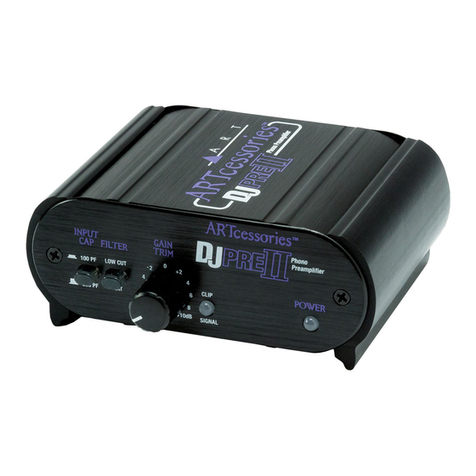
Phonograph Records Have Three Basic Problems
1. It is physically impossible to press them with ridges that
allow low frequencies to come out at the same reproduc-
tion level as mid and high frequencies. Bass compensa-
tion is therefore needed during playback.
2. Records produce a certain amount of hiss, which is
covered up in post-production by boosting the gain of the
high frequencies before pressing. Counter-EQing during
playback compensates for this.
3. Magnetic cartridges produce a weak signal (typically
around 5mV), which must be boosted to match the rest of
the amplification, and this too is done during playback. In
the mid-1950s, the Recording Industry Association of
America established compensation standards. The result-
ing RIAA preamp has been built into every hi-fi and stereo
amplifier with phono or turntable inputs since then. A sep-
arate RIAA preamp is necessary when you are connecting
a turntable to a mixer that does not have one built in.
4. Moving Coil cartridges typically have a low impedance and
very low output (0.2mV typically). Most will work with a
load between 24 and 100 Ohms. This load may be critical
to the sound of the cartridge.
5. There is a variant on Moving Coil called “high output” that
require a 47k load and have outputs in the 2mV range.
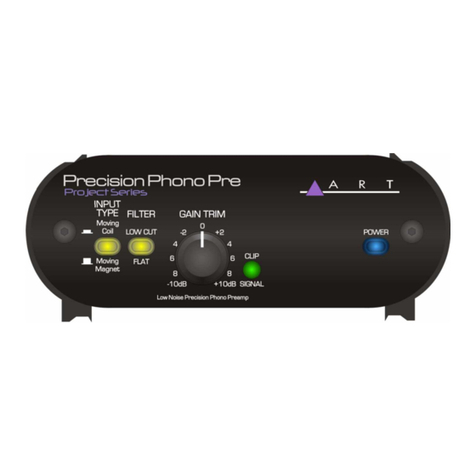
The Precision Phono Pre can accommodate this using the
MM setting and recovering 6-8dB of gain using the level
control.