www.barbecook.com
7
When the gasison its way to the burners, it passes through the
venturis. Thanks to the holesat the sides, the gasis then mixed with
airand - as a result - with oxygen. This is necessary for a good ignition
in the burners: only the correct mixture of gas and oxygen will ignite
properly and will result in nice flames.
4.2 Burner hoods
The burner hoods are the hoods that you mount above the burners of
your appliance.Theyprotect the burners from dripping fat.The holes
at the sidesof the hoods also distribute the heat over the grill, so it is
heated much faster and more evenly.
4.3 Enamel
Some parts of the appliance are covered in a layer of melted glass,
called enamel.This enamel protects the underlying metal from
corrosion. Enamel isa high-quality material: it is resistant to
rust, does not fade under the influence of high temperatures and is
very easy to maintain.
Because the enamel is less flexible than the metal whichthe
appliance incorrectly. To avoid problems, be careful when
assembling enamelled parts and always maintain the enamel
as described furtherinthis manual.
4.4 Flare-ups
Flare-ups are sudden flames that sparkfrom the bowl when you are
grilling. They are usually caused by dripping fat or marinade.
5 ASSEMBLING THE APPLIANCE
5.1 Safetyinstructions
•Do not modifythe appliance when assembling it. It is very
dangerous and not allowed to alter parts that are
•pre-assembled and/or sealed by the manufacturer.
•Always followthe assemblyinstructions carefully.
•The user is responsible for the correct assembly of the appliance.
Damagescaused by improper assembly are not covered by the
warranty.
5.2 To assemble the appliance
You need a cross-slotted screwdriver, a flat-slotted screwdriver and an
AA battery (electrical igniter). There are no batteries supplied with the
appliance.
1. Put the appliance on a flat and clean surface.
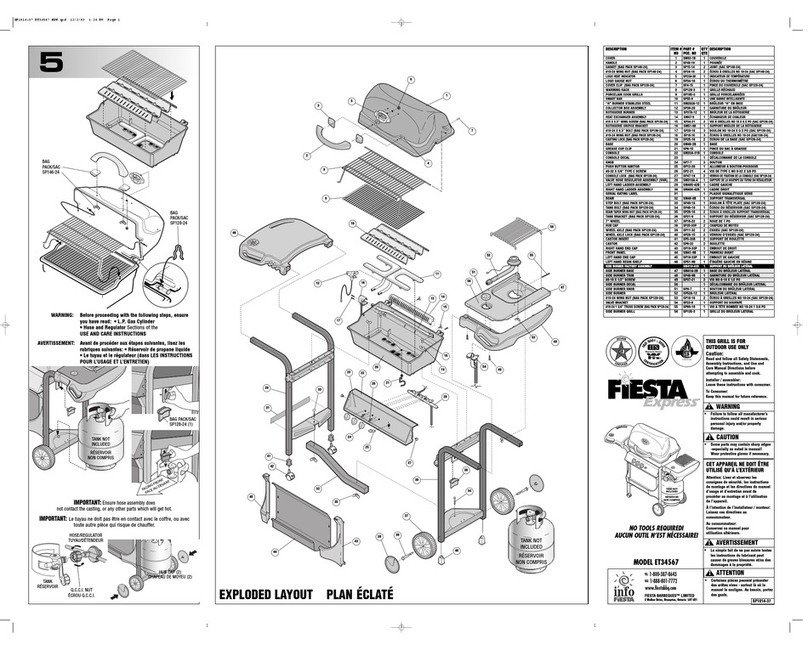
2. Assemble the appliance as shown on the assembly drawings.
You find them in the second part of this manual, after the
exploded view of yourappliance.
Be careful when assembling enamelled parts. The tools and
screws may damage the enamel.Use the provided fiber
washers to protect the enamel around the screws.
The blister packs can contain more screws than necessary.
Screws canbe left over after the assembly.
The package includesan emergency kit with spare assembly
parts (screws, bolts, fiber washers...) You can use them in case
you lost or broke some parts.
6 CONNECTING GAS TO THE
APPLIANCE
6.1 Which cylinder, hose and regulator?
To connect gas to the appliance, you need a gascylinder, hose and
pressure regulator. The hose and regulator are supplied withthe
appliance, the cylinder is not.
Which cylinder, hose and regulator you have to use, dependsonthe
country you live in. In Austria (AT), Switzerland (CH) and Germany (DE),
you have to use a propane cylinder and a hose and regulator for 50
mbar.
Country Cylinder, hose and regulator
AT Propane, 50 mbar
CH Propane, 50 mbar
DE Propane, 50 mbar
If you have to replace the hose or pressure regulator, buy
materials withthe same properties as the ones supplied with
the appliance.
Take your pressure regulator with you when buying a gas
cylinder. Not all pressure regulators fit all cylinders.
6.2 Safety instructions
•Never connect the cylinder directly to the appliance. Always
mount a pressure regulator on the cylinder first.
•Never modify pre-assembled or sealed parts of the cylinder, the
hose or the pressure regulator.
•Keep the hose as short as possible (1,5 m maximum) to prevent it
from dragging on the ground.
•While connecting the cylinder, hose and pressure regulator:
- Never distort the hose.
- Always keep the cylinderinan upright position.
- Never open the gas supply.
•Check for leaks each time you make changes to the gas
connection. See “7 Checking for gas leaks”.
6.3 Connecting the hose to the appliance
1. Locate the gastube of your appliance.