Only the LEFT channel input is used in Three Way Mono mode. The left channel low pass
output provides the low pass output. The mid or band pass output is taken from the right
channel low pass output connector and the high pass is taken from the right channel high
pass connector. All filter slopes are 24dB per octave, Linkwitz-Riley alignment.
PROGRAMMING the 10B-LR crossover:
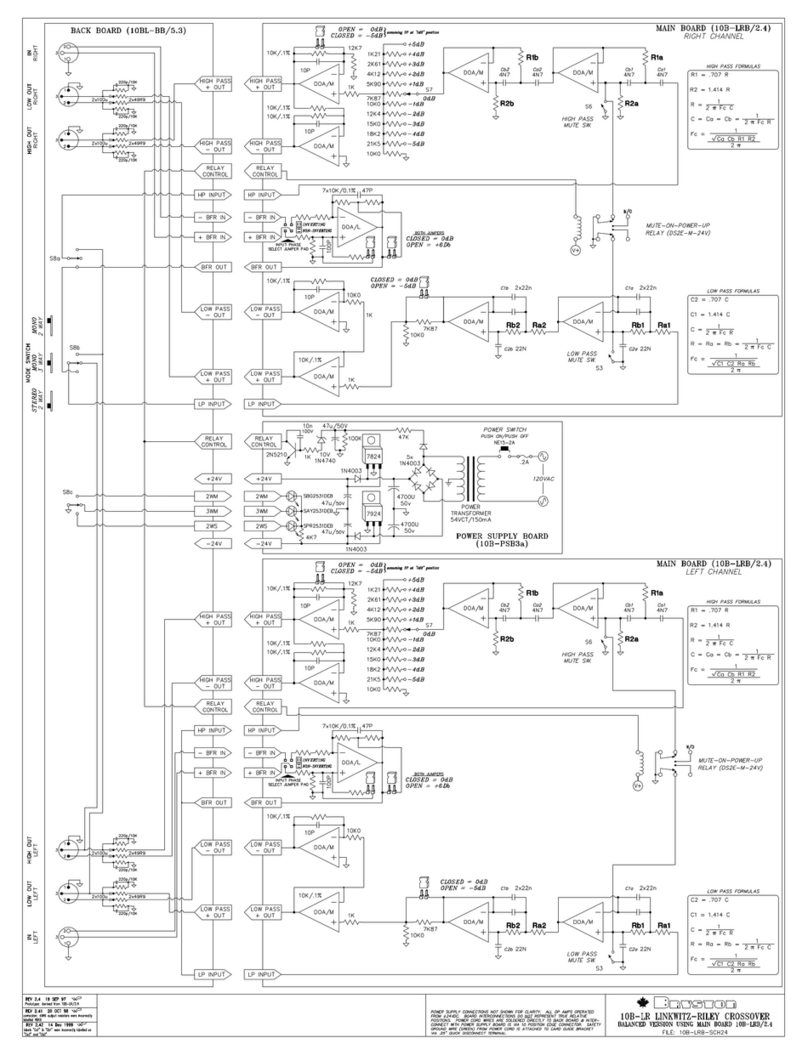
The crossover points in the 10B-LR are set by inserting small programming boards (4 per
channel) each containing 2 resistors. See illustration "10B-LINKWITZ-RILEY STEREO
CROSSOVER" and on page 7 and document "10B-FREQ-RES-TABLES.doc"
POWER AMPLIFIERS:
When power amplifiers of different power capabilities are used, the woofers will likely be
driven by the most powerful amplifier and the tweeters by the least powerful amplifier since
the woofers can generally be expected to be less efficient. When power amplifiers of
equivalent power capabilities are used in a bi-amped system, and when the power amps
employ totally separate power supplies for each channel (as all Bryston power amplifiers do)
it is desirable to place each power amplifier as close to its speaker as possible and use one
channel to drive the woofer and the other to drive the tweeter. Please note that if the power
amps being used do not employ totally separate power supplies for each channel, some
envelope distortion between channels may occur since the power drawn from the low
frequency channel driving the woofer will usually be considerably greater than from the
higher frequency channel driving the tweeter.
POWER AMPLIFIER PLACEMENT:
Where there is a considerable distance between the audio signal source and the speakers,
it is preferable to reduce the distance between the power amplifiers and the speakers at the
expense of increasing the distance between preamp and crossover or crossover and power
amplifier. The low impedance across the speaker lines is more likely to affect signal quality
with distance than is the higher impedance across the preamp to crossover, or crossover to
power amplifier cables.
BALANCED versus UNBALANCED CABLING:
If the distance between the power amplifier and crossover or crossover and preamplifier is
greater than 30 feet, it may be desirable to use balanced cables to interconnect the two
distant pieces of equipment as this may reduce noise pickup. To facilitate this, the 10B
crossover is available with balanced inputs and outputs (PRO versions) using 3 pin XLR
connectors (outputs use male connectors, inputs use female connectors). Pin 3 is the
positive (non-inverted or Hot) signal, pin 2 is the negative (inverted or neutral) signal and pin
1 is ground.
Where a long run of balanced cable is used to interconnect the preamplifier to the
crossover, and the crossover is placed within a few feet of the power amplifier there is no
advantage in using a balanced interconnection between the crossover and power amplifier.
Balanced cabling does not reduce noise; it merely reduces the ability of the cable to pickup
noise. The balanced output of a 10B Pro crossover can easily be used as an unbalanced
output by using XLR pin 3 (positive) as the HOT line and XLR pin 1 as the ground line.
Since there is no phase inversion in the 10B, the negative XLR output pins (#2) can
be used in the same way to achieve the same effect and the output will remain un-inverted
with respect to the input. In other words, any signal that enters the negative XLR input pin
(#2) will exit the negative XLR output pin (#2) un-inverted with respect to the input. Similarly