daka 832 furnace manual_3-18-13 Page 3 of 14
September 26, 2012, Revised March 18, 2013
measure chimney draft are readily available at furnace shops and are economical to purchase
or rent. If a draft gauge is not available, with the draft regulator fully installed and a good fire
burning, adjust the counterbalance weight closer to the gate for as low a draft setting as
possible, without the fire dying or getting smoke-back with the stove door slightly open. To
obtain higher heat levels, move the weight away from the gate to increase the setting.
9. It is designed to operate with a maximum warm air duct pressure of 0.2” water column and a
maximum warm air duct temperature of 250° degrees F. The warm air supply duct system
must be constructed of materials with a minimum temperature rating of 250° degrees F.
Plenums installed to the furnace must be constructed of metal. Do not use flexible pipe.
IMPORTANT: WHETHER INSTALLED AS A SUPPLEMENTARY/ADD-ON OR CENTRAL
FURNACE, INSTALLATION OF A COLD AIR RETURN LINE IS MANDATORY.
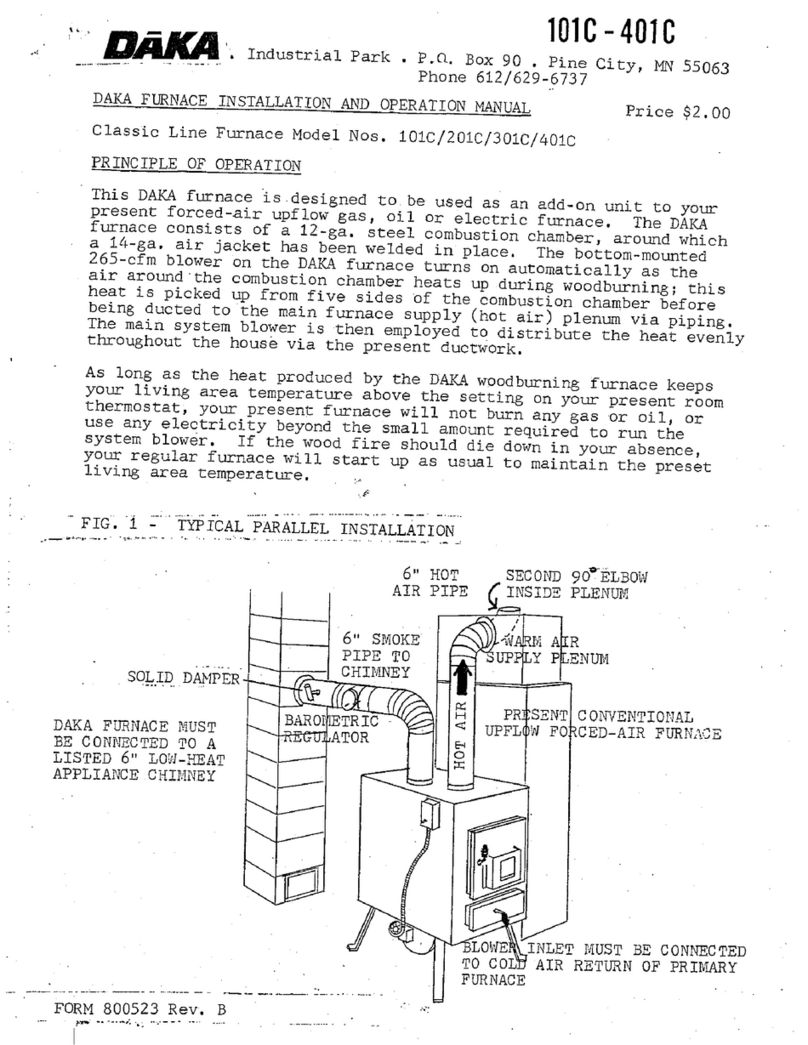
10. When any supplementary furnace is connected in parallel to an existing primary central
furnace, a back-draft damper must be installed in the plenum of the primary furnace below
the warm air inlet from the supplementary furnace to prevent the primary furnace from
operating in an unintended manner; see Fig. 1 for an illustration of the position of this
damper.
DANGER - RISK OF FIRE OR EXPLOSION. DO NOT BURN GARBAGE, GASOLINE, DRAIN OIL
OR OTHER FLAMMABLE LIQUIDS.
WARNING - RISK OF FIRE. DO NOT OPERATE WITH FLUE DRAFT EXCEEDING .06" WATER
COLUMN. DO NOT OPERATE WITH FUEL LOADING OR ASH REMOVAL DOORS OPEN, DO
NOT STORE FUEL OR OTHER COMBUSTIBLE MATERIAL WITHIN MARKED INSTALLATION
CLEARANCES. INSPECT AND CLEAN FLUES AND CHIMNEY REGULARLY.
CAUTION - HOT SURFACES. KEEP CHILDREN AWAY. DO NOT TOUCH DURING OPERATION.
MAXIMUM DRAFT MARKED ON NAMEPLATE.
Disposal of Ashes
Ashes should be placed in a metal container with a tight-fitting lid. The closed container of ashes
should be placed on a non-combustible floor or on the ground, well away from all combustible
materials, pending final disposal. If the ashes are disposed of by burial in the soil or otherwise locally
dispersed, they should be retained in the closed container until all cinders have thoroughly cooled.
Creosote - Formation and Need for Removal
When wood is burned slowly, it produces tar and other organic vapors, which combine with expelled
moisture to form creosote. The creosote vapors condense in the relatively cool chimney flue of a slow-
burning fire. As a result, creosote residue accumulates on the flue lining. When ignited this creosote
makes an extremely hot fire.
The chimney connector and chimney should be inspected at least twice monthly during the heating
season to determine if a creosote buildup has occurred. If creosote has accumulated, it should be
removed to reduce the risk of a chimney fire.
INSTALLATION INSTRUCTIONS:
I. UNPACKING
- DO NOT LIFT FULL CARTON THAT CONTAINS FIREBRICK AND BLOWER FROM INSIDE
THE FIREBOX.
- Open box and remove individual firebricks and blower first.
- Check piece count against parts list in back of manual.
PLEASE DO NOT RETURN THE PRODUCT TO THE STORE WHERE PURCHASED.