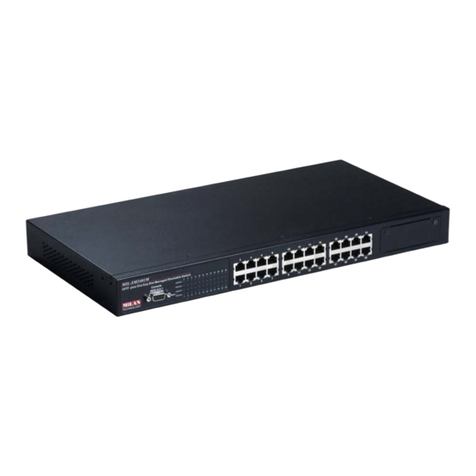
Lite/Unmanaged Industrial Gigabit Ethernet Switch Quick Installation Guide
7
Ethernet Interface Connecting (RJ45 Ethernet)
The switches provide two types of electrical (RJ45) and optical (mini-GBIC) interfaces.
Connecting the Ethernet interface via RJ45:
To connect to a PC, use a straight-through or a cross-over Ethernet cable,
To connect the IAS/IVS switch to an Ethernet device, use UTP (Unshielded Twisted Pair) or STP
(Shielded Twisted Pair) Ethernet cables.
The pin assignment of RJ-45 connector is shown in the following figure and table.
Pin Assignment PoE Assignment
1,2 T/Rx+,T/Rx- Positive VPort
3,6 T/Rx+,T/Rx- Negative VPort
4,5 T/Rx+,T/Rx- X
7,8 T/Rx+,T/Rx- X
Ethernet Interface Connecting the (Fiber, SFP)
For a 100 Mbps fiber port available, please prepare the LC connectors or SC connectors (with the use of
an optional SC-to-LC adapter). They are also available with multimode, single mode, long-haul (for
connections up to 120+ km) or special-application transceivers.
For a 1000 Mbps fiber port available, please use the mini-GBIC SFP (small form pluggable). These
accept plug in fiber transceivers that typically have an LC style connector. They are available with
multimode, single mode, long-haul (for connections up to 80+ km) or special-application transceivers.
For each fiber port there is a transmit (TX) and receive (RX) signal. Please make sure that the transmit
(TX) port of the switch connects to the receive (RX) port of the other device, and the receive (RX) port of
the switch connects to the transmit (TX) port of the other device when making your fiber optic
connections.
DANGER: Never attempt to view optical connectors that might be emitting laser energy.
Do not power up the laser product without connecting the laser to the optical fiber and
putting the cover in position, as laser outputs will emit infrared laser light at this point.