8DRAWMERTHREE-SUM OPERATOR’S MANUAL
Most conventional compressors work by processing the
full-band of the music, where the whole of the signal is
compressedusing the samecontrols,however,this is by
nomeansperfect.Aproblemoccurswhereby when apeak
occurs, such as the beat of a kick drum, all of the signal
is effectively "turned down" by the compressor, including
thevocals, guitar,hi-hatsetc. eventhoughthesemay not
needcompressing.Inaddition,whenprocessingcomplex
mixes using a conventional compressor, you can easily
reachthepoint wheregainpumpingbecomes audible,with
high-energy, low-frequency sounds affecting the gain of
thewholemix. Multi-band compressors were designed to
avoidtheseproblems, by treating different sections of the
frequencyspectrumindependently.
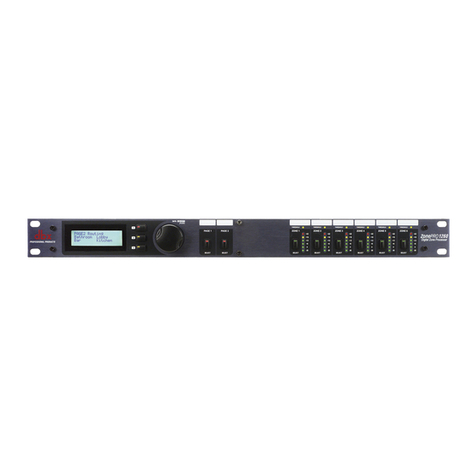
TheDrawmerThree-Sumhasbeen designed to allow the
audioto splitintothreeseparatefrequencybandsbymeans
ofacrossovercircuit,eachbandthenbeing treated with a
separatecompressorand,at the output,thevariousbands
areagaincombinedtoprovideafull-rangesignal.Inaddition,
unlikeconventionalthree bandcompressors,theDrawmer
Three-Sum allows the three signals to be sent to three
independentcompressors,eachgiving their own unique
flavour to the music - some warmer at bottom end
compression,othersprovidingan enhanced top end. The
control is entirely with the operator.
TheDrawmerThree-Sum, where eachband'scompressor
canbeadjusted separately,isavery versatileandpowerful
tool. For instance, the perceived amount of bass can be
increased by setting a higher ratio or lower threshold for
the bass band than in the mid and high bands. Similarly,
ifyoufeel themidfrequenciesof themixarelacking, simply
turnupthe outputlevelofthemid-band compressor-using
more compression in the mid-band can often help lift out
thevocals. Likewise, compress thetop end a littleharder
to give it more brightness or enhancement. If the gain
reductionofeach bandiscontrolledbyadjusting themake-
up gain knobs on each of the three
compressorsthen the overall levelsof
signal peaks will not increase but the
sound will be much more impressive.
However, no matter how much care is
taken,itisquitepossibleto fully control
thesignal in each band butstillendup
with a signal that is too high in level
when the bands are combined.
Therefore an output gain control has
beenprovidedontheThree-Sumtotrim
the whole stereo signal, followed by a fast acting limiter
that will catch any overshoots. To ensure transparency
the limiter design is ‘two stage’, applying different
processing to the H.F. content of the material. In
applications where the dynamics of the material need to
be retained to create an open sound, set the output gain
so that the limiter only activates on fast signal peaks.
Setting up the Cross-Over Points.
Which cross-over frequencies should be used? This
invariably depends on the material being processed, the
settings of a mix will be very different from that of a full
drumkit,howeverthegeneralruleofthumbisthatinmost
circumstancesthecross-overpointsneedto
besetinsuch a way as to separate themain
bassand treble sounds fromthemid-range.
Keeping in mind that instruments have
harmonics that can extend over several
octaves, the goal is to try to partition your
mixinto bands. Playyourmix, and mute the
bandsnotrequired.Nowyou canhearexactly
which frequencies are contained in each
band, and can tune in to the signal.
On a full mix the kick drums and bass instruments will be
mainly in the low band while the mid band should be set
wideenoughtoaccommodatethefullvocalrange,except
forperhaps the highest harmonicsand breath noises -
OPERATION CHAPTER 3