Dana User Manual
Page 5 of 28
Copyrights DSP4YOU ltd
1 3 Feature description
1.3.1 Digital Signal Processing
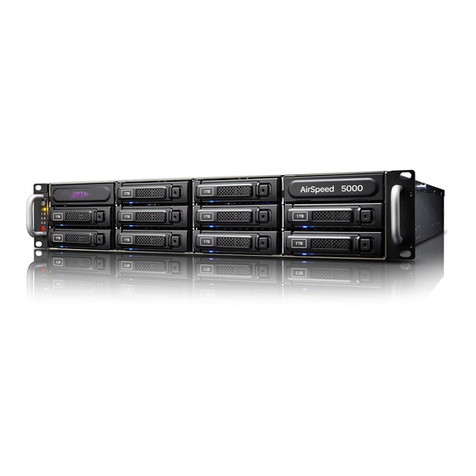
Dana Server is fitted with a powerful floating point Digital Signal Processor (DSP) providing the necessary processing
for most small to medium installations. Two types of Audio Digital Signal Processors currently exist on the market:
- Fixed DSP architecture where a manufacturer ships a processor with a unique processing signal flow. In 99%
of cases, such product bears the limitation of a fixed I/O architecture. Being a simpler product to design for
manufacturers, fixed DSP architecture come at a lower cost. The obvious limitation of such device is the
fixed DSP configuration of the product which manufacturers typical never modify. As the A/V installation
evolves (.e.g. more in/out), experience tells us that fixed DSP with fixed I/O processors do not scale well.
- On the other side of the spectrum, open DSP and flexible I/O architecture processors will provide the
extensive programming flexibility that is required for complex, large scale systems. Their ability to scale and
fit almost all applications however comes at the detriment of high cost and complex programming skills.
With Dana server, our engineering team designed a product at the crossroads of these 2 types of platforms by
providing:
- Flexible I/O configuration thanks to our 4 I/O slots and numerous AVB end points products
- Inter-changeable pre-configured fixed DSP architecture with plug&play configuration allowing simplicity of
use and simultaneously providing flexibility for a wide range of applications.
Template algorithms included on Dana servers include: Metering, Automatic Gain Control, Parametric equalizers, true
26 x 24 matrixing, Compressor/Limiter, delay, polarity. For more information about Dana server Audio DSP flow
diagram, please consult the plug-in section of the DSP4YOU website.
1.3.2 Audio Video Bridging
AVB defines a group of network protocols for the distribution of time synchronized and low latency Audio & Video
streams over IEEE8 2 networks. By leveraging a combination of existing 8 2 network technologies along with
standards specifically designed for the purpose, AVB technology lays the ground work for un-paralleled guaranteed
media streaming over Ethernet networks. The overall concept of AVB is actually rather simple. Without getting into
too much detail, the three core protocols specify:
- Timing and synchronization
- Bandwidth allocation through the Stream Reservation Protocol (SRP)
- Traffic shaping to ensure that low priority Ethernet traffic does not interfere with AVB traffic
Engineered from the ground up for media streaming applications, AVB has a definitive edge over legacy Ethernet
technology in the sense that it allows bandwidth allocation and priority rules based on timing. Unlike similar audio
over IP (AOIP) technology, AVB will dynamically assign and defend bandwidth allocation for AVB streaming thanks to
the concept of Stream Reservation Protocol (SRP).
Terminology for AVB streaming goes as follow:
o Audio Video Bridging (AVB): General descriptive for a group of protocols providing audio/ video streaming,
timing, synchronization, Quality of service (QoS) , control and discovery.
o AVB Endpoint: AVB powered device, capable of transmitting and/ or receiving audio streams using P1722/
P1733 transport protocol.
o Talker: AVB endpoint transmitting audio to the network. (Source)
o Listener: AVB endpoint receiving audio from the network. (Sink/ Destination)
o Talker/Listener: AVB endpoint that is both transmitting and receiving. All AVB endpoints used on Dana series
are by default Talker/Listener devices.
o Precision Time Protocol (PTP): Allows devices on the network to get a notion of global time in the effort to
synchronize with each other. PTP component in each AVB module can act as a Grand Master (providing
clock) or as a slave (receiving clock). Once a grand master negotiates and is selected as a sync source, all
units will synchronize to it.
o Streams: General term describing packetization of one or multiple audio/ video channels over the network.
Stream can be unicast or multicast. For the time being, the AVB module only supports unicast streaming.
Future revisions will provide additional features.
o Stream ID: Unique 64-bit stream identifier used by AVB transport protocols to identify streams.
1.3.3 Multi-track USB Audio playback/recording
Dana server not only innovates by introducing AVB at the core of our architecture, it also innovates with our multi-
channel playback/recording interface. Based on the USB 2. protocol, the USB audio card available for the Digital
Audio Interface slot can provide 8 channels of recording and 8channels of playback to a nearby PC/Mac machine.
The current maximum specifications for playback/recording are:
- Playback: 48kHz/ 24bit / Up to 8channels
- Recording: 48kHz/ 24bit / Up to 8channels
Refer to the USB audio card specifications for more information.