10
Check Your Chimney
This is a very important part of your heating system. It
must be clean, the right size, properly constructed and in
GOOD CONDITION. No boiler can function properly with a
bad chimney.
Installation must conform to the requirements of the
1.
authority having jurisdiction or, in the absence of such
requirements, to the National Fuel Gas Code, ANSI
Z223.1/NFPA 54, and/or Natural Gas and Propane
Installation Code, CAN/CSA B149.1.
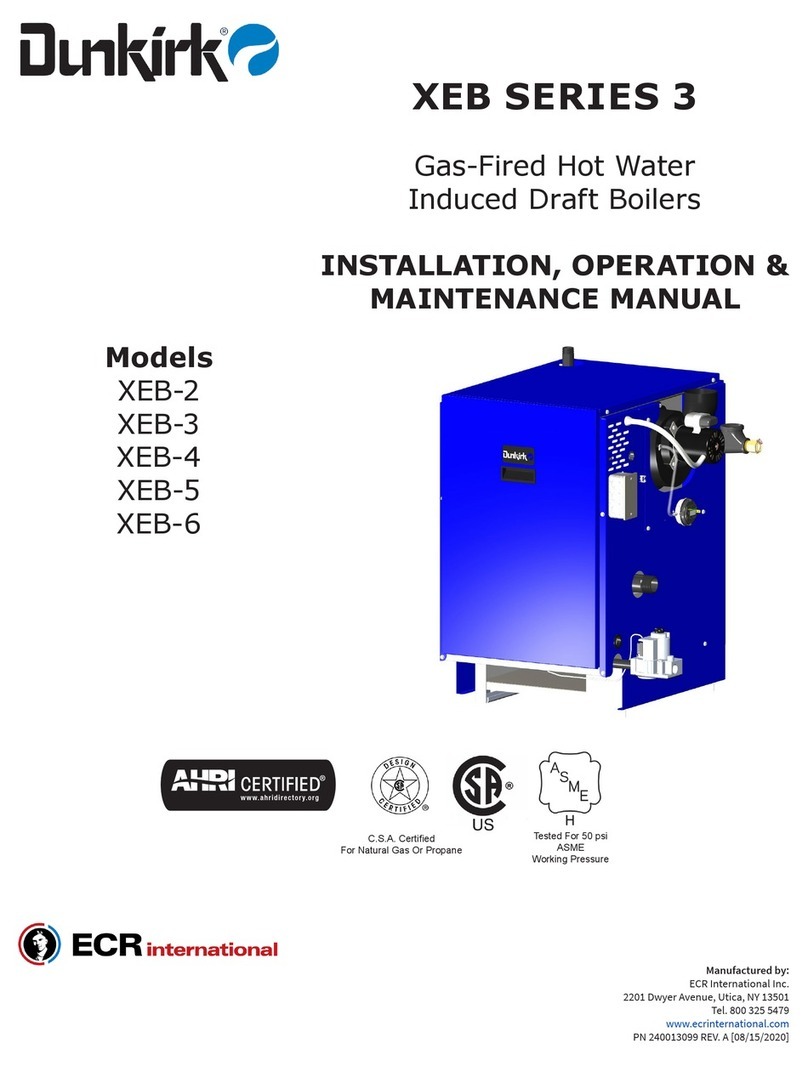
The boiler’s induced draft blower has a 3” outlet. A
2.
3” X 4” increaser tting is included in the parts bag.
Locate the increaser tting on the outlet of the induced
draft blower, and secure gas-tight with a bead of
the furnished silicone sealant. The increaser tting is
required on this boiler for Category I venting, and 4”
is the minimum permissible vent diameter. This does
not imply that the vent connector is intended to be
4” diameter pipe. The vent connector shall be sized
according to the appropriate venting tables in the
National Fuel Gas Code or the Canadian Installation
Codes, and may be required to be larger than 4”
diameter.
NOTICE
The boiler installation for chimney venting
is not complete unless the 3” x 4” increaser
tting is located and secured.
These are high efciency boilers with a low stack or
3.
exhaust temperature.
If venting into a masonry chimney without a liner, line
4.
the chimney from top to bottom with either:
Listed Type B vent pipe A.
Listed exible vent linerB.
Poured ceramic liner. C.
Outside chimneys should not be used unless they are
5.
(choose one of the following):
Enclosed in a chaseA.
Lined with Type B vent pipeB.
Use a listed exible vent linerC.
Use a certied chimney lining systemD.
The vent connector from the boiler to the chimney
6.
should run as directly as possible with as few elbows as
possible.
Where possible, it is recommended to common vent
7.
the water heater and boiler. Consult the appropriate
Vent Sizing Tables in either the National Fuel Gas
Code, or the Canadian Installation Codes for specic
requirements of multiple appliance venting.
If the boiler is the only appliance connected to the
8.
vent, Type B vent pipe is recommended for the vent
connector.
Slope pipe up from boiler to chimney not less than 1/4”
9.
per foot (21mm/m).
End of vent pipe must be ush with the inside face
10.
of the chimney ue. Use a sealed-in thimble for the
chimney connection.
The sections of vent pipe should be fastened with sheet
11.
metal screws to make the piping rigid. Use stovepipe
wires to support the pipe from above.
Do not connect to replace ue.
12.
Do not install a damper on this boiler.
13.
Minimum Vent Pipe Clearance
If the vent pipe must go through a crawl space, Type B
vent pipe should be used. Where vent pipe passes through
a combustible wall or partition, use a ventilated metal
thimble. The thimble should be 4 inches larger in diameter
than the vent pipe.
If boiler is installed with single wall vent, it must have
a 6” clearance between its surface and any combustible
material. A new Type B gas vent or exible liner must be
installed in accordance with the instructions furnished with
the vent. Maintain clearances as specied for the vent pipe.
Check the vent pipe to see if it is re-stopped where it goes
through the oor or ceiling. It should have an approved
vent cap with clearances from the roof as shown in
Figure
9
. If clearances are less than shown in
Figure 9
, have the
vent checked by local authorities.
Vent connectors serving appliances vented by natural draft
shall not be connected into any portion of mechanical draft
systems operating under positive pressure.
Removing Existing Boiler From Common Venting
System
When an existing boiler is removed from a common
venting system, the common venting system is likely to be
too large for proper venting of the appliances remaining
connected to it.
At the time of removal of an existing boiler, the following
steps shall be followed with each appliance remaining
connected to the common venting system placed in
operation, while the other appliance remaining connected
to the common venting system are not in operation.
Seal any unused openings in the common venting
1.
system.
Visually inspect the venting system for proper size and
2.
horizontal pitch and determine there is no blockage or
restriction, leakage, corrosion and other deciencies
which could cause an unsafe condition.
CHIMNEY & VENT PIPE CONNECTION