6
Placing Battery into Service
Battery voltage, specific gravities of each individual cell as well
as temperature of pilot cell should be taken and recorded prior
to battery being placed on charge. See Battery Maintenance
Report Appendix A
Proper charging is essential for maximum battery life.
A temperature compensated voltage regulated charger is
recommended to be used in renewable energy applications.
When a discharged battery is initially placed on charge,
it draws a current equal or close to the charger’s maximum
output. As the battery’s voltage rises, the charger output
should adjust to the changing voltage to assure a safe,
efficient charging rate during all stages of the charge.
A freshening charge at the absorption charge rate should
be given to a new battery before putting it into service. The
battery should be cool; less than 90°F (32°C), when it’s
installed. The battery should remain in equalize until the
specific gravity shows no change for a three-hour period
with readings taken hourly or a max. of 12 hrs.
Proper maintenance is essential to obtain long life and
maximum efficiency from any renewable energy battery.
Carefully following a scheduled maintenance routine will
help increase battery performance and prolong service life.
Maintain an accurate records system of battery cycles and
maintenance/repair work for each battery. A records system
is particularly important for operations that use a large
number of batteries.
f you don’t already have one, these procedures should help
you create a reliable records system:
1. Assign a code/identification number to each battery / cell.
2. Designate a “pilot cell” for each battery. Record the specif-
ic gravity, voltage and temperature of the pilot cell when
the battery is first received and equalized, and before and
after each charge. The readings taken on the pilot cell are
considered to represent the specific gravity, voltage and
temperature of all the cells. Always use the same cell for
the pilot cell. The pilot cell should be positioned near the
center of the battery and can be identified with a marking
of some sort on the intercell connector shroud or cell
cover.
3. At least once each month, measure and compare the
specific gravity of all the cells. The readings should be
uniform from cell to cell. f the specific gravity readings
fall 20 points (0.20) below the nominal specific gravity
reading of 1.250, the electrolyte levels should be checked
and brought up to a uniform level before checking for a
second time. f, at any time, the readings are 20 points
(.020) greater than the nominal specific gravity readings
of 1.250, or the range of the on-charge cell voltage
readings is more than 0.15 volts, the battery could be
showing signs of cell failure. Contact your authorized
East Penn Mfg Representative.
4. Remember to accurately record the number of cycles,
specific gravity, temperature and voltage readings; and
all maintenance and repair information for every battery.
Maintenance Report Appendix A is an example of a basic
record-keeping form.
BattEry maintEnancE
Batteries should be inspected periodically to avoid damage
resulting from previously undetected problems or improper
maintenance and operational procedures.
Look for:
• Corrosion on the tray, terminals or intercell connectors.
•Leaks or damage to the tray.
• Damaged cable leads, terminals or connections.
• Damaged, clogged or missing vent caps.
Repair or replace any damaged parts and thoroughly clean
the battery. n case of serious damage or for major repairs,
contact nearest authorized East Penn representative.
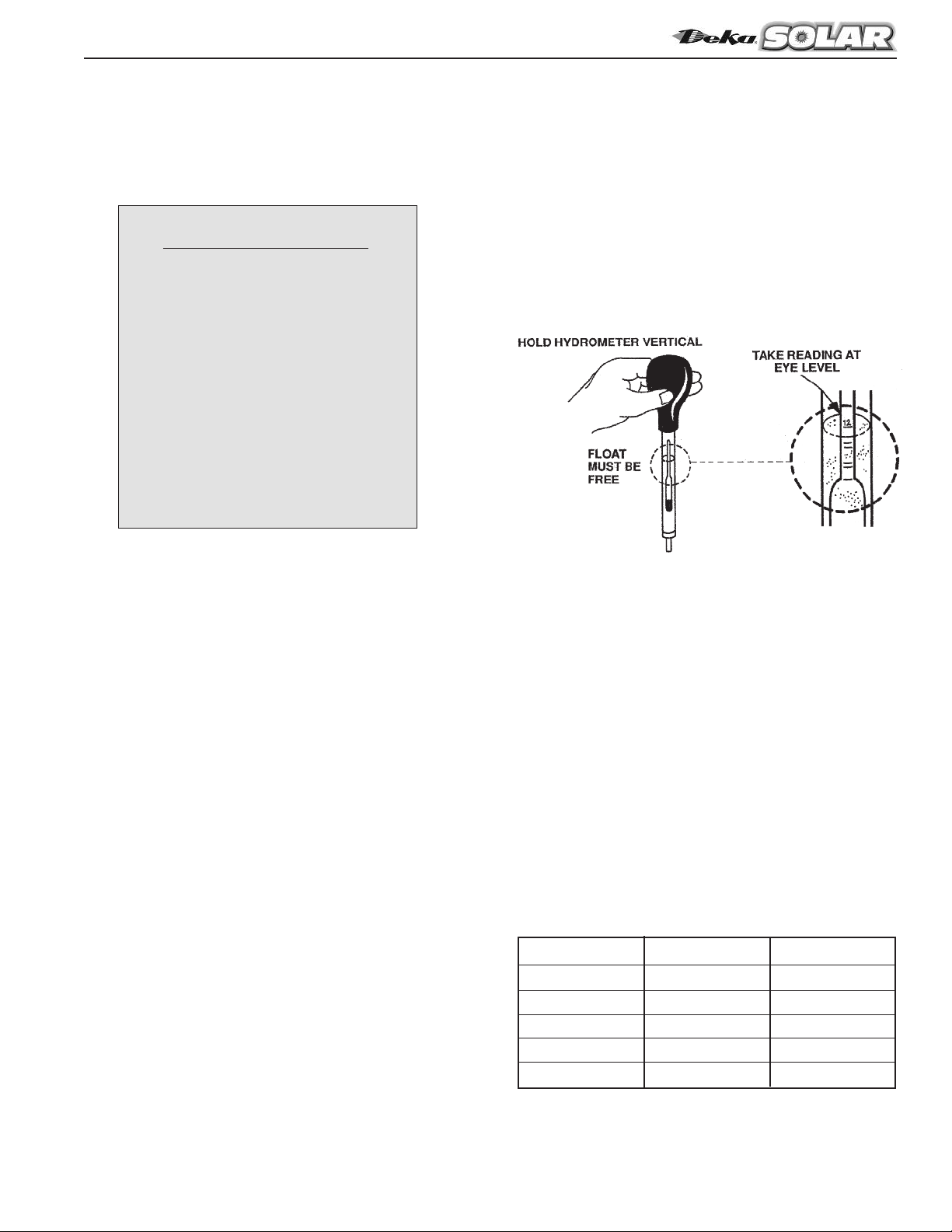
Before taking any specific gravity or voltmeter readings,
the battery should be fully charged. Take specific gravity and
voltage readings for each cell and record the readings on
your battery inspection form. Use the battery’s positive
terminal cell as cell #1 and follow the intercell connectors to
the last cell (the battery’s negative terminal cell). Look for
any unusual readings that might indicate a problem cell.
Neutralizing Acid and Electrolyte
For cleaning batteries, non-corrosive, water based battery
cleaning products are all that should be used. For user safety
and environmental regulatory compliance, the cleaning liquid
should contain no hazardous chemical ingredients. Even
some products labeled “Battery Cleaner” must be avoided
because of hazardous ingredients and damage to batteries
and related equipment.
Acid spills are common in battery rooms. When acid spills
occur it is critical to minimize:
1. Health and safety risk to personnel and the environment.
2. Damage to batteries, equipment,
and surrounding surfaces.
3. Time to neutralize, absorb, and clean-up.
4. Disposal costs of waste materials.
5. Regulatory compliance risks and fines.
Neutralizing acid absorbers and spill kits have the per-
formance attributes required when dealing with acid spills.
The ph neutral dry and non-hazardous waste is easy to
sweep-up and dispose as non-hazardous waste.
Adding Water/Adjust Electrolyte Levels
Batteries normally lose a certain amount of water due to
evapo-ration and electrolysis during charging. The electrolyte
level should be maintained at a ¼” below the bottom of the
vent well opening of the cover. t is important not to allow the
electrolyte level in any cell to drop below the top of the moss
guard, since low levels can damage the plates and shorten life.
t is equally important to avoid overfilling the cells, as
electrolyte will be forced out of the vent caps during charg-
ing onto the top of the battery, causing tray corrosion and
reducing battery capacity.
Only distilled or de-ionized water should be used to water
cells because certain impurities and chemicals found in tap
water can be harmful to batteries. Warranty may be affected if
water other than distilled or de-ionized is used.