GENERAL
It is recommended that servicingof this receiverbe done
by the factory service
center. Specialequipment and skills are
maintained at the factory to give fast and efficient serviceon
all of our products.
When retuming radio receivers to the factory for service,
include crystals, ac and dc power cables and telescoping
antenna. Disconnect cables
and antenna,pack carefully and
include a trrief. detailed description of the difficulty you are
having.
The receiver circuitry is designed to utilize the best
feafures of four types of semiconductors: rectifier diodes,
conventional bi-polar transistors, insulated-gate field-effect
transistorsand integrated circuits. Servicing
should not be
attempted by anyone who is not familiar with the manu-
facturer's recommendationsand cautions relating to each of
these
devices. The useof ohmmeters
is particularly hazardous
since they can deliver voltagesand currents large enough to
damagesemiconductors.
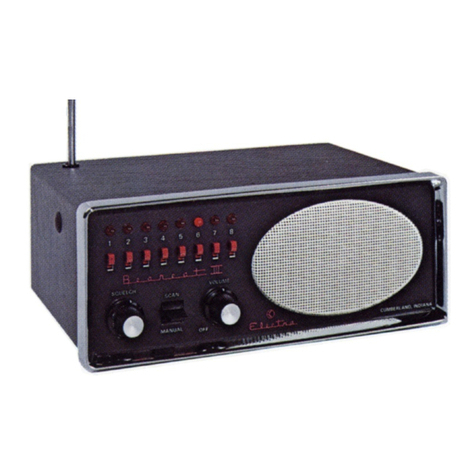
Unusual circuitry in this receiver includes the automatic
tuning system. I.C. No.1 and the associated
circuits generate
tuning voltagesto track the antenna, r-f and oscillator circuits
as channelsare scanned. Also, when the receiver is operating
in the "L" band,
loadingcoil L-l isswitched
into the telescop-
ingantenna
circuit.
Audio output power is measuredwith bursls of modula-
tion or by measuring the maxirnum excursion on voice
modulation asshorn on an oscilloscope. S'hen a continuous
tone is received.the output rrill start at full porverand then
decreaseto approximatel,v
half power to protect the output
inteEated circuit from overload. It rrill then retum to full
power for voicecommunications.
The LED indicators have a forward voltage drop of about
l.6v at 20ma. The current shouldnot exceed50ma. They are
polarized and may be damaged by a high reverse voltage.
When a channellamp doesnot light, the failuremay beeither
the lamp or the switchingI.C. If the channeln'orks,check the
lampi if not, check the I.C. [hen groupsof lamps are out.
refer to the losic chart.
TRACKEDTUNING
SYSTEM
All tuned circuits in the RF sections
are tuned by voltage-
variable capacitators which optimize the radio for eachcrystal
individually regardlessof where it falls in any band. This tun-
ing is done automatically and allows the Bearcat IV to tune
all parts of any band without compromise.
Tracked tuning is accomplished by meansof a DC voltage
applied
to YVCI . 2.3,4,5.6. This
voltage
varies
with crystal
frequencv and is higher for higher frequency crystals. It isad-
justed
br Tl. T2. Rl7 and
R52.
Facton- alignment
of the RF and trackedtuning system
in-
volves
highlv specialized
equipment and training not available
to nornral
senice activities.
Because
this unique feature is out-side
the experienceof
eren the most highlr- trained technicians.
theseadjustments
should onlv be made bv Electra.
BANDSWITCHING
SwitchesSWll-lB are used to select
the proper band for
eachchannel. Thesesn'itches,
the channelscanning
logic(IC6,
7.8.9) and hansistor
switches
QB, Qll, and Q13 generate
three l2\' bandswitch signals- U, U, and H. These
signals
select the proper RF section (VHF or UHF) and switch in-
ductors in the VHF section to select
L or H band. For any
selected
channel.the logic diagramisas
follows:
BandSelected 0=
OVDC
I =
12VDCL
H
t-/T
BA\DS\\'ITCHI\G FUNCTIONS
(Qtt) on
for L/T bandonly
l. SwitchesDBon(Grounds
TriplerTank)
2. Switches
QB
off
3. Switches
Q{ on (Shiftstuningvoltageupward)
{. SwitchesDl on (Shorts
antenna
loadingcoil)
5. -suppliesbiasroltagesto Ql, Q2, Q3
(UHF Section)
(QB) on for [, or H band
Suppliesdrain voltageto Q6 (VHF amplifier)
(Ql3) on for H band only
l. SwitchesDB on (Grounds
Tripler Tank)
2. Supplies
Gate 2 bias to Q7 (UHF \lixer)
3. SwitchesD5 andD6on(Shorts
outlow band
coils
L9andLl l)
4. Switches
Q4 on (Shifts tuning voltageupward)
SERVICING
I
I
0
0
I
0
0
0
I
U
-10-