SWITCHES:
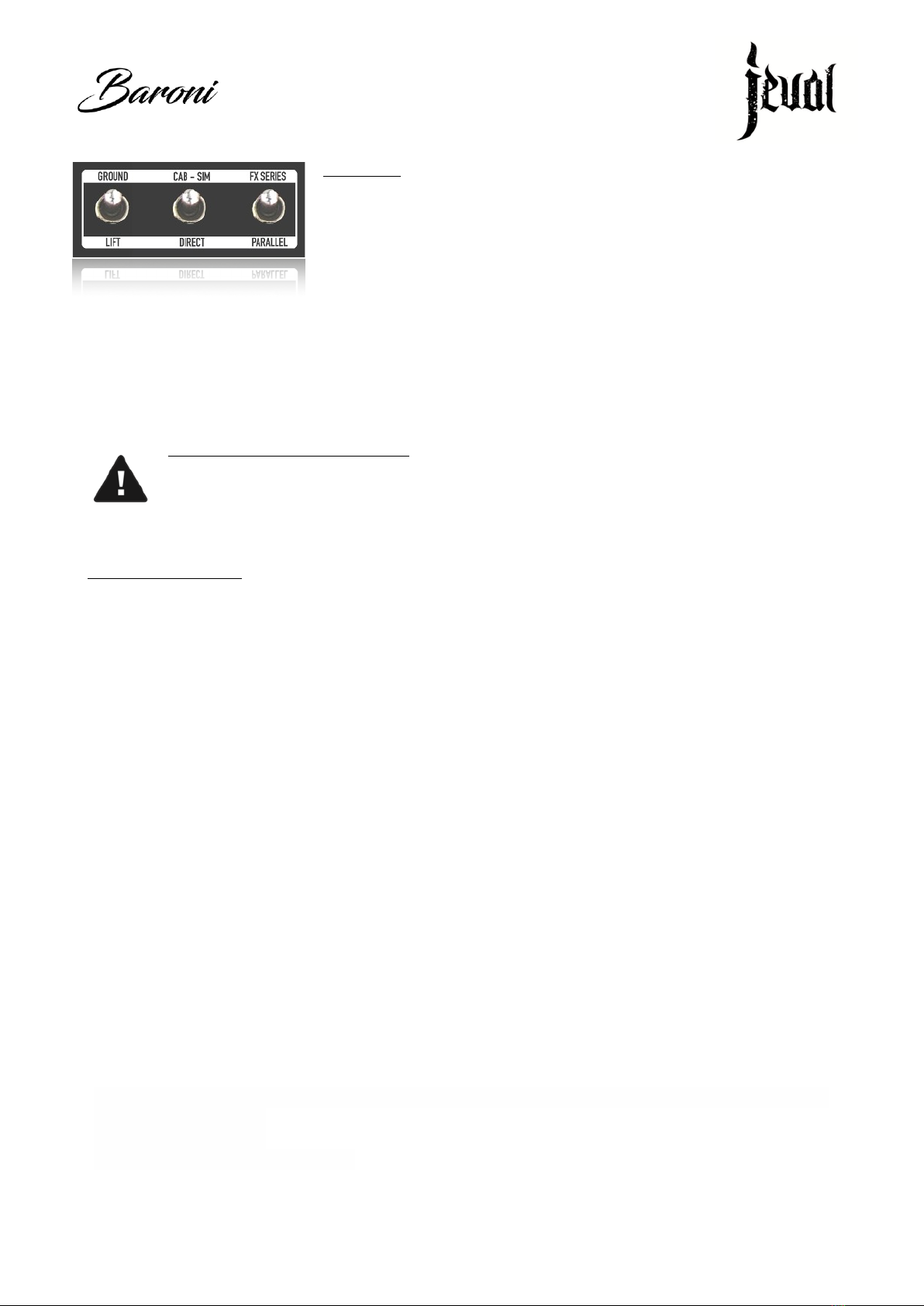
- Ground/Lift Switch: Useful to avoid ground loop when using Line Out
connected to other grounded devices.!
- CAB-Sim/Direct: JEVAL’s Line Out is equipped with a Cab-Sim based on a
2x12 loaded with Celestion V30 speakers with a Shure SM56 in front of it. The
Cab-Sim can be excluded by switching to Direct, when you want to use external plug-ins or IR devices to emulate other
kind of cabinets.!
- FX Loop Series/Parallel: JEVAL’s buffered Fx Loop let you choose between Series or Parallel mode. Parallel mode is
highly suggested when you are using a digital effect, to prevent it converting all your signal into digital. Using Parallel
mode your original signal will be kept intact and completely analog, just by adding the effect on it . (Please note that
some effect pedals has already a “parallel” mix control, and may have an inverted phase. Using it with JEVAL’s Loop in
Parallel Mode may cause Phase issues. Keep the loop in Series mode in this case.)!
SAFETY/USE RECOMMENDATIONS:
NEVER connect your JEVAL Speaker Outs to the input of an amplifier or any other devices, Speaker
out must to go STRAIGHT into a passive guitar cabinet, from 4 to 16Ohm. Connecting it to a
Grounded device, may cause serious damage. Use the LINE OUT instead. (it works simultaneously
with Speakers out, but AFK150 can be used even without a cab connected for silent playing/recording).
TIPS & SUGGESTIONS:
1) A solid state amp, like any other amplifier, is not magical and even if it has a very high efficiency rate, it can’t produce
more energy than what it takes from electric network to operate. It uses a portion of that energy to power its own
circuits, maybe some lights, there’s some loss due by transformers and other components, part of this energy is
converted in heating and that’s why no circuit has 100% efficiency. That said , The JEVAL is a REAL 150 W RMS (that is
a standard measurement “Root Mean Square”) and in order to produce that 150 W RMS @4 Ohm, it has a total
maximum consumption of 190W from your wall socket...The power consumption must always be indicated on a device
label so, please be sure check it. If your “Amp” is rated 200 W (often without mentioning which kind of Watts, there’s
“musical” Watts, PMPO Watts,..) and the max power consumption is “55W”, there’s something wrong .. you may have
bought a “magical” device, something not quite what it should have been .. Long story short: The max power
consumption must always be bigger than the power produced.!
2) A solid state amp’s total power halves when the impedance doubles. It means that the JEVAL can produce 150W rms
when connected to a 4 ohm cabinet, and goes down to 75 W rms @8 Ohm and 40W rms @ 16 Ohm. To calculate the
total impedance of your cabinet, remember that the impedance halves when 2 speakers are connected in parallel. (a
2x12” with two 8Ohm speakers connected in parallel gives you a total of 4 ohms.) We have equipped the JEVAL with 2
speakers output, already connected in parallel with each other, so you can connect two 8ohm cabinets to get a total of
4 Ohms and use your JEVAL at its full power to fit your needs in any situations.!
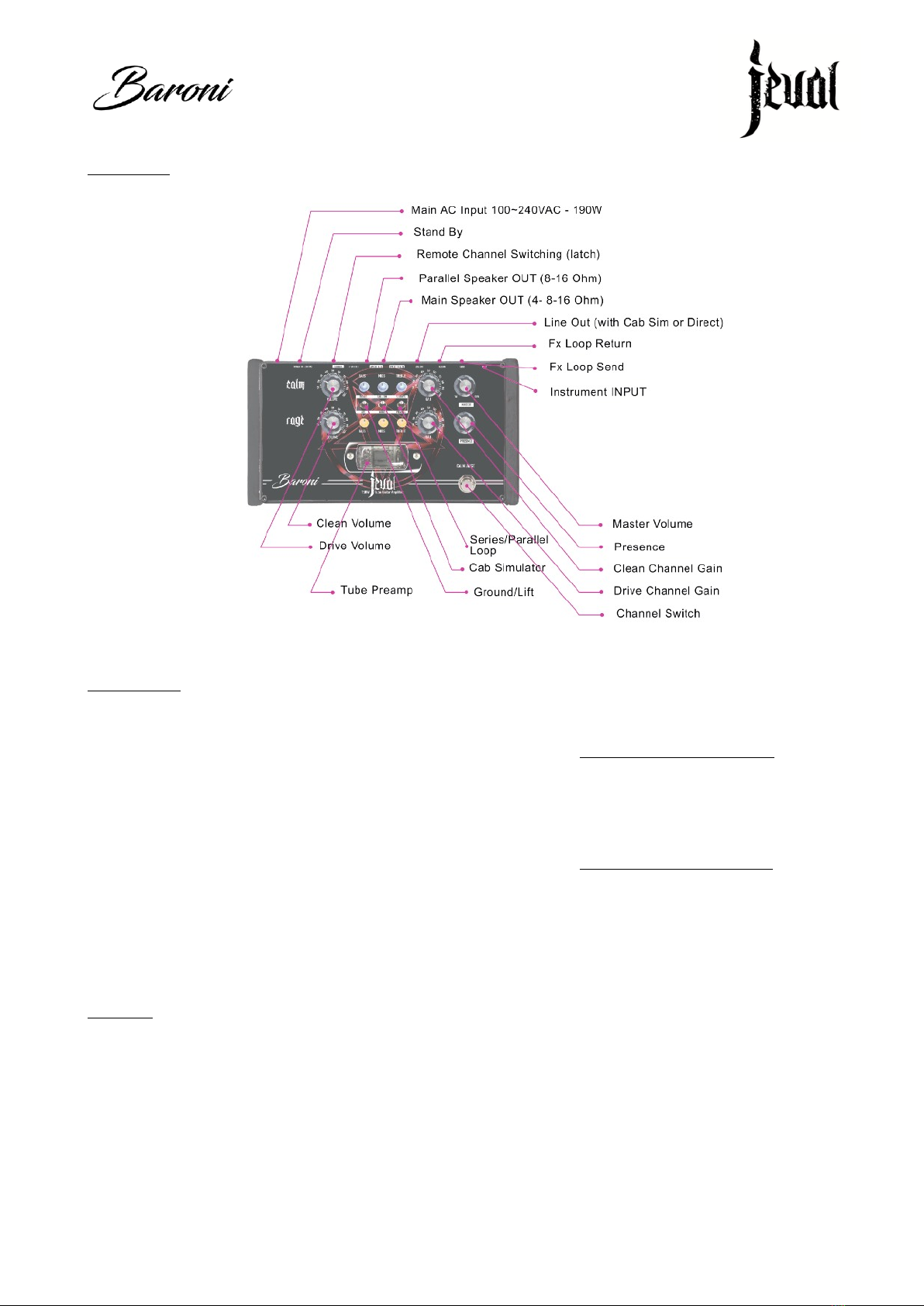
3) Stand-By switch shut down the power section to mute everything when you have to quickly swap guitar or anything
else, but the tube preamp is still powered, to prevent delay time during tube pre-heating and keep it ready to play. To
preserve tube long life, disconnect the power plug when you want to fully switch off the whole device.!