2
Set Up tips for best performance
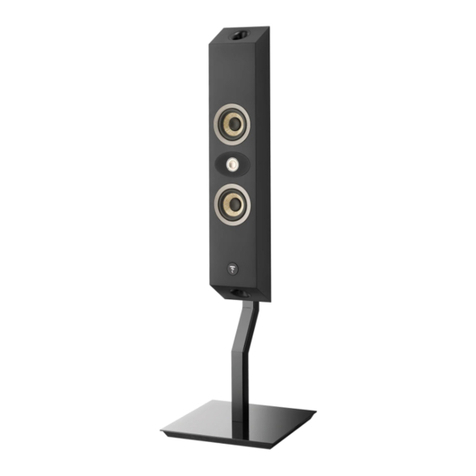
1. We highly recommend the matching stands for the ClaraVu monitors. They complete the elegant streamlined
look that can be proudly displayed in any décor and place the speakers at optimum height. You can add the
sub modules when you want to upgrade to a full range system. The following instructions refer to setup for a
full range system.
2. In placing the speakers in a room, there are several considerations:
a. Place the sub modules on a firm foundation. It is a good idea to use the included bubble leveler to
ensure the top plate of each stand is level. Use the adjustable spikes under the sub’s feet to level the
sub modules and monitors.
b. Place the included metal discs under the sub spikes on hardwood floor to protect it.
c. Place the monitor speaker on top of the sub module, aligning them to make an integrated system.
d. A good starting point for setting up speakers is using the golden rule, explained on this page on the
Internet:
http://www.cardas.com/content.php?area=insights&content_id=26&pagestring=Room+Setup
e. In general, an equilateral triangle set up where the listener’s position and the 2 speakers are at the
apexes of the triangle is a good starting point.
f. The distance between the 2 speakers should be at least 6 feet apart for good stereo channel
separation and imaging.
g. In some instances, a near field set up, with the distance between the listener and each speaker is less
than the distance between the 2 speakers, could work well. Experiment with the speaker toe-in to
fill in the middle of the soundstage image.
h. A good starting point for toeing is when the insides of the speaker cabinets are just visible from the
listener’s position.
i. For best results in soundstage depth, experiment with the distance from the speakers to the wall
behind them. Pulling them further out into the room will add more depth to the soundstage.
j. Toeing the speakers in and out with respect to the listener’s position can affect the width of the
soundstage image. Make sure that you achieve good channel separation with a strong center
image.
k. Moving the speakers closer to the wall can help to strengthen the bass. Pull the speakers away from
the wall can fix boomy bass problems.
3. The ClaraVu speakers are easy to set up but do take time to dial in the best position for them.
4. In some instances, turning the monitors upside down on the sub modules so that the tweeters are on the bottom
may help bass performance and soften the high frequencies. Experiment to see which suits you best.
5. There are five different ways to hook up the sub modules in a full range system:
a. Best option: connect speaker cables from main amp to the monitors, then jumpers from the monitors
to the lower posts of the subs. This way the best cables take the full signal to the monitors, then
passes it on to the subs. Very little signal is needed as the sub amps will amplify it. Adjustments to
the subs include crossover frequency, phase, and volume.
b. Second best option: if your preamp has two sets of lowe-level output, connect speaker cables to the
monitors and interconnects from the preamp to the line input of the sub. If the preamp has only one
set if outputs, use line splitter connectors to create two sets of outputs. This is requires longer run of
ICs which is typically less expensive than speaker cables.
c. Third best option: Biwire speaker cables to the top and bottom. This way, the monitors get the full
signal but through only half of the copper in the speaker cables. The subs get half of the copper
which probably is an overkill. Performance is very close to the second option but biwire speaker
cables tend to cost more.
d. Fourth best option: Speaker cables to the sub LOWER binding posts, then jumpers from the sub’s
UPPER posts to the monitors. In this option, it is an overkill to run expensive speaker cables to the
subs as it needs little signal and the use of a 125Hz. passive high-pass filter in the way probably
degrades the sound somewhat for the monitors. But you may choose this option if you have a very
powerful amp that may be overpowered for the monitors. Since only frequencies above 125Hz. Is
passed to the monitors, it lessens the impact on them.
e. Fifth option: Speaker cables to lower posts of the subs then jumpers to the monitors. This is just like
the first option in reverse but it is not as good since the monitors are getting the signal after the
jumpers. The first option is the preferred option.