OPERATING YOUR TRAVELER PORTABLE CHARCOAL GRILL
T-8
WARNING: Never add charcoal l ght ng flu d to hot or even warm coals
as flashback may occur caus ng severe burns.
Step 3
When charcoal is burning strong again, close the grill lid and allow
food to continue cooking.
DIRECT HEAT GRILLING
For most grilling, the ignited coals are spread in a single layer under
the food. This is called direct grilling and is appropriate for relatively
quick-cooking items such as hamburgers, steaks and most seafood.
The single layer of coals emits even, steady heat, whether the grill lid
is open or closed, and represents the way most people grill.
For more control, pile some of the coals on one side of the grill where
they will emit intense heat. You can move the food around on the grill,
setting it over the very hot coals when you want to sear it or when a
thick piece needs to cook a little more quickly. You can also use the
adjustable charcoal grate and dampers to control the temperature in
your grill.
INDIRECT HEAT GRILLING
For items that take longer to cook, you will want to use indirect grilling.
This method is for long, slow cooking in a covered grill. For indirect
cooking, the coals are piled two or three coals deep on one side of the
grill, or divided and piled on two sides. This leaves an empty space
next to the coals or between them. Food cooked over indirect heat is
often started over direct heat and then moved to the cooler (empty)
part of the grill for even, slow cooking.
To make the heat as even as possible, construct two piles of coals. It
is common to place a metal drip pan in the empty space beside or
between the coals, which is filled with water, wine, beer, broth, or a
combination. Place the food directly over the drip pan. This injects a lit-
tle extra moisture into the cooking environment and also catches drip-
ping juices, which makes clean-up a little easier and reduces the pos-
sibility of flare-ups.
GRILL MAINTENANCE
When finished cooking, and the unit has adequately cooled, clean out
all remaining ashes. Ashes collect moisture, which can lead to prema-
ture rusting and decay. Periodically coating the interior surfaces with
vegetable oil will aid in the protection of your unit.
Frequency of clean up is determined by how often your grill is used.
ake sure coals are completely extinguished before cleaning inside of
the grill. Thoroughly rinse with water and allow to air dry before using
again. Wipe out the interior of the unit with a cloth or paper towels.
ADJUSTABLE AIR VENTS
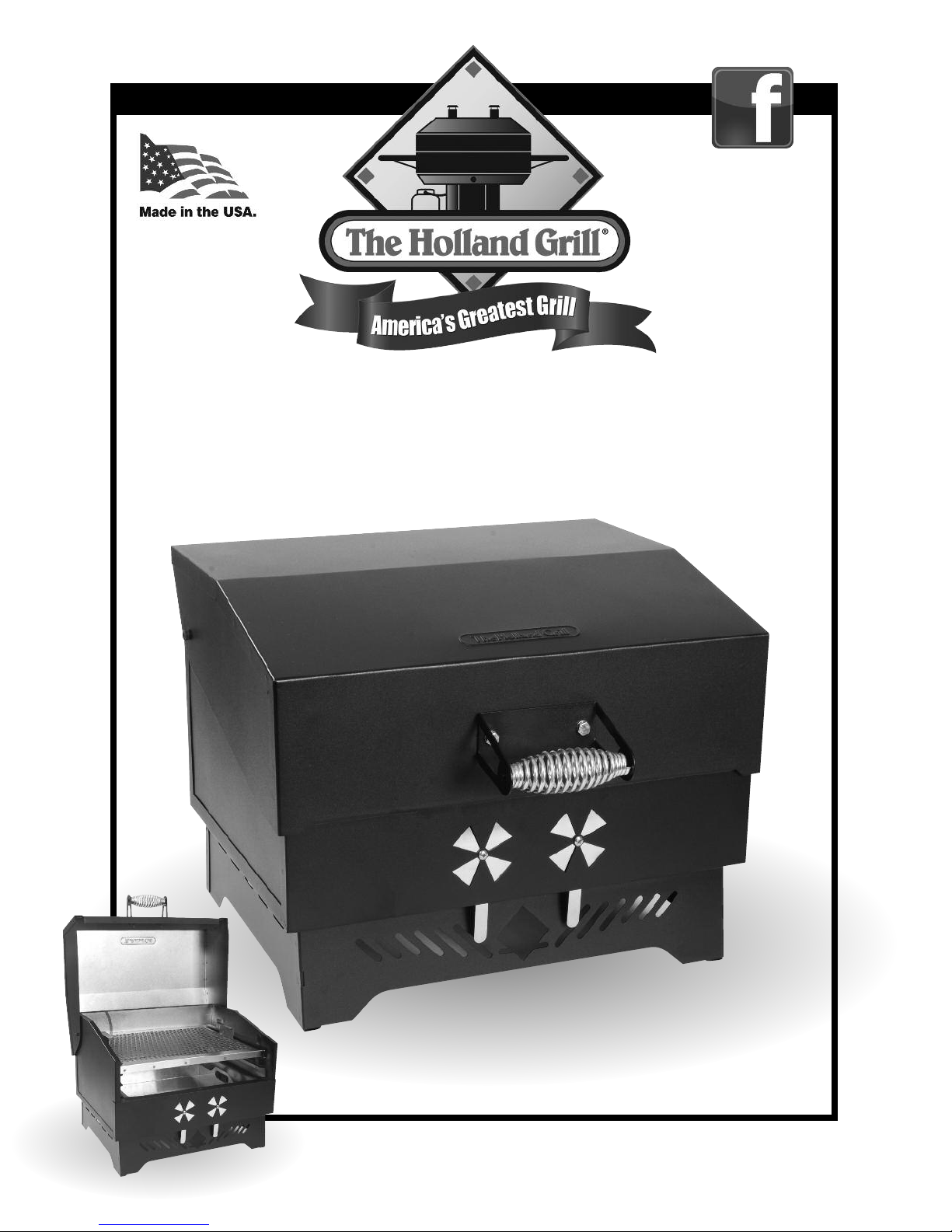
Two adjustable air inlet vents are located on the front of the grill. ove
the control handles to fine tune the amount of air entering the grill.
Open allows more air and the coals will burn hotter. Less air allows the
coals to burn longer.
WARNING: The vent control handles w ll be very hot when the gr ll s n
use. Use a gr ll m tt or your tongs to adjust.
FLAVORING WOOD
To obtain your favorite smoke flavor, experiment by using chunks,
sticks or chips of flavor producing wood such as hickory, pecan, apple,
cherry, or mesquite. ost fruit or nut tree wood may be used for
smoke flavoring. Do not use resinous wood such as pine as it will
produce an unpleasant taste.
Wood chunks or sticks 3" to 4" long and 1" to 2" thick work best.
Unless the wood is still green, soak the wood in water for 30 minutes
or wrap each piece in foil and tear several small holes in the foil to
produce more smoke and prevent the wood from burning too quickly.
A lot of wood is not required to obtain a good smoke flavor. A recom-
mended amount for the Holland Charcoal Grill is 5 to 6 wood chunks
or sticks. Experiment by using more wood for stronger smoke flavor or
less wood for milder smoke flavor.
Additional flavoring wood should not have to be added during the
cooking process. However, it may be necessary when cooking very
large pieces of food.
ADDING CHARCOAL DURING COOKING
Additional charcoal and/or wood may be required to maintain or
increase cooking temperature.
NOTE: Dry wood burns hotter than charcoal, so you may want to
increase the ratio of wood to charcoal to increase the cooking temper-
ature. Hardwood such as oak, hickory, mesquite, fruit and nut wood
are an excellent fuel because of their burning rate. When using wood
as fuel, make sure the wood is seasoned and dry. DO NOT use
resinous wood such as pine as it will produce an unpleasant taste.
Step 1
Stand back and carefully open grill lid. Use caution since flames can
flare-up when fresh air suddenly comes in contact with fire.
WARNING: Wear protect ve gloves or oven m tts when adjust ng cook ng
gr d he ght.
Step 2
Use cooking tongs to add charcoal and/or wood to charcoal tray, being
careful not to stir-up ashes and sparks.