Page 6
simple cabinet (with lower cost advantage), but
also with a very pure mid-range and extended
high frequency.
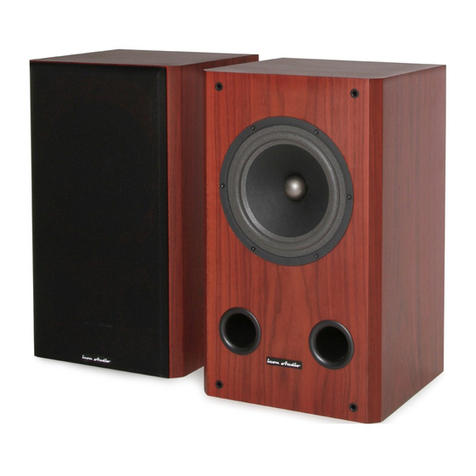
The final design the 8” FRm unit was achieved by
many hours of listening to many kinds of music
(mainly acoustic) and fine tuning by our listening
panel.
Any full range speaker will always have the
disadvantage of a frequency peak in the upper
midrange. To counter this we have used a very
simple circuit to attenuate this frequency peak so
the tonal balance is more linear. This is not a
crossover, instead it is a filter for the upper
midrange. This has the effect of raising the
impedance of the speaker and therefore limits the
output at certain frequencies, this way no power is
wasted, having the advantage with lower powered
amplifiers that this unused power is then available
for another frequency especially bass, thereby
improving the performance and lowering the
distortion of the amplifier.
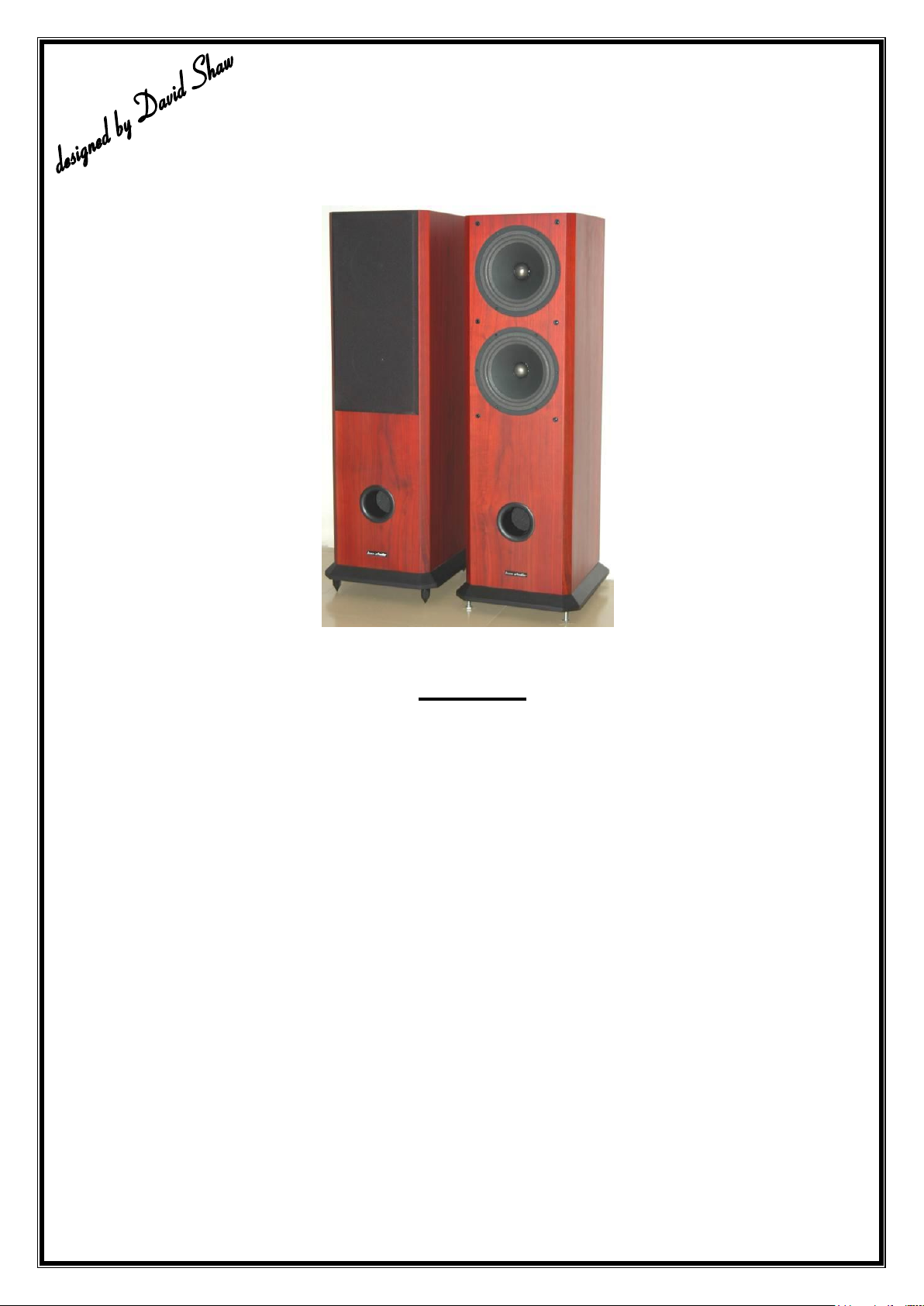
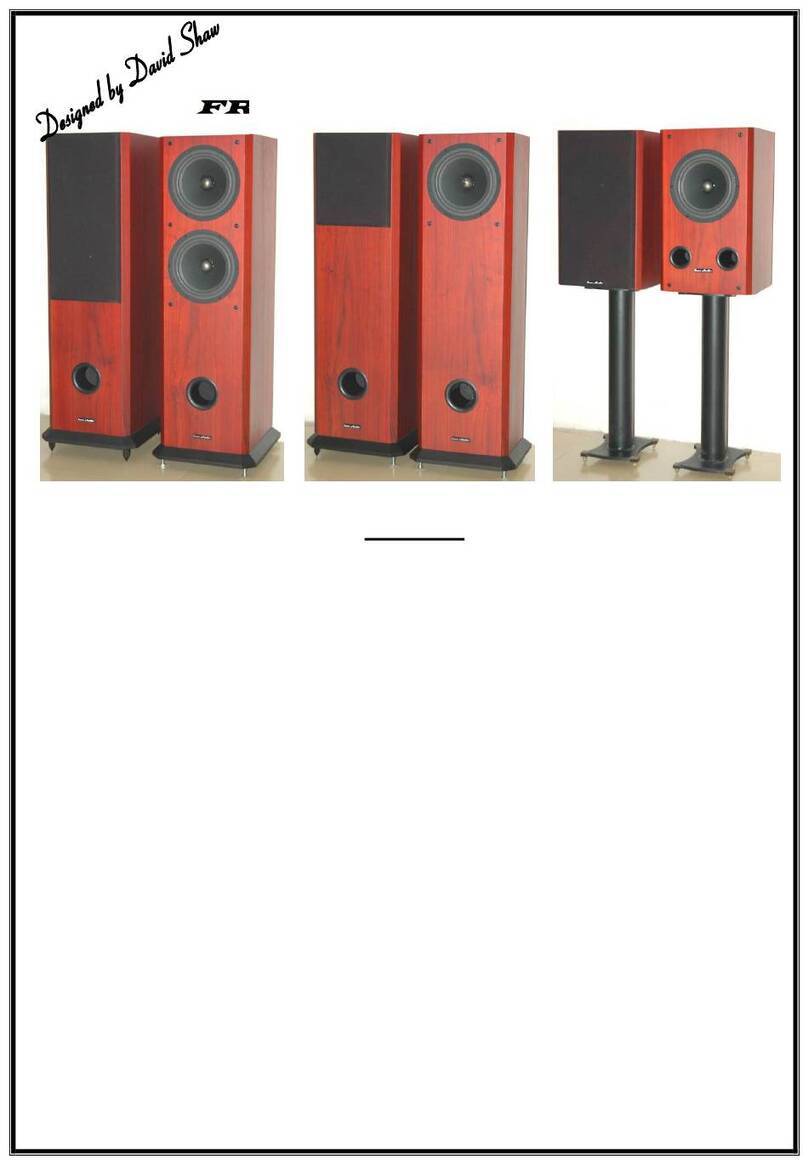
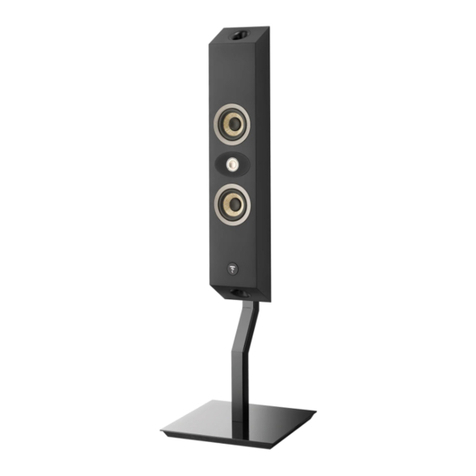
The FRm 3 is the largest of these systems having
two drive units, designed with larger rooms in
mind or where extended deep bass is important to
the listener. And if necessary with bigger
amplifiers capable of a very large sound output.
If you consider, full range loudspeakers have a
great deal to offer compared to a conventional 2
or 3 way. Going back to basics, the only reason a
loudspeaker has more than one unit is because
one has difficulty covering the whole audio
spectrum from which is normally thought of as
20Hz to 20,000 Hz. The reality is however that the
additional complexity of using more than one
speaker can cause problems in other ways which
although not as obvious as poor frequency
response, can make life difficult for the amplifier
driving the speaker, especially lower powered
valve amplifiers. For example a typical 2 way
speaker uses a larger speaker for bass and
midrange with a small dedicated “tweeter” to
reproduce the treble part of the spectrum. All well
and good you might say but if we consider exactly
what happens the problems in doing this become
more apparent:
If we ask a loudspeaker to reproduce a rising
frequency there will become a point where the
crossover will limit the energy being supplied to
the bass unit and will start to send it to the
tweeter. At that point both speakers will try to
reproduce that note and therefore there will be
distortion and confusion to the ear as time delay
and phase shift start to add distortion to the way
that frequency is reproduced. The result is not a
“bad” sound but a loss of detail in the stereo
image. The test equipment used by a
manufacturer will be looking for harmonic
distortion and a flat frequency response, so if the
speaker passes those tests it will be classed as
“good”. The reality is that we are not sending
simple frequency sweeps to a speaker, but
complex musical information. A single note from a
piano, violin, human voice etc will contain low,
medium and high frequencies which will be split
into two or three parts by the crossover for the ear
to put back together again. Now although the
frequency information will be correct some
essential phase and detail will either be lost or
misunderstood by the time the three parts are
separated by the crossover, reproduced by the
three speakers for our ears to try and understand
the original meaning.
Musical information which often consists of the
orchestra and singer(s). Obviously one device (i.e.
the microphone) is able to pick up all these
sounds at the same time as we use only one
microphone for the whole frequency range so a
“perfect” loudspeaker would behave in the same
way. But because is the “norm” to have a 2 or 3
way speaker most people assume that this is
essential. This is not true!
Our full range loudspeaker is specially developed
to reproduce the whole of the audible range of
sounds. You will immediately hear that this has a
kind of purity and immediacy that is lacking from
multi driver speakers.
In the past we have had experience working with
and making cabinets for full range loudspeakers
such as Fostex, Lowther and older Wharfedale
and Goodmans designs. These are still highly
regarded by many audiophiles as having qualities
which modern designs seemed to have lost.
What we are aiming to achieve with the FRm
series is a Full Range speaker that is a
combination of the best of old and new.
A small disadvantage of FRm 3 speakers is that
they are more directional than conventional
speakers because the treble radiator is “recessed”
in the cone. This is similar to Tannoy “Dual
Concentric” speakers and Electrostatic types. So
careful positioning is needed. When listening the
drive units should be at “ear level”. In some cases
it may be necessary to tilt the speakers back
slightly. This may be done by adjusting the spikes
lower at the back, or not fitting the rear spikes.
This will give increased definition of the sound
stage. You should then be able to “pin point”
instruments left, right and centre and even
“outside” the speakers with excellent “front-back”
definition as well.
Dynamic Range;
Due to the “no power wasted” design and the lack
of a “crossover” a much larger amount of the
amplifier power is converted into sound, giving a
dynamic range much larger than conventional
designs. This is especially noticeable when
comparing to electrostatic types.