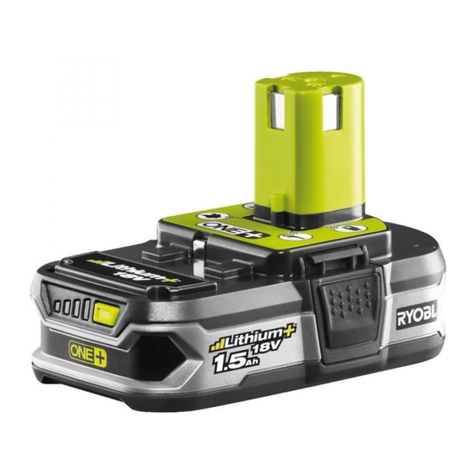
2Ah & 4Ah BATTERY INSTRUCTION MANUAL
1
GENERAL POWER TOOL SAFETY WARNINGS
The rating plate on your tool may show symbols. These represent important information about the product or instructions on its use.
1. SAVE THESE INSTRUCTIONS - THIS OPERATOR’S
MANUAL CONTAINS IMPORTANT SAFETY AND
OPERATING INSTRUCTIONS FOR KATANA® LI-ION
BATTERY PACKS AND THE LI-ION CHARGER.
2. BEFORE USING THE BATTERY PACK AND
CHARGER, READ THIS OPERATOR’S MANUAL, YOUR TOOL
OPERATOR’S MANUAL, AND ALL LABELS ON THE BATTERY
PACK, CHARGER AND TOOL.
3. CAUTION - TO REDUCE THE RISK OF INJURY, CHARGE LITHIUM-ION
PACKS ONLY IN THEIR LITHIUM-ION CHARGER.
Other types of chargers may cause personal injury or damage. Do
not wire a battery pack to a power supply plug or car cigarette lighter.
Battery packs will be prematurely fail.
4. USE LITHIUM-ION PACKS ONLY ON COMPATIBLE LITHIUM-ION
TOOLS.
5. AVOID DANGEROUS ENVIRONMENTS.
Do not charge battery pack in rain, snow, damp or wet locations. Do not
use battery pack or charger in the presence of explosive atmospheres
(gaseous fumes, dust or flammable materials) because sparks may be
generated when inserting or removing battery pack, possibly causing
fire.
6. CHARGE IN A WELL VENTILATED AREA.
Do not block charger vents. Keep them clear to allow proper ventilation.
Do not allow smoking or open flames near a charging battery pack.
Vented gases may explode.
7. DO NOT BURN OR INCINERATE BATTERY PACKS.
Battery packs may explode, causing personal injury or damage. Toxic
fumes and materials are created when battery packs are burned.
8. DO NOT CRUSH, DROP, OR DAMAGE BATTERY PACKS.
Do not use a battery pack or charger that has received a sharp blow,
been dropped, run over, or damaged in any way (e.g., pierced with a
nail, hit with a hammer, stepped on).
9. DO NOT DISASSEMBLE.
Incorrect reassembly may result in the risk of electric shock, f ire
or exposure to battery chemicals. If it is damaged contact KATANA
Customer Service.
10. BATTERY CHEMICALS CAUSE SERIOUS BURNS.
Never allow contact with skin, eyes, or mouth. If a damaged battery
pack leaks battery chemicals, use rubber or neoprene gloves to dispose
of it. If skin is exposed to battery fluids, wash with soap and water and
rinse with vinegar. If eyes are exposed to battery chemicals, immediately
flush with water for 20 minutes and seek medical attention. Remove and
dispose of contaminated clothing.
11. DO NOT SHORT CIRCUIT.
A battery pack will short circuit if a metal object makes a connection
between the positive and negative contacts on the battery pack. Do not
place a battery pack near anything that may cause a short circuit, such
as coins, keys or nails in your pocket. Do not allow fluids to flow into
battery pack. Corrosive or conductive fluids, such as seawater, certain
industrial chemicals, and bleach or bleach containing products, etc.,
can cause a short circuit. A short circuited battery pack may cause fire,
personal injury, and product damage.
12. STORE YOUR BATTERY PACK AND CHARGER IN A COOL
DRY PLACE.
Do not store battery pack where temperatures may exceed 40°C (104°F)
such as in direct sunlight, a vehicle or metal building during the summer.
Battery charger safety instructions
1. Before using the charger read all instructions and cautionary markings on
the charger, battery pack and the product using the battery pack.
2. This charger is not intended for any uses other than charging
rechargeable batter ies. Any other use may result in risk of re, electric
shock or electrocution.
3. Do not place any object on top of the charger or place the charger on a
soft surface that may result in excessive internal heat. Place the charger
in a position away from any heat source.
4. To reduce risk of damage to the electric plug and cord, pull by the plug
rather than the cord when disconnecting the charger.
5. Make sure the cord is located so that it will not be stepped on, tripped
over, or otherwise subjected to damage or stress.
6. An extension cord should not be used unless absolutely necessary. Use of
an im proper extension cord could result in the risk of re, electric shock
or electrocution.
7. Do not operate the charger if it has received a sharp blow, been dropped
or otherwise damaged in any way. Have it checked by an electrician or
power tool repairer.
8. Do not disassemble charger. Take it to an electrician or power tool repairer
when service or repair is required. Incorrect reassembly may result in a
risk of electric shock, electrocution or re.
9. To reduce risk of electric shock, unplug the charger from the outlet before
attempting any cleaning. Removing the battery pack will not reduce this
risk.
10. Never attempt to connect 2 chargers together.
11. DO NOT store or use the tool and battery pack in locations where the
temperature may reach or exceed 40ºC (such as inside sheds or metal
buildings in summer).
12. The charger is designed to operate on standard household electrical
power (240 volts). Do not attempt to use it on any other voltage!
13. The battery pack is not fully charged out of the carton. First read the
safety instructions and then follow the charging notes and procedures.
14. The longest life and best performance can be obtained if the battery pack
is charged when the air temperature is between 18 - 24ºC. Do not charge
the battery pack in an air temperature below 10ºC or above 40ºC. This is
important and will prevent damage to the battery pack.
15. Do not incinerate the battery pack even if it is seriously damaged or is
completely worn out. The battery can explode in a re.
16. Never attempt to open the battery pack for any reason. If the plastic
housing of the battery pack breaks or cracks, immediately discontinue
use and do not recharge.
17. During charging, the battery must be placed in a well ventilated area.
SYMBOLS
Do not use battery in conditions
above 40OC
Avoid & do not operate near or in
open flame.
Direct current, DC Contains Lithium Ion. Waste electrical
products should not be disposed of with
household waste. Please recycle where
facilities exist. Check with your Local
Authority or retailer for recycling advice.
Refer to instruction manual/booklet
General warning Avoid & do not operate near or in water.
220350(2Ah) / 220370(4Ah)