manuals.online logo
Brands
  1. Home
  2. •
  3. Brands
  4. •
  5. McElroy
  6. •
  7. Welding System
  8. •
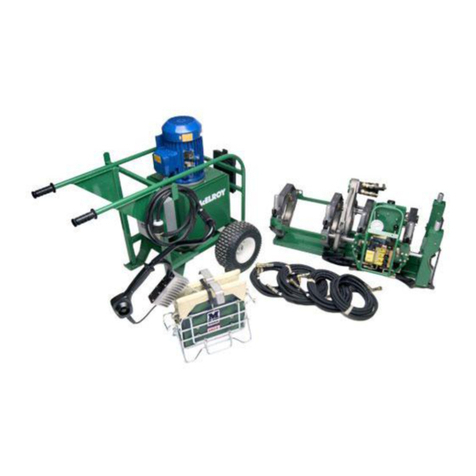
  9. McElroy T-500 I Series User manual

McElroy T-500 I Series User manual

This manual suits for next models

12

Other McElroy Welding System manuals

McElroy Pit Bull 28 User manual

McElroy

McElroy Pit Bull 28 User manual

McElroy Pit Bull 26 User manual

McElroy

McElroy Pit Bull 26 User manual

Popular Welding System manuals by other brands

Razorweld RAZORCUT45 instruction manual

Razorweld

Razorweld RAZORCUT45 instruction manual

Lincoln Electric Fleet 500 Operator's manual

Lincoln Electric

Lincoln Electric Fleet 500 Operator's manual

Migatronic OMEGA 220 quick guide

Migatronic

Migatronic OMEGA 220 quick guide

Magmaweld ID 300T DC user manual

Magmaweld

Magmaweld ID 300T DC user manual

Sealey POWERMIG Series instructions

Sealey

Sealey POWERMIG Series instructions

Defort 98291254 user manual

Defort

Defort 98291254 user manual

Hobart Welding Products AirForce 375 owner's manual

Hobart Welding Products

Hobart Welding Products AirForce 375 owner's manual

GF MSA 330 instruction manual

GF

GF MSA 330 instruction manual

Hakko Electronics FX-888D instruction manual

Hakko Electronics

Hakko Electronics FX-888D instruction manual

Abicor Binzel ABIPLAS WELD 100 W operating instructions

Abicor Binzel

Abicor Binzel ABIPLAS WELD 100 W operating instructions

EWM Taurus 355 Basic TDM operating instructions

EWM

EWM Taurus 355 Basic TDM operating instructions

Thermal Dynamics PakMaster 100 XL plus operating manual

Thermal Dynamics

Thermal Dynamics PakMaster 100 XL plus operating manual

Berner PLASMACUT 54 instruction manual

Berner

Berner PLASMACUT 54 instruction manual

Pro Spot PR-155 Assembly instructions

Pro Spot

Pro Spot PR-155 Assembly instructions

Forney 210 operating manual

Forney

Forney 210 operating manual

Thermal Arc 400S operating manual

Thermal Arc

Thermal Arc 400S operating manual

Lincoln Electric HANDYMIG 170I Operator's manual

Lincoln Electric

Lincoln Electric HANDYMIG 170I Operator's manual

GYS PROTIG 201 AC/DC Original instructions

GYS

GYS PROTIG 201 AC/DC Original instructions

manuals.online logo
manuals.online logoBrands
  • About & Mission
  • Contact us
  • Privacy Policy
  • Terms and Conditions

Copyright 2025 Manuals.Online. All Rights Reserved.

31
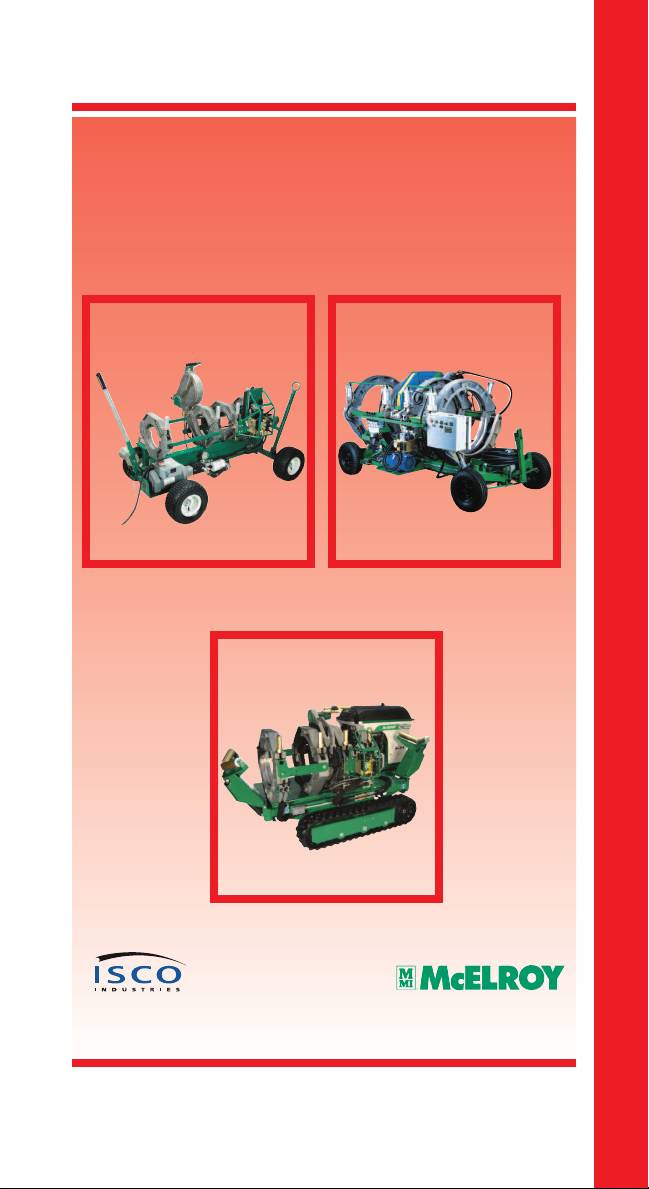
Hydraulic Butt Fusion Machine Procedure
© Copyright 2007 ISCO Industries, LLC All rights reserved.
Hydraulic Butt Fusion
Machine Procedure
ISCO Fusion Manual
32
Hydraulic Butt Fusion Machine Procedure
© Copyright 2007 ISCO Industries, LLC All rights reserved.
Hydraulic Butt Fusion Machine Procedure
The principle of heat fusion is to heat two surfaces to a designated temperature,
and then fuse them together by application of force. This pressure causes flow of
the melted materials, which causes mixing and thus fusion. When the polyethyl-
ene material is heated, the molecular structure is transformed from a crystalline
state into an amorphous condition. When fusion pressure is applied, the mole-
cules from each polyethylene part mix. As the joint cools, the molecules return
to their crystalline form, the original interfaces are gone, and the two pipes have
become one homogeneous unit.
The principle operations include:
Cleaning The pipe ends must be clean and free of any dirt,
debris or other contaminants
Clamping The pipe pieces held axially to allow all
subsequent operations to take place.
Facing The pipe ends must be faced to establish
clean, parallel mating surfaces perpendicular
to the centerline of the pipes.
Alignment The pipe ends must be aligned with each other to minimize
mismatch or high-low of the pipe wall.
Heating A melt pattern that penetrates into the pipe must be formed
around both pipe ends.
Joining The melt patterns must be joined with a specified force. The
force must be constant around the interface area.
Holding The molten joint must be held immobile with a specified force
until adequately cooled.
BUTT FUSION OF PIPES AND COMPONENTS WITH DIFFERENT
WALL THICKNESSES
When Butt Fusion is used to join pipes and other components together they must
have the same outside diameter and the difference between minimum wall thick-
ness dimensions for the two components being joined should not exceed 26%.
Example: You have a pipe or fitting that has a wall thickness of 25 mm (1”). You
can weld that pipe to pipes or fittings that have a wall thickness of 20 mm (3/4”)
min. or 32 mm (1-1/4”) max.
Important:
•The pipe line is only as strong as its weakest link.
•The fusion pressure used to join two different wall
thicknesses is always that of the thinner.
ISCO Fusion Manual
33
Hydraulic Butt Fusion Machine Procedure
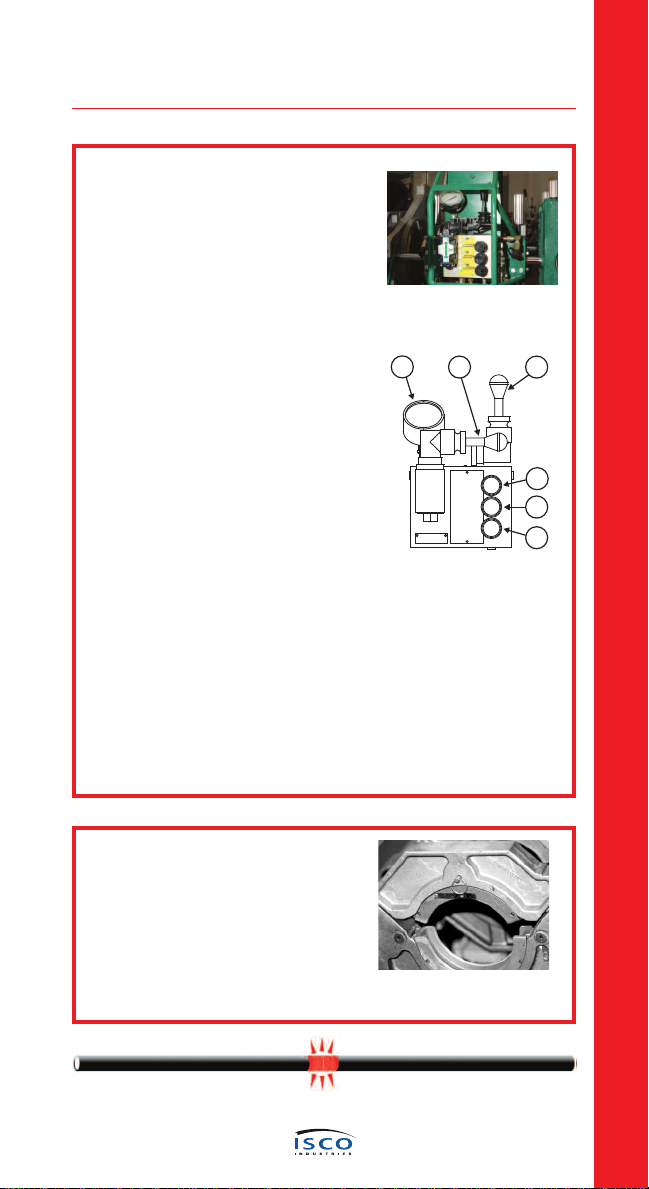
Hydraulic Manifold Block
Mounted on this block are a carriage directional
control valve, a selector valve, three pressure
reducing valves, and a pressure gauge.
A) The carriage control value, mounted on the
top of the manifold, determines whether the
carriage is moving left, right, or in neutral.
B) A pressure gauge is mounted on top of the
manifold.
C) The selector valve, mounted on the front of
the manifold, selects a pressure from one of the
pressure reducing valves. Each pressure reduc-
ing valve is labeled with a different function.
D) The top valve adjusts facing pressure,
normally 3 to 7 Bar (50-100 psi) gauge pressure.
E) The middle valve adjusts heating pressure,
always 0 Bar (0 psi) or backed all the way out
turning knob counterclockwise. The drag pres-
sure may have to be compensated for when working
with more than one joint of pipe on the movable side
or with tie-ins.
F) The bottom valve adjusts fusion pressure, this pressure
must be determined.
FACING 
HEATING
FUSING
BC A
D
E
F
Install Clamping Inserts
Select and install appropriate clamping
inserts for the pipe that is being fused.
© Copyright 2007 ISCO Industries, LLC All rights reserved.
ISCO Fusion Manual
34
Hydraulic Butt Fusion Machine Procedure
© Copyright 2007 ISCO Industries, LLC All rights reserved.
Hydraulic Butt Fusion Machine Procedure
Check Hydraulic Pressure
The pressure gauge on the manifold block indicates the pressure of the
carriage valve. How much pressure depends on the position of the selec-
tor valve and the pressure set on the specific pressure reducing valve.
With the selector valve up, the facing pressure can be set. It may be nec-
essary to adjust the carriage speed, while facing, with the top pressure-
reducing valve to control facing speed.
Shift the selector valve to the center position, heating, and set the pres-
sure reducing valve at its lowest setting, or the drag pressure, whichever is
higher.
With the selector valve in the down position, the fusion pressure can be
set.
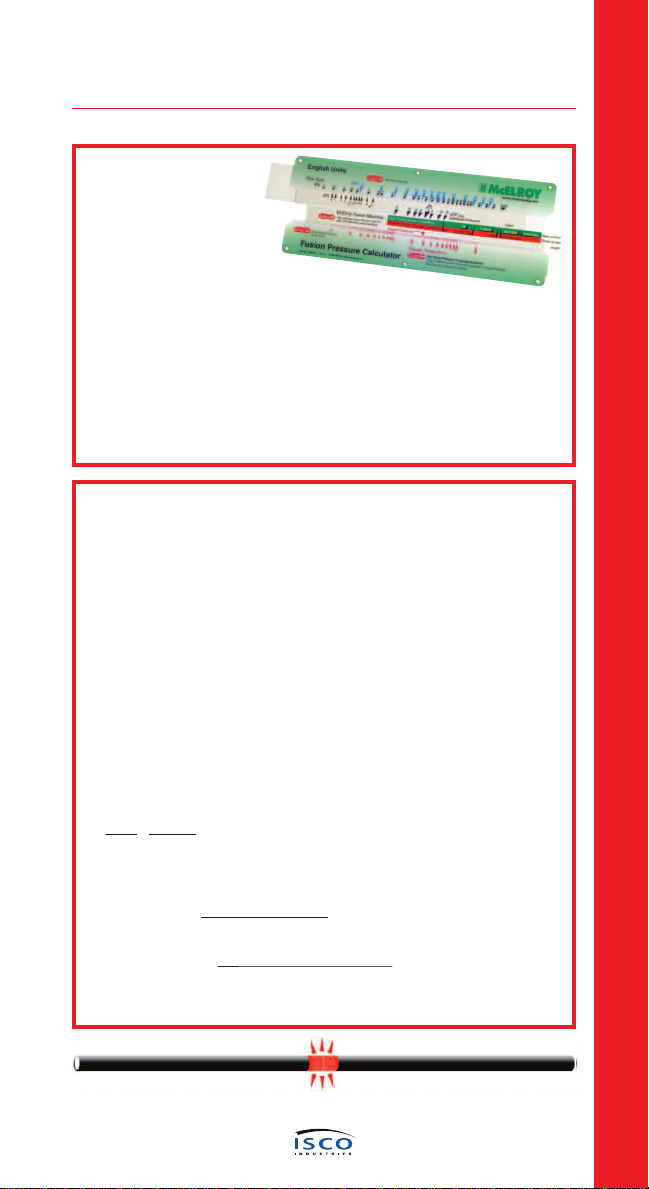
The fusion pressure can be calculated using the Fusion Pressure
Calculator (shown on the next page or by using the formula on the next
page, or they can be found in the reference section.)
An approximate 2 Bar (30 psi) drag factor should compensate for seal, and
pipe drag with one joint of pipe on a pipe stand. If additional lengths of
pipe are being moved by the movable jaws, the actual drag pressure should
be determined using the following procedure:
After facing the pipe, move the carriage so that the pipe ends are
approximately 50 mm (2") apart.
Shift the carriage control valve to the middle (neutral) position, select
the heating mode, and adjust the middle pressure reducing valve to its
lowest pressure by turning the valve counterclockwise.
Shift the carriage control valve to the left.
Gradually increase the pressure by turning the heating valve clockwise.
Increase the pressure until the carriage moves.
Quickly reduce the heating pressure valve counterclockwise until the
carriage is just barely moving.
Record this actual drag pressure.
Take the pressure, determined from the Fusion Pressure Calculator, and
add the actual measured drag pressure. This will be the actual fusion
pressure to set with the bottom pressure reducing valve. If fusion pres-
sures are used from the reference section, you must subtract 2 Bar (30
psi) drag, which is already figured in and then add the actual drag
pressure back.
Adjust the middle heating valve to show recorded drag so that pipe ends
will stay in contact with heater during heating phase.

ISCO Fusion Manual
35
Hydraulic Butt Fusion Machine Procedure
Fusion Pressure Calculator
Interfacial Pressure (IFP)
Minimum 4.1 Bar (60 psi)
Optimum 5.2 Bar (75 psi)
Maximum 6.2 Bar (90 psi)
Interfacial Pressure (IFP) = amount of force
per sq. inch of the surface area of the pipe end.
Interfacial Pressure (IFP) and Fusion machine
gauge pressure are not the same.
HHoowwttooUUsseetthheeFFuussiioonnPPrreessssuurreeCCaallccuullaattoorr
Step 1: Set DR at Pipe Size.
Step 2: Align McElroy Fusion Machine with IFP.
Step 3: Read Gauge Pressure at red arrow.
Step 4: Add Drag Pressure to gauge pressure.
Determining Fusion Pressure
Variable Definitions
OD = Outside Diameter
t = Wall Thickness
π= 3.1416
DR = Dimensional Ratio
IFP =Recommended Interfacial
Pressure (Shown Above)
TEPA = Total Effective Piston Area
DRAG = Force Required to Move Pipe
Example:
Using a McElroy No. 250 Standard Fusion Machine (Low Force, Yellow Cyl.)
OD of Pipe = 200 mm
DR of Pipe = 11
Recommended Interfacial Pressure = 5.2 Bar (75 PSI)
Measured Drag 2 Bar (30 PSI)
Formula: Wall Thickness
t =
TEPA = 1077 mm2(1.67 in2) (chosen from the table on page 36)
Gauge Pressure =
Gauge Pressure =
(200 - 18.2) x 18.2 x 3.14 x 5.2
1077 +2 = 52 Bar
(OD - t) x t x πx IFP
TEP A =DRAG
OD
DR =11
200 mm =18.2 mm
+
© Copyright 2007 ISCO Industries, LLC All rights reserved.
ISCO Fusion Manual
36
Hydraulic Butt Fusion Machine Procedure
© Copyright 2007 ISCO Industries, LLC All rights reserved.
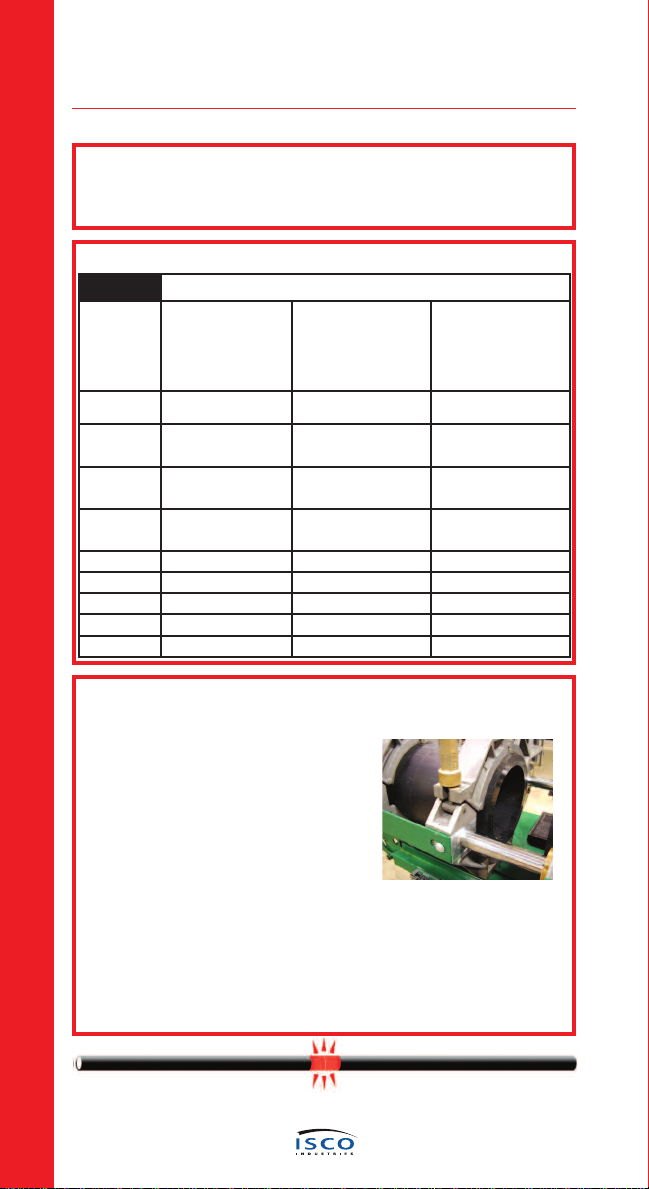
Loading Pipe Into Machine
((NNoo..441122aannddNNoo..661188UUsseeddIInntthheeFFoolllloowwiinnggIIlllluussttrraattiioonnss))
Clean the inside and outside of pipe
ends that are to be fused.
Open the upper jaws and insert pipe
in each pair of jaws with applicable
inserts installed.
Let the ends of the pipe protrude more
than 25 mm (1") *past the face of the jaws.
*This distance changes with fusion
machine type.
Tighten the clamp knobs on the outer jaws to prevent pipe slippage and
lightly tighten inner clamp knobs for possible later alignment adjustments.
Determining Fusion Pressure (Continued)
Hydraulic Butt Fusion Machine Procedure
TEPA = Total Effective Piston Area mm2 (in2)
Fusion
Machine
Model
High Force
Standard
(Green
Cylinders)
Medium Force
High Velocity
(Orange
Cylinders)
Low Force
Extra High Velocity
( Yellow
Cylinders)
250 or T-250 3039 (4.71) NA 1077 (1.67)
412 or
T-412 7600 (11.78) 3877 (6.01) 2026 (3.14)
618 or
T-618 7600 (11.78) 3877 (6.01) 2026 (3.14)
T-500 Series
I or II NA 3877 (6.01) NA
824 19000 (29.44) 9885 (15.32) 6097 (9.45)
1236 19000 (29.44) 9885 (15.32) 6097 (9.45)
T-900 19000 (29.44) 9885 (15.32) 6097 (9.45)
1648 20272 (31.42) 9123 (14.14) NA
2065 20272 (31.42) NA NA
N
No
ot
ti
ic
ce
e:
:
See Reference Section, pages 80-85, for fusion pressure charts show-
ing pressures precalculated to include 2 Bar (30 psi) for system drag.
ISCO Fusion Manual
37
Hydraulic Butt Fusion Machine Procedure
Facing The Pipe
Pivot the facer into place and secure.
Move the carriage to the right.
Open the ball valve on the facer
motor.
Assure the selector valve handle is
up in the facing position.
Move the carriage to the left.
If the facer stalls, adjust the facing
pressure so the facer continues to
cut.
IImmppoorrttaanntt:
When facing heavy wall pipe, it may be nec-
essary to increase the system pressure.
IImmppoorrttaanntt:
When drag pressure exceeds
20 Bar (300 psi) it is necessary to move the carriage
to the left bringing the pipe ends into contact
with the facer before opening the facer valve.
Let the carriage bottom out at the facer stops.
Turn the facer off. Move the carriage to the
right so the facer can be removed.
© Copyright 2007 ISCO Industries, LLC All rights reserved.
ISCO Fusion Manual
38
Hydraulic Butt Fusion Machine Procedure
© Copyright 2007 ISCO Industries, LLC All rights reserved.
Remove Facer
Pivot the facer out to the storage position.
Remove chips from pipe ends, careful not to
touch faced pipe ends.
If faced pipe ends are touched, use clean
non-synthetic cloth to clean affected area
before proceeding.
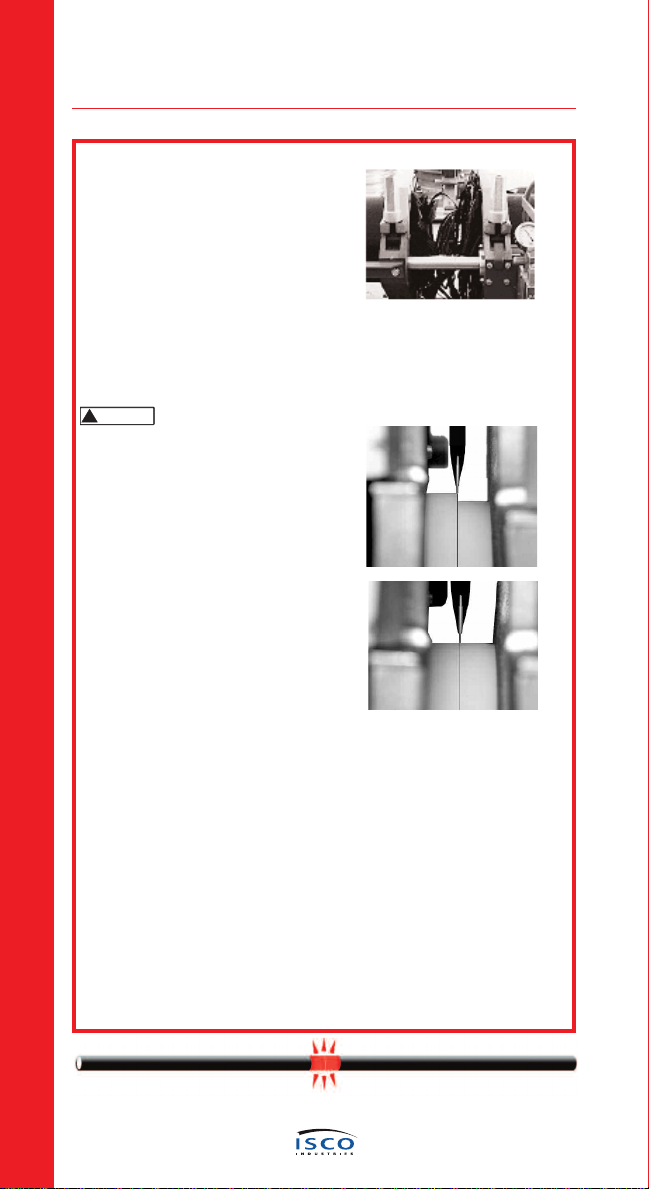
Move the carriage to the left until
ends of pipe butt together. Check pipe joint for
proper alignment.
Do not use finger to check
for hi/low (misalignment). The unit is
under pressure, and slippage could result
in crushed fingers. Always keep hands
clear of the jaw area.
If pipe is not lined up, tighten the inner
high side jaw to bring into alignment.
Important:
Always tighten the side that
is higher, never loosen the low side.
When the pipe is properly aligned
tighten outside clamps to insure
against slippage.
If clamp knob adjustment has been made,
reinstall facer and begin facing procedure again.
Let the carriage bottom out on facer stops.
Turn facer off. Move the carriage to the right
so the facer can be removed.
Remove chips from pipe ends careful not to
touch faced pipe ends.
Bring the pipe ends together under fusion
pressure to check for slippage. If slippage
occurs, return to Loading Pipe Into Machine
on page 36.
NNoottiiccee::
Their should be no more than 10% of the wall
thickness in misalignment to maintain full joint strength.
Hydraulic Butt Fusion Machine Procedure
WARNING
!
ISCO Fusion Manual
39
Hydraulic Butt Fusion Machine Procedure
CChheecckkHHeeaatteerrTTeemmppeerraattuurree
Incorrect heating temperature
can result in questionable fusion joints. Check
heater plates periodically in multiple locations
with a pyrometer and make necessary
adjustments.
For butt fusion heater surface temperature
should be Minimum 205°C (400° F), Optimum
218°C (425° F), Maximum 230°C (450° F).
IImmppoorrttaanntt::
The dial thermometer on the
heater indicates internal temperature.
The dial thermometer can be used as
reference once the surface temperature has
been verified.
Position Carriage For Heater Insertion
Move carriage to the right to open a gap large
enough to insert the heater.
Hydraulic Butt Fusion Machine Procedure
CAUTION
!
FACING
HEA TING
FUSING
Select the Fusion Position
Move selector valve handle down to the
fusing position. Use fusion pressure
required from Fusion Pressure Calculator
or the formula on page 35 . Also see
Reference Section, page 80-85.
FACING
HEA TING
FUSING
© Copyright 2007 ISCO Industries, LLC All rights reserved.
ISCO Fusion Manual
40
Hydraulic Butt Fusion Machine Procedure
© Copyright 2007 ISCO Industries, LLC All rights reserved.
Heating The Pipe
A) Move the carriage to the left under the
fusion pressure, bringing the heater into
contact with both pipe ends, seating pipe
ends against heater. At first indication of
melt around circumference of pipes, move
to step B.
B) Move selector valve to center position,
allowing pressure to drop and stabilize at
lowest setting, in most cases “0”. When fusing
more than one pipe length on the movable side
of the fusion unit, drag must be compensated for.
C) Return carriage control valve to
neutral (middle) position. The pipe ends
are now heating at “0” pressure or the pressure
to compensate for drag, allowing the pipe ends to remain
in contact with the heater.
IInnsseerrttiinnggHHeeaatteerr
Heater is Not Explosion Proof.
Operation of heater in a hazardous
environment without necessary safety pre-
cautions could result in explosion and
death.
If operating in a hazardous environment,
heater should be brought up to temperature
in a safe environment,then unplugged before
entering the hazardous atmosphere for fusion.
Use a clean non-synthetic cloth to
clean the butt fusion heater adapter
surfaces.
Check heater plates for coating damage,
plastic buildup rings and surface imperfec-
tions. These conditions could cause a poor
fusion. Replace them if conditions exist.
Verify heater temperature noting the
reading on the dial thermometer.
Insert heater between the pipe ends.
Hydraulic Butt Fusion Machine Procedure
!DANGER
FACING
HEA TING
FUSING
A
FACING
HEA TING
FUSING
B
FACING
HEA TING
FUSING
C