1017 User Guide 3
Relays
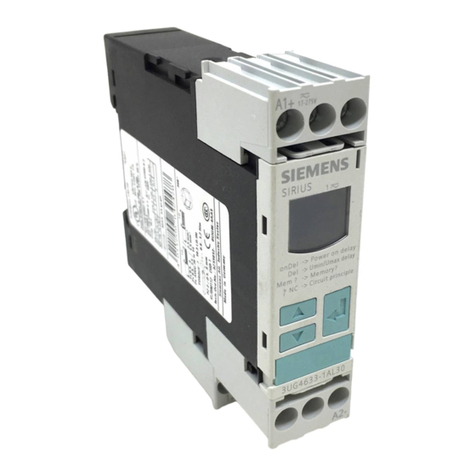
A relay is an electrically-controlled switch. Although many types
of electrical switches exist, a relay’s mechanical nature gives it the
advantage of reliability and current-switching capacity. The main
disadvantage to using mechanical relays is their limited life-span,
as opposed to solid state relays who do not suffer from this
drawback. For more information, check the Mechanical Relay
Primer and the Solid State Relay Primer.
Using a Digital Output Relay
Relays have a connection scheme determined by the arrangement
of contacts within the relay. Because relays are a type of switch,
they are defined in the same way other electromechanical switches
are defined.
In switch schemes, the number of poles represents the number of common terminals a switch has, and the number of
throws represents the number of switchable terminals that exist for each pole. The relays used in the InterfaceKit
0/0/8 are DPDT relays: double pole, double throw. The internal construction of this type of relay is depicted in the
diagram above. Many other types of relays exist: SPST, DPDT, and DPST, to name a few.
In a relay, one of the throw terminals is labelled Normally Closed (NC), and the other is labelled Normally Open
(NO). As the name indicates, the normally closed terminal is the terminal connected to common when the relay coil
is not powered. When the relay coil is energized by the relay control circuit, the electromagnetic field of the coil
forces the switch element inside the relay to break its contact with the normally closed terminal and make contact
with the normally open terminal. The switch element would then connect the normally open terminal and the
common terminal.
Rated Current/Voltage/Power
These relays cannot be switched at maximum current and maximum voltage at the same time. Ensure that the total
power of the load does not exceed the switching power of the relay. For example, you can switch these relays at
200V DC and 0.3 A (60W), or 30V DC and 2A (60W), but not 200V DC and 2A (400W).
Wetting Current
When a relay is in one switch position for a period of time, oxidation of the open contact(s) can occur. Depending
upon the internal coating material of the contacts, oxide films of varying density will be displaced upon the surface
of open contacts; this film acts as an insulator to current flow. When the relay is switched, a certain amount of
current flowing through the contacts, known as the wetting current, is required to remove the film of oxides and
ensure proper conduction. The wetting current required to operate this relay is low enough for use in signal switching
applications. Check the specification table for your relay board to find out the Minimum Load Current ("Wetting
Current").