c) Do not continue to attempt jump starting if the vehicle will not start
after 5 attempts. In this instance, have the vehicle serviced by a me-
chanic as the problem is likely beyond a discharged battery.
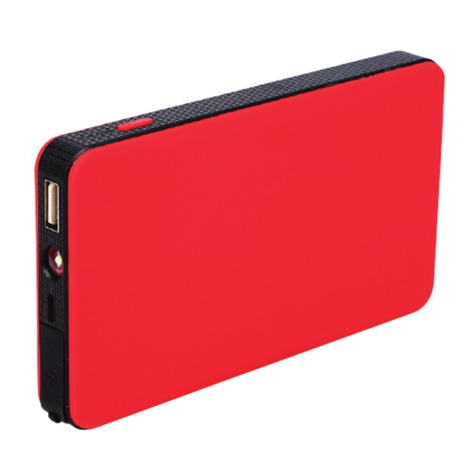
4. Disconnect cable from Jump Starter
Once the engine has been successfully started, then disconnect the
10a Smart connector from the Jump Starter.
a) If your engine is still running after disconnecting the Jump Starter,
and you are aware of the reason why your main battery was drained,
drive your vehicle as normal and your alternator should recharge your
main battery. On the other hand, if you are unaware as to the reason
your main battery lost it’s charge, please drive your vehicle directly
home or to a service station. Proceed to step 5.
b) If your engine stops running immediately after removing the 10 Smart
jumper cable, it is likely that your main battery is no longer able to
hold a charge, or that you do not have a properly functioning alternator.
In this instance, you may use the Jump Starter as a temporary
replacement for your main battery. Leave the Jump Starter connected
to your main battery, and drive your vehicle directly home or to a ser-
vice station. Depending on the size of the vehicle and the electrics in
use, you can expect to drive over 60 miles (100 KM) with a fully
charged Jump Starter.
5. Disconnect clamps from battery
First disconnect the 10d Negative (-) clamp and then finally the
10c Positive (+) clamp from battery terminals.
Please be aware that the Jump Starter is not intended to be used as a
permanent replacement for your main battery. Lastly please note that
your vehicle's alternator will not recharge the Jump Starter.
6