MAINTENANCE
Make sure that the machine is not live when car-
rying out maintenance work on the motor.
These machines have been designed to operate over a
long period of time with a minimum of maintenance.
Continuous satisfactory operation depends upon pro-
per machine care and regular cleaning.
Cleaning
Keep the ventilation slots of the machine clean to pre-
vent overheating of the engine.
Regularly clean the machine housing with a soft cloth,
preferably after each use. Keep the ventilation slots free
from dust and dirt.
If the dirt does not come off use a soft cloth moistened
with soapy water. Never use solvents such as petrol,
alcohol, ammonia water, etc. These solvents may
damage the plastic parts.
Lubrication
The machine requires no additional lubrication.
Faults
Should a fault occur, e.g. after wear of a part, please con-
tact your local Powercraft dealer.
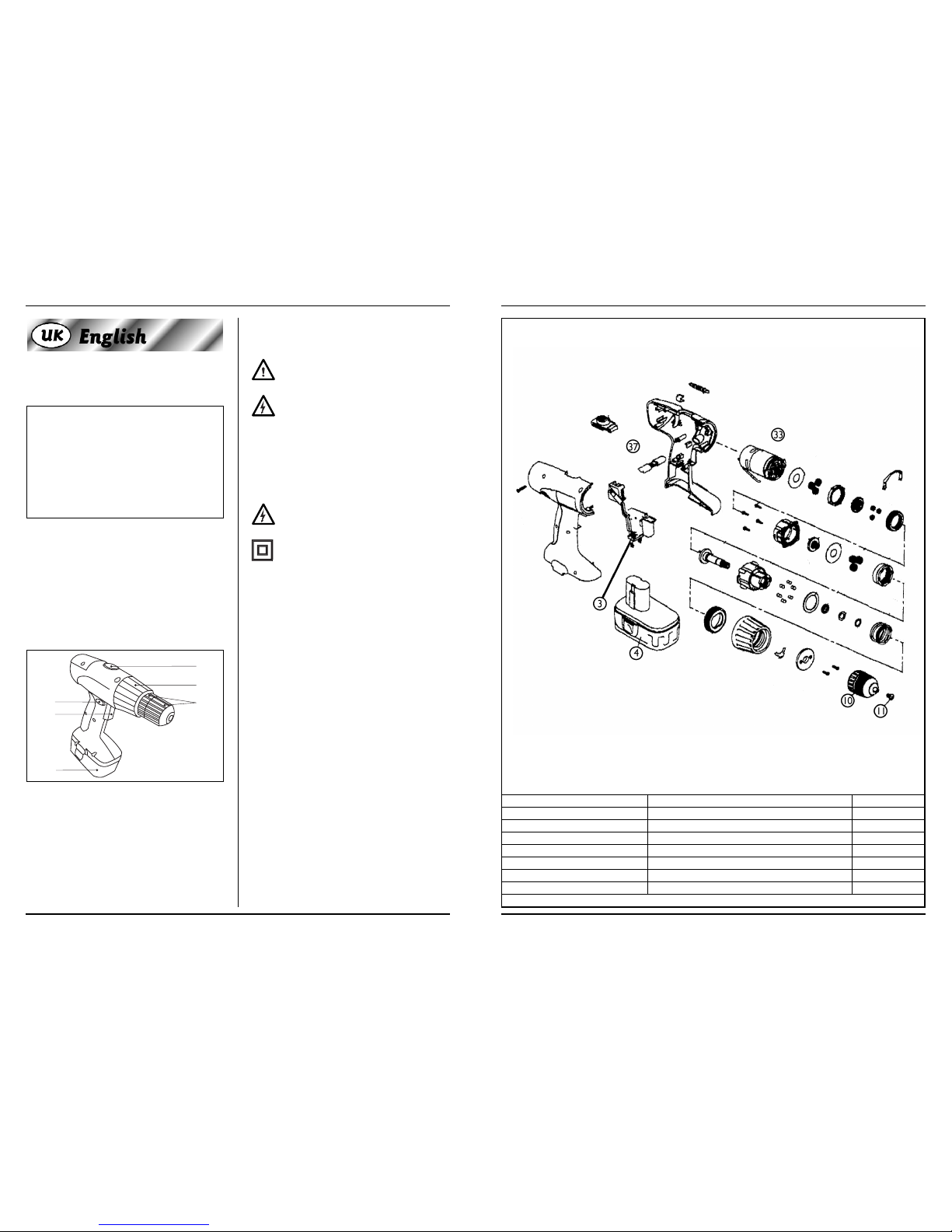
In the back of this manual you find an exploded view
showing the parts that can be ordered.
ENVIRONMENT
In order to prevent the machine from damage during
transport, it is delivered in a sturdy packaging. Most of
the packaging materials can be recycled. Take these
materials to the appropriate recycling locations.
Take your unwanted machines to your local Powercraft-
dealer. Here they will be disposed of in an environmen-
tally safe way.
NiCd cells are recyclable. Take them to your local
Powercraft-dealer or a local recycling station. The col-
lected battery packs will be recycled or disposed of in an
environmentally safe way.
GUARANTEE
The guarantee conditions can be found on the separately
enclosed guarantee card.
We declare under our sole responsability that this
product is in conformity with the following
standards or standardized documents
prEN50260-1, prEN50260-2-1, prEN50260-2-2,
EN60335-1,EN60335-2-29, EN55014-1,
EN55014-2, EN61000-3-2, EN61000-3-3
in accordance with the regulations.
98/37/EEC,
73/23/EEC,
89/336/EEC
from 01-05-2002
Im Park 20
50996 KÖLN BRD
E. Kok
Quality department
CE
ı
DECLARATION OF CONFORMITY (UK)
Powercraft 3
6. Don’t force tool
It will do the job better and safer at the rate for which
it was intended.
7. Use right tool
Don’t force small tools or attachments to do the job
of heavy duty tool. Don’t use tools for purposes not
intended.
8. Dress properly
Do not wear loose clothing or jewelry. They can be
caught in moving parts. Rubber gloves and nonskid
footwear are recommended when working out-
doors. Wear protective hair covering to contain long
hair.
9. Use safety glasses
Also use face or dust mask if cutting operation is
dusty.
10.Don’t abuse cord
Never carry tool by cord or yank it to disconnect it
from receptacle. Keep cord from heat, oil and sharp
edges.
11.Secure work
Use clamps or a vise to hold work. It’s safer than using
your hand and it frees both hands to operate tool.
12.Don’t overreach
Keep proper footing and balance at all times.
13.Maintain tools with care
Keep tools sharp and clean for better and safer per-
formance. Follow instructions for lubricating and
changing accessories. Inspect tool cords periodically
and, if damaged, have repaired by authorized service
facility. Inspect extension cords periodically and
replace if damaged. Keep handles dry, clean and free
from oil and grease.
14.Disconnect tools
When not in use, before servicing, and when chan-
ging accessories such as blades, bits and cutters.
15.Remove adjusting keys and wrenches
Form the habit of checking to see that keys and adjus-
ting wrenches are removed from tool before turning
it on.
16.Avoid unintentional starting
Don’t carry plugged-in tools with finger on switch. Be
sure switch is off when plugging in.
17.Outdoor use extension cords
When tool is used outdoors, use only extension
cords intended for use outdoors and so marked.
18.Stay alert
Watch what you are doing. Use common sense. Do
not operate tool when you are tired.
19.Check damaged parts
Before further use of the tool, a guard or other part
that is damaged should be carefully checked to deter-
mine that it will operate properly and perform its
intended function. Check for alignment of moving
parts, binding of moving parts, breakage of parts,
mounting, and any other conditions that may affect its
operation. A guard or other part that is damaged
should be properly repaired or replaced by an autho-
rized service center unless otherwise indicated
elsewhere in this instructions manual. Have defective
switches replaced by an authorized center. Do not
use tool if switch does not turn it on and off.
20.Warning
The use of any other accessory or attachment other
than recommended in this operation instructions or
the catalog may present a risk of personal injury.
21.Have your tool repaired by an expert
This electric appliance is in accordance with the rele-
vant safety rules repairing of electric apliances may be
carried out only by experts otherwise it may cause
considerable danger for the user.
22.Connect the dust extraction device
Whenever there are facilities for fitting a dust extrac-
tion system, make sure it is connected and used.
IMPORTANT SAFETY INSTRUCTIONS FOR
BATTERY AND BATTERY CHARGER
If you come into contact with acid from the battery, imme-
diately wash it off with water. If acid gets into the eyes, rinse
withplentyofwaterandconsulta doctor!
1. Read and observe the operating instructions and safety
instructions for the battery and battery charger before
use!
2. Please note! Only use the battery and battery charger
deliveredbythesuppliertoavoidthe risk of accidents.
3. Keep the battery, battery charger and the electrical
applianceawayfromdamp,suchasrain or snow.
4. Before using the battery charger, always check that all
thecablesarecorrectlyconnected.
5. Do not use the battery charger if you see that its cable is
damaged. Have the damaged cable replaced immedia-
tely.
6. If you are not using the battery charger, remove the plug
fromthemains.Donotpullout the plug by the cable.
7. If you drop the battery charger or it is interrupted by
another strong mechanical use, have it checked for
damage by a recognised professional workshop before
youuseitagain.Damagedpartsmust be repaired.
8. Handlethebatterywithcare.Donot drop it or knock it.
9. Never try to repair the battery or battery charger your-
self. Repairs must always be carried out by a recognised
professionalworkshoptoavoidtheriskof accidents.
10. Before cleaning or servicing the battery or battery char-
ger,alwaysremovethecharger'splugfrom the mains.
11. Never charge the battery if the ambient temperature is
below10°Corabove40°C.
12. The ventilation holes of the charger should always be
free.
13. Thebatterymaynotbeshort-circuited.
If short-circuiting occurs, power with a high electri-
cal current will flow. This can lead to the battery
overheating, catching fire or exploding, which can result in
damage to the battery or the user having an accident.
Therefore:
1. Do not connect cables to the poles of the bat-
tery.
2. Ensure that there are no metal objects (nails,
paperclips,coins,etc.)inthebatteryholder.
3. Donotleavethebatteryinwater or rain.
14. Damaged battery chargers or batteries which can no
longerbe charged should be disposed of as special waste.
Donotdisposeofthemtogetherwith domestic waste.
15. Never throw the battery into water or a fire, it may
explode.
6Powercraft