EN -
ADJUSTING THE STITCH
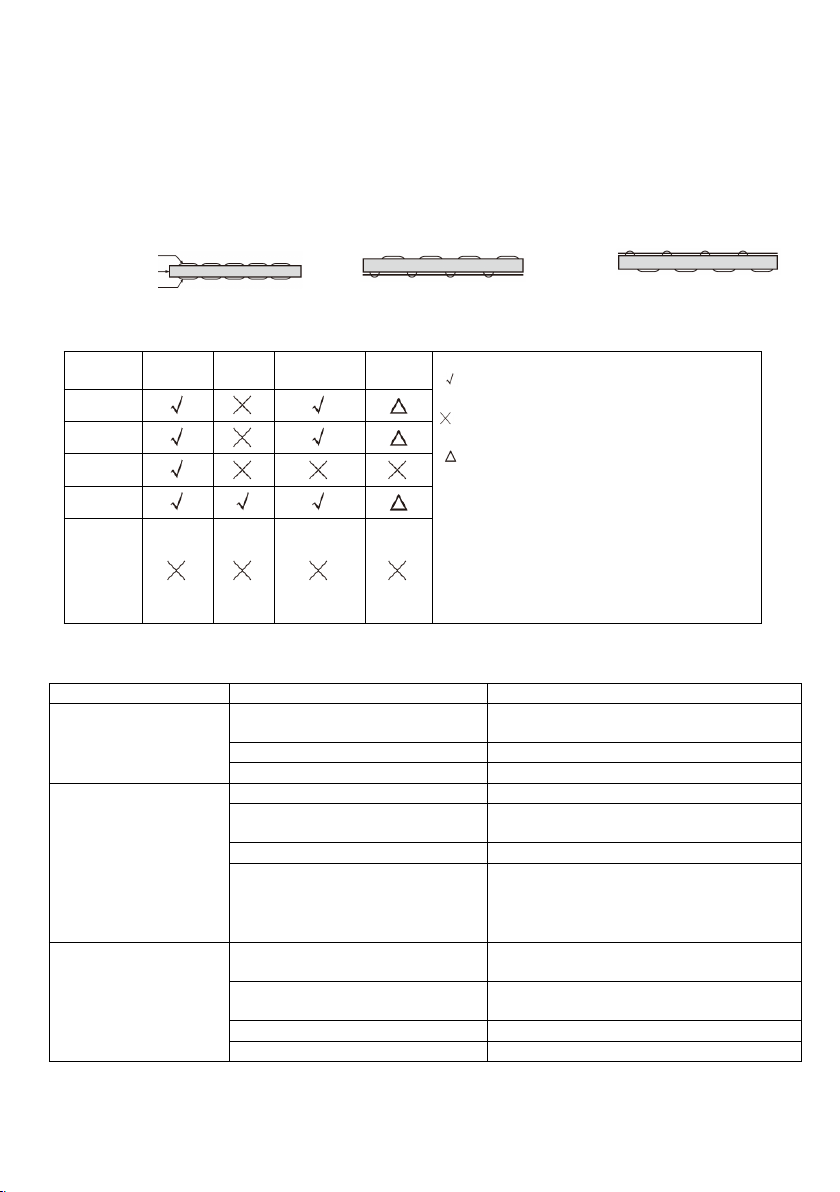
Normal stitching shall have top and
bottom threading evenly, neither
over tight nor loose.
If the bottom threading looks like
a straight line, it indicates that the
top thread is too loose. Please
turn upper thread tension dial to
direction with bigger number to
increase pressure until the
stitching returns to normal.
If the top thread looks like a
straight line, it indicates an
over-tight top thread. Please
turn the upper thread tension
dial to the direction with
smaller number to reduce
pressure until the stitching
returns to normal.
APPLICABLE CLOTH FOR SEWING
Cotton
/ Linen Silk /
Wool Polyester Elasti
c
means easy to
sew
Means
to sew
means not
smooth to
sew
Hard:
Jeans,
canvas,etc.
Soft:
towel,
duster,
etc.
Fabric thickness:
Thin fabric
<
0.35
mm
Regular fabric 0.35 mm
~ 0.8 mm
Thick fabric
>
0.8mm
Elastic cloth:
If cloth size is 100 mm x 30
mm and the cloth can be
extended to or over 106
mm under 0.5kg tension
force, then the cloth is
elastic.
Regular
Thick
Thin
Hard
Soft
TROUBLESHOOTING GUIDE
Problem Possible Cause Possible Solution
Skipped stitches
The needle is not inserted correctly. Remove and re-insert the needle (flat side
towards the back).
The needle is damaged. Insert a new needle.
The foot is not attached correctly. Check and attach correctly.
Needle
breaks.
The needle is damaged. Insert a new needle.
The needle is not correctly inserted. Insert the needle correctly (flat side towards
the back).
Pull fabric with force when sewing Remove and insert a new needle.
Needle is not lowered into fabric
when start sewing.
Remove and insert a new needle. Thread
again, turn the hand wheel to lower the
needle into fabric, then start sewing.
Loose, uneven stitches
The machine is not correctly
threaded. Check the threading.
The bobbin spool is not correctly
threaded. Thread the bobbin spool.
Needle bent Remove and insert a new needle.
Thread tension is wrong. Correct the thread tension.
Cloth
Bottom thread