manuals.online logo
Brands
  1. Home
  2. •
  3. Brands
  4. •
  5. RF
  6. •
  7. Amplifier
  8. •
  9. RF A 300 User manual

RF A 300 User manual

Other RF Amplifier manuals

RF SMART mini HD User manual

RF

RF SMART mini HD User manual

RF SMART handy3 User manual

RF

RF SMART handy3 User manual

Popular Amplifier manuals by other brands

Magnat Audio EDITION FOUR Owner's manual/warranty document

Magnat Audio

Magnat Audio EDITION FOUR Owner's manual/warranty document

Inter-m PA-2000A Operation manual

Inter-m

Inter-m PA-2000A Operation manual

Yamaha TX6n owner's manual

Yamaha

Yamaha TX6n owner's manual

Peavey TNT 150 user guide

Peavey

Peavey TNT 150 user guide

Bosch LBB 1903/10 Installation and user instructions

Bosch

Bosch LBB 1903/10 Installation and user instructions

Avocent Emerge DA1200D Installer/user guide

Avocent

Avocent Emerge DA1200D Installer/user guide

Redgum RGi35 operating instructions

Redgum

Redgum RGi35 operating instructions

Cambridge Audio AXA25 user manual

Cambridge Audio

Cambridge Audio AXA25 user manual

Alpine MRP-M200 owner's manual

Alpine

Alpine MRP-M200 owner's manual

Technical Pro H1502UrBT user manual

Technical Pro

Technical Pro H1502UrBT user manual

FMS EMGZ307 operating manual

FMS

FMS EMGZ307 operating manual

Racal Instruments 5601 user manual

Racal Instruments

Racal Instruments 5601 user manual

Valcom V-1094A Technical specifications

Valcom

Valcom V-1094A Technical specifications

Cambridge Audio 851D user manual

Cambridge Audio

Cambridge Audio 851D user manual

QSC 3800 Specifications

QSC

QSC 3800 Specifications

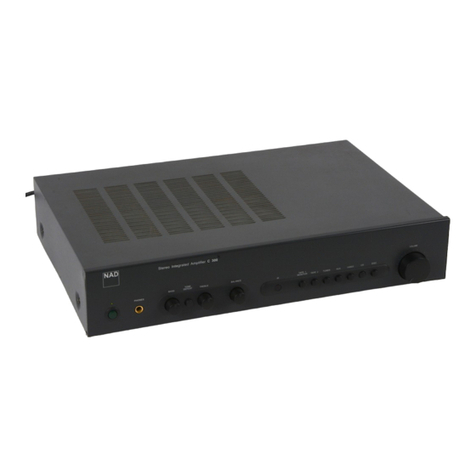
NAD C300 owner's manual

NAD

NAD C300 owner's manual

Rotel RMB-1077 owner's manual

Rotel

Rotel RMB-1077 owner's manual

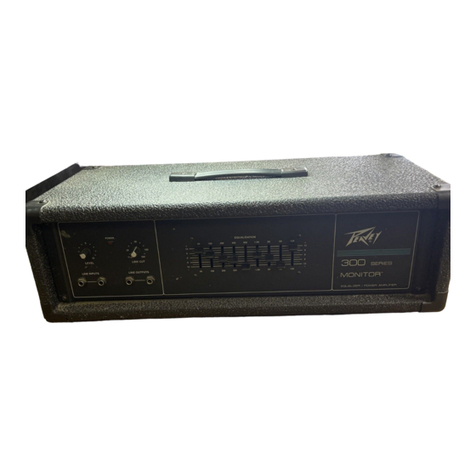
Peavey Monitor 300 Series operating guide

Peavey

Peavey Monitor 300 Series operating guide

manuals.online logo
manuals.online logoBrands
  • About & Mission
  • Contact us
  • Privacy Policy
  • Terms and Conditions

Copyright 2025 Manuals.Online. All Rights Reserved.

The material contained in this document is the property of Electronics & Innovation Ltd., it is subject to
change without notice.
Ocotber 008 Revision D
1
A 300
Broadband Power Amplifier
HIGH RF VOLTAGES MAY BE PRESENT AT THE OUTPUT OF THIS UNIT. All
operating personnel should use extreme caution in handling these voltages and be
thoroughly familiar with this manual.
Do not attempt to operate this unit prior to reading this manual.
The material contained in this document is the property of Electronics & Innovation Ltd., it is subject to
change without notice.
Ocotber 008 Revision D
Warranty
Electronics & Innovation Ltd., (hereafter E&I) warrants for the period of one year from the
date of original delivery, each unit to be free of defects in materials and workmanship. For
the period of 1 months E&I will, at its option, repair or replace defective parts so as to
render the unit fully operational such that it performs according to the original
specifications; free of charge to the original purchaser.
Should warranty service be required, the unit must be returned to E&I, freight cost to be
borne by the owner. If, in our opinion, the unit has been damaged by use outside the
limits prescribed in this manual or by accident, then the warranty shall not be honored. In
such a case E&I will provide an estimate for repair, assuming repair is possible and
provide a quote at standard service rates.
Contents
Chapter 1
General Information3
Chapter
Operation..4
Chapter 3
Technical Information.7
Chapter 4
Maintenance8
Chapter 5
Safety1
The material contained in this document is the property of Electronics & Innovation Ltd., it is subject to
change without notice.
Ocotber 008 Revision D
3
Chapter 1 Introduction
The A300 is a broadband solid state amplifier covering the frequency spectrum from 300
KHz to 35 MHz. It is rated at 300 watts of RF power with low harmonic and
intermodulation distortion. Over 400 watts of saturated power can be produced with
increased distortion products. A highly linear Class A design, the A300 will amplify inputs
of AM, FM, SSB, pulse and any complex modulation signals. The amplifier has 56 dB
gain, it is unconditionally stable and will not oscillate even with combinations of
mismatched source and load impedance. It is protected against failure due to output load
mismatch and/or overdrive.
RMS forward and reverse powers are monitored by a front panel meter. An integral power
supply permits operation from 100- 40 VAC 47-63 Hz single phase AC power.
1.2 I STRUME TATIO IDE TIFICATIO
Each amplifier is identified by a serial number tag on the back panel of the unit. Both the
model number and the serial number should be quoted to identify specific unit.
1.3 SPECIFICATIO S
Physical and electrical specifications are listed in Table 1-1 below
The material contained in this document is the property of Electronics & Innovation Ltd., it is
subject to change without notice.
Ocotber 008
4
Revision D
Table 1-1. SPECIFICATIO S
FREQUENCY COVERAGE: 300 kHz to 35 MHz.
GAIN: 55 dB min, ±1.5 variation.
CLASS A LINEAR OUTPUT: Nominal 300 watts.
HARMONIC DISTORTION: > - 5 dBc at 50 watts output.
SATURATED RF POWER OUTPUT:
450W Min. from 300kHz - 4MHz;
400W Min. from 4 MHz - 35MHz;
INPUT IMPEDANCE 50 ohms, VSWR, 1.5:1 Maximum.
OUTPUT IMPEDANCE: 50 ohms, VSWR, .5:1 Maximum
STs STABI
LITY: Continuous operation into any load or
source impedance.
PROTECTION:
Unit will withstand a + 13dBm input
signal (1.0 Volts RMS) for all output load
conditions, without damage.
POWER OUTPUT METER: True RMS power detection. ±3% of full
scale accuracy.
POWER REQUIREMENTS: 100 – 40 VAC 47-63 Hz.
SIZE: 13 X 16.75 X 0 inches 330 X 4 5 x 508
mm.
WEIGHT: 95 pounds 43 kg
CONNECTORS: N
OPERATING TEMPERATURE: 0 – 40 C
RACK MOUNTING:
Chapter 2 Operation
2.1 I TRODUCTIO
The A300 RF amplifier is used to amplify the RF level of signal sources in the
300 KHz to 35 MHz range. No tuning or any other form of adjustment is required.
The A300 produces rated power output at its output connector, regardless of load
impedance. Any power reflected due to output load mismatch is absorbed in the
amplifier. Therefore, although the output impedance is 50 ohms (maximum
VSWR: .5:1), the amplifier will work into any load impedance.
2.2 RACK I STALLATIO
The material contained in this document is the property of Electronics & Innovation Ltd., it is
subject to change without notice.
Ocotber 008
5
Revision D
This unit is 7.4U high, 16.75” width. With the handles removed it will fit into a
standard rack.
2.2.1 Mains Voltage
The unit accommodates AC line voltages from 100 TO 40 VAC 47 – 63 Hz.
2.3 OPERATIO
A fixed line cord is supplied to form a connection between the mains supply and
the rear of the unit. This is configured from the factory with a 0 A / 50 Volt
plug.
2.3.1 Proceed as follows:
(i) Ensure that there is at least 3” or 7.5 cm clearance at the rear of the
unit for air flow.
(ii) Ensure RF input voltage is not excessive
a. The 1 V rms indicated maximum input voltage is 5 times the level of
the input signal required to achieve maximum output. Input voltages
in excess of volts peak may permanently damage the instrument.
(iii) Connect the output via a 50 ohm coaxial lead and N plug to the load.
(iv) Connect the input signal via a 50 ohm coaxial lead and N plug to the
input connector.
2.3.2 Front Panel Display
The A300 front panel has a passive LCD display designed for simplicity and ease
of use. During initialization, the LCD shows the software revision. After the
amplifier is initialized, the LCD indicates Forward Power, Reflected Power, and
amplifier status (see figure .1).
Pf:___W Pr:___W
Status:________
Figure 2.1 : Front Panel Display
Where Pf refers to forward power, Pr refers to reverse power, and Status
indicates “OK” unless there is a fault condition, such as:
• Overheat (heat-sink temperature is too high for reliable operation)
• PSU fault (internal fault in the main switching power supply)
The material contained in this document is the property of Electronics & Innovation Ltd., it is
subject to change without notice.
Ocotber 008
6
Revision D
In the event of a fault, the unit may be reset by cycling the power. In the case
over an over temp fault, ensure that the air inlet and out let are not restricted. If
the fault persists, please contact Field Service.
2.3.3 RS 232 Interface
The A300 features a standard RS- 3 serial interface suitable for connection to a
PC or host system. The communication protocol is extremely simple to facilitate
readback and control with readily available terminal programs such as
Hyperterm. The RS- 3 link has the following parameters:
Baud rate: 19 00
Data bits: 8
Parity: none
Stop bits: 1
Flow control: none
An example configuration using HyperTerminal on a PC is shown in figure . .
In the default state, the RS- 3 port will echo the same information sent to the
front panel LCD display, allowing a running datalog to be stored to disk using the
capture feature of the terminal program.
Figure 2.2: Example RS-232 setup using Hyper Terminal
The material contained in this document is the property of Electronics & Innovation Ltd., it is
subject to change without notice.
Ocotber 008
7
Revision D
Single character commands can be sent to the amplifier to achieve the following:
"1" key enables telemetry (readback similar to LCD display) - this is the default
mode at power up
“ ” key clears any faults and tries to start the supply.
“0” key disables telemetry (Complement to “1” key)
Custom commands and display lists can be implemented upon customer
request.
Chapter 3 Technical Description
3.1 GE ERAL DESCRIPTIO
The A300 is designed to amplify signals by 55 dB in the frequency band of 300
KHz to 35 MHz. The signal from the front panel N connector is fed via a length of
50 ohm coaxial cable into the input of the driver amplifier module. The signal
from the input of the driver is coupled to the input of the MMIC front end. The
output signal of the MMIC is coupled to the gate of transistor Q1. The further
amplified signal appearing at the drain of Q1 is coupled to the input of Q . This is
transformed to 50 Ω and fed to the driver output BNC port.
The driver output signal is fed through a length of coaxial cable to the input of the
power splitter, the four outputs of this are each fed to the four amplifier modules.
In each PA module the signal is split into two equal phase and amplitude signals.
These signals are fed to the inputs of transistors Q1 and Q . The amplified
signals appearing at the drains of Q1 and Q are then fed to the output BNC port
via the impedance matching network. The output of the modules is then fed to
the combiner to produce a single signal.
The power signal is then fed into a length of 50 ohm coaxial cable to the RF bi-
directional coupler. The output of the coupler is then fed directly to the N
connector on the front panel, this is the unit output.
The forward and reverse coupled ports of the bi-directional coupler are fed to the
RF detector which is situated on the main control board. The RF detector feeds a
voltage, which is representative of the true RMS power to the control board
proper. The control board in turn drives the front panel display.
There are four switch mode power supply units three provide a 48 VDC 4
ampere source. The other provides 48VDC and 4 VDC outputs and provides a

The material contained in this document is the property of Electronics & Innovation Ltd., it is
subject to change without notice.
Ocotber 008
8
Revision D
total of 4 amps. The main power supply also has a 5 VDC output which feeds
the control board.
Combiner
Splitter
Gating Board
Option
403 LA
A075 PA
Coupler
TTL Input
4 Volt
To Page a
RF IN
RF OUT
To Page b
To Page c
To Page b
48 Volt
48 Volt
RF Detect
A075 PA
A075 PA
A075 PA
A30
0
RF Amplifier
A30
0
–
SCH
-
01
The material contained in this document is the property of Electronics & Innovation Ltd., it is
subject to change without notice.
Ocotber 008
9
Revision D
Chapter 4 Maintenance
4.1 INTRODUCTION
The E&I A300 RF amplifier requires no periodic maintenance. The instrument is
unconditionally stable and is fail-safe under all load conditions. Damage can only
be externally caused by the incorrect selection of the AC supply voltage or by an
input signal in excess of the specified 1 volt rms equivalent to a power level of
13dBm.
This chapter therefore, deals only with certain fundamental procedures for fault
location.
AC IN
SMPS 48 Volt
SMPS 48 Volt
SMPS 48 Volt
SMPS 48 / 4 Volt
To page 1 a
4 Volt
To page 1 b
Controller
To page 1 c
TTL Control
Front Panel LCD
To Rear
Panel RS 3
Fans
CKT
BRK
Line
Filter
The material contained in this document is the property of Electronics & Innovation Ltd., it is
subject to change without notice.
Ocotber 008
10
Revision D
Performance limits quoted are for guidance only and should not be taken for
guaranteed performance specifications unless they are also quoted in the
Specification Section 1. .
4. PERFORMANCE CHECKS
To determine the amplifier’s performance carry out the following procedure.
4. .1 Initial Check
The following check can be made after repair and adjustments or
whenever the condition of the unit is in question.
a. Connect AC power supply. Switch on power and observe that the
display initializes.
b. Connect a sweep generator (HP 8601 or similar) capable of sweeping
the frequency range 300 KHz to 35 MHz, to the input connector.
c. Adjust the output level of the sweep generator so that a 50 ohm video
detector connected at the output of the unit will not be damaged by
excessive power output. (Reference section 4.4.1 for set up.)
d. Observe the gain versus frequency ripple on an oscilloscope calibrated
in decibels. The gain variation must be not more than +/- 1.5 dB over
the frequency range.
e. Connect a calorimetric power meter (HP435B or equivalent) through a
30 dB 500 watt attenuator to the output connector. Adjust the input CW
signal to any frequency between 300 kHz and 35 MHz for 50 watts
output.
f. Observe the harmonic distortion of the output, properly attenuated, on
a spectrum analyzer. The harmonic components contributed by the
amplifier should be better than 5 dB down from the fundamental.
(a) If the above items are found to be outside of the specification, check
the spectral content of the input signal. If this is a pure signal then
the unit needs to be returned to the factory for service.