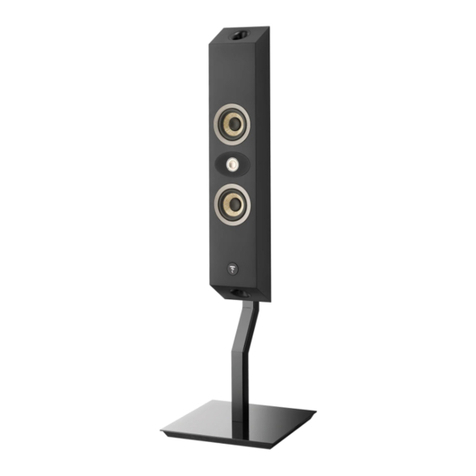
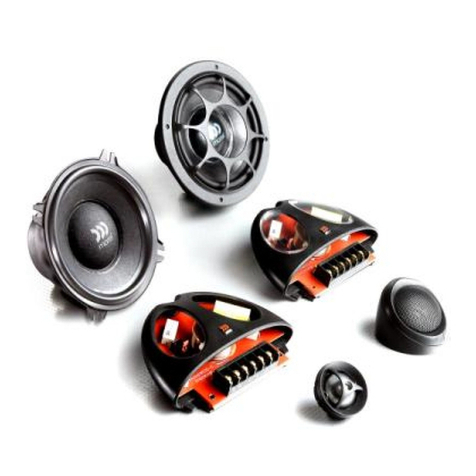
Your new STUDIODRIVER component set is part of an exciting line of
loudspeakers. They are the definitive result of years of research and
development,realized bythesame engineeringteamcharged withdesigning
audiophile quality speaker systems for a select group of high performance
German automobiles, working hand in hand with our own award-winning
engineering staff. Like all STUDIODRIVER products, they reflect our
commitment to strive for Precision Reproduction of Pure Music Without
Limits!
STUDIODRIVER componentsemploy cutting edgealuminumcurvilinear cones
to eliminate unwanted resonance inherent in conventional metal cone
designs.Ouruse of an ultra-light and rigid aluminum coneallowsa dramatic
increase in sound velocity, or what we call "sonic-speed". This means
impulses from the voice coil travel though the aluminum cone nearly four
timesfaster thantypicalpapercones. Evenmoresignificant thanpurespeed,
music is reproduced in a way that is clearly more dynamic, precise, detailed
anddistortion-free. Inotherwords...sound reproductionhasnever beenmore
REAL. Always respected in the audio community for its ability to dissipate
heat efficiently, aluminum cones assure excellent cooling of the voice coil,
resulting in increased power handling and reduced power compression.
STUDIODRIVER loudspeakersalsofeatureauniquecopper cap over the pole
piece, which effectively alters the magnetic field around the voice coil,
minimizing the effect of "eddy currents", this results in a more controlled,
linear impedance and phase response.
TheNT-1 25mm highfrequencydriverfeatures a titaniumdomeforthe perfect
combination of superior strength and ultra-light weight.
Note: STUDIODRIVER Component midrange and midbass loudspeakers employ
pure aluminum cones. They can be damaged if they are not handled with care.
Care should be taken during installation to avoid damage to the cones. Physical
damage to the cones will not be covered under warranty.
As always, STUDIODRIVER recommends that your component speakers be
installed by an Authorized Dealer.
INTRODUCTION
1RETURN TO CONTENTS