5
government health agencies and industry groups. They review the available body of
research to develop ANSI standards. These ANSI standards are reviewed regularly
for research development
»» International Commission on Non-Ionizing Radiation Protection (ICNIRP) 1996
»» Verband Deutscher Elektrotechniker (VDE) DIN-0848
»» United States Federal Commission, Radio Frequency Exposure Guidelines (1996)
»» National Radiological Protection Board of the United Kingdom, GS 11, 1988
»» American National Standards Institute (ANSI) IEEE. C95. 1-1992
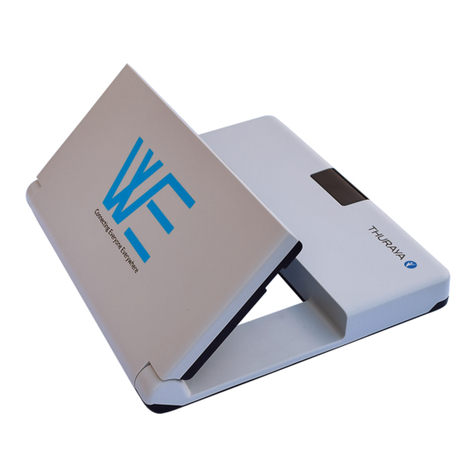
• Do not operate your satellite system when a person is within 57cm of Thuraya WE.
A person or object within 57cm of the antenna could impair call quality and may
cause Thuraya WE to operate at a higher power level than necessary and expose
that person to RF energy in excess of that established by the FCC RF Exposure
Guidelines
• Thuraya WE was evaluated against the FCC RF exposure requirements of 47 CFR
Part 2.1091. An exclusion zone of 0.57m was required in front of the antenna. Away
from this area, the electric field measured at 0.20m did not exceed the MPE limit
• Thuraya WE was evaluated against the CE RF exposure requirements of EN
62311:2008. An exclusion zone of 0.64m was required in front of Thuraya WE. Away
from this area, the electric field measured at 0.20m did not exceed the reference
limit
• As a precaution, please maintain the maximum body distance possible fromThuraya
WE during call transmission
FCC Notices
Part 15 conditions
Thuraya WE contains a Wi-Fi transmitter and associated digital circuitry that operate
under Part 15 of the FCC Rules. The following notice applies to operations under Part 15:
Thuraya WE complies with Part 15 of the FCC Rules. Operation is subject to the following
two conditions:
1. Thuraya WE may not cause harmful interference, and
2. Thuraya WE must accept any interference received, including interference that may
cause undesired operation
Thuraya WE has been tested and found to comply with the limits for a Class B digital
device, pursuant to Part 15 of the FCC Rules. These limits are designed to provide
reasonable protection against harmful interference in a residential installation. Thuraya
WE generates, uses and can radiate radio frequency energy and, if not installed and
used in accordance with the instructions, may cause harmful interference to radio
communications. However, there is no guarantee that interference will not occur in
a particular installation. If Thuraya WE does cause harmful interference to radio or
television reception, which can be determined by turning it off and on, the user is
encouraged to try to correct the interference by one or more of the following measures:
• Reorient or relocate Thuraya WE
• Increase the separation between Thuraya WE and receiver
• Connect Thuraya WE into an outlet on a circuit different from that to which the
receiver is connected
• Consult the dealer or an experienced radio/TV technician for help
WE Manual Guide_ENG&Arabic_Rev_MM.indd 5 27/03/2018 4:12:45 PM