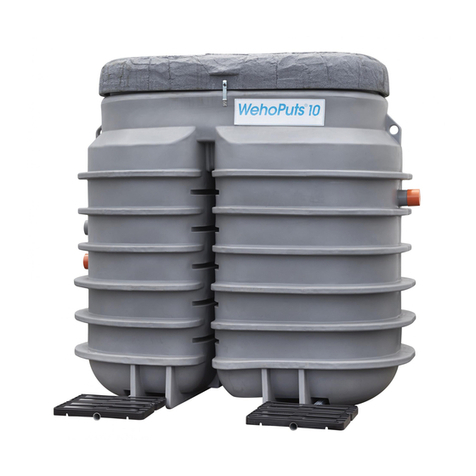
The biochemical Uponor wastewater treatment plant
is a domestic wastewater treatment system intended
for continuous household use, or for a second home
equipped for year-round, regular use. The Uponor
treatment plant processes all wastewater in a
household (from bathing, dishes, laundry, and toilet
ushing). It is suitable for all kinds of building lots,
including those that are small or rocky.
Foreign objects and materials must not be washed
down into the treatment plant, such as debris for
solid waste disposal or materials that are classied
as problem waste, which can endanger the biological
processing of the treatment plant.
Operating principle
The Uponor Clean II wastewater treatment plant
represents top technology in wastewater treatment.
Because of its new design, the treatment plant has
compact outer dimensions. After installation of the
treatment plant, only three unobtrusive covers are
visible in the yard.
The treatment plant is primarily designed for use
by two households. With a holiday automation
technology, it is also suitable for summer cottages
that are used frequently year-round. Thanks to
the holiday automation, the treatment plant can
withstand breaks, as the active sludge is sustained
by continued aeration and recycling. The treatment
plant is installed in the ground and the extension
pipes can easily be extended.
The treatment plant is a biochemical wastewater
system, where all household sewage can be directed.
The cleaning process works on a batch principle,
with an active sludge process and a chemical
occulation. The wastewater is treated in equal
batches, so that each batch is puried to the same
extent. Microbes living in the active sludge complete
a biological purication, while the phosphorus
compounds are removed from the wastewater by
chemical precipitation. At the end of the cleaning
process, the puried water is pumped out, for
example, into an open ditch, drainage well or ditch
that serves as a discharge point.
1. Overview
Cleaning process cycle:
• pre-settling of wastewater, storage of incoming wa-
ter and storage of the sludge in the septic tank
• lling of the process tank
• aeration
• dosage and mixing of the occulation chemical
• rst settling
• excess sludge is returned to the septic tank
• second settling
• discharge of the puried water
If no water is entering the plant, the process is in a
waiting or holiday cycle, in which the wastewater is
regularly aerated in the process tank. The aeration
keeps the microbes active in the process tank.
The Finnish Environment Institute SYKE has completed
standard CE testing on the Uponor wastewater
treatment plant. The results of the test are excellent
and well above the requirements.
The treatment plant is easy to use. The Clean
occulation chemical is added into the plant a few
times a year, and the sludge emptying truck comes
to empty the sludge accumulated in the septic
tank at least once a year. Electric consumption is
low primarily because of the mammoth pumping
technique. The wastewater and sludge are
transferred without mechanical pumping. The air
used in the process is produced by blowers located
underneath the second cover of the control panel.
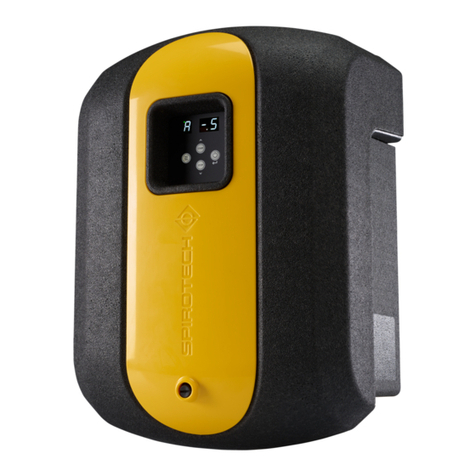
The treatment plant has a wireless alarm system,
visible through an Info panel installed inside the
house. An indicator light on the Info panel indicates
when it is time to ll the chemical vessel, if the water
level in the tank is too high, if there is a technical
malfunction or when the septic tank must be
emptied. A test button can be used to query the
state of the plant activity. The activity can also be
controlled and followed with a mobile device using a
PlantCare mobile bookmark.
NOTE! PlantCare program uses treatment plants
local network and local web browser. It is not
connected to internet.
Uponor Clean II Treatment Plant Operating Manual | 3