manuals.online logo
Brands
  1. Home
  2. •
  3. Brands
  4. •
  5. Yiancar Designs
  6. •
  7. Keyboard
  8. •
  9. Yiancar Designs Gingham Keyboard User manual

Yiancar Designs Gingham Keyboard User manual

Popular Keyboard manuals by other brands

Man & Machine Really Cool + user guide

Man & Machine

Man & Machine Really Cool + user guide

SteelSeries APEX PRO TKL Product information guide

SteelSeries

SteelSeries APEX PRO TKL Product information guide

Vortexgear POK3R user manual

Vortexgear

Vortexgear POK3R user manual

Logitech RUGGED LITE quick start guide

Logitech

Logitech RUGGED LITE quick start guide

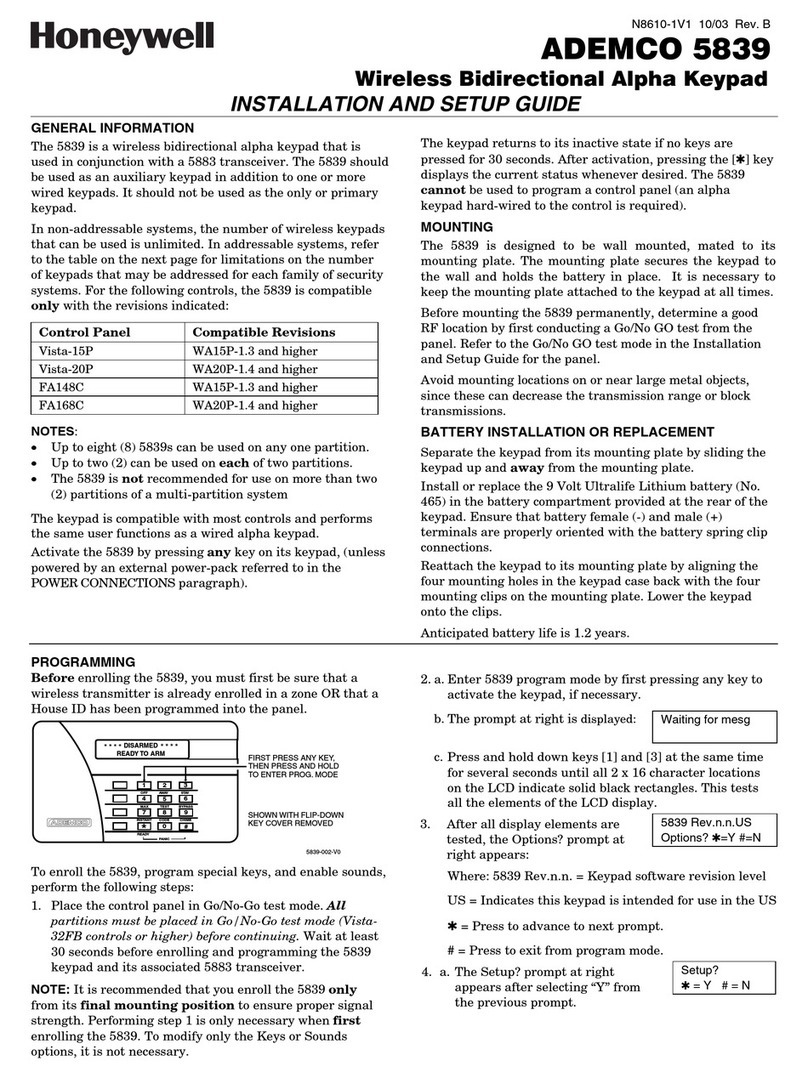
Honeywell ADEMCO 5839 Installation and setup guide

Honeywell

Honeywell ADEMCO 5839 Installation and setup guide

PROZIS EZ user manual

PROZIS

PROZIS EZ user manual

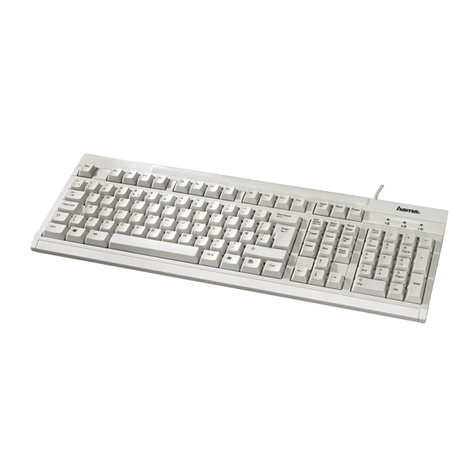
Hama AK-120 Operating	 instruction

Hama

Hama AK-120 Operating instruction

Rodgers RK-76 owner's manual

Rodgers

Rodgers RK-76 owner's manual

Logic Controls KB5000 Series user manual

Logic Controls

Logic Controls KB5000 Series user manual

Rapoo E9270P quick start guide

Rapoo

Rapoo E9270P quick start guide

AbleNet Chester Creek USB Keyboard quick start guide

AbleNet

AbleNet Chester Creek USB Keyboard quick start guide

iKey DP-88 Specifications

iKey

iKey DP-88 Specifications

Logitech G413 TKL SE Complete Setup Guide

Logitech

Logitech G413 TKL SE Complete Setup Guide

Ultimate Technology 500 POS user guide

Ultimate Technology

Ultimate Technology 500 POS user guide

Mace MACALLY MERGOKEY user guide

Mace

Mace MACALLY MERGOKEY user guide

iKey KYB-42-KIOSK Specifications

iKey

iKey KYB-42-KIOSK Specifications

Akko MX108 user manual

Akko

Akko MX108 user manual

Viper V770 user manual

Viper

Viper V770 user manual

manuals.online logo
manuals.online logoBrands
  • About & Mission
  • Contact us
  • Privacy Policy
  • Terms and Conditions

Copyright 2025 Manuals.Online. All Rights Reserved.

Assembly Instructions
Gingham
Keyboard
Welcome to your new
Gingham Keyboard.
Before we start, make sure you have the following:
• Soldering Iron
• Solder
• Cutters
• Stabilizers
• Mechanical Switches (preferably PCB mount)
• Keycaps
• Mini USB cable
This kit is designed with only through-hole components.
Component Identification
4.7uF Electrolytic
Capacitor
75Ohm Resistors
Colours: Purple,
Green, Black Gold,
Brown
22pF Ceramic
Capacitors
Markings: 22
10k Ohm Resistor
Colours: Brown, Black,
Black, Red, Brown
100nF Ceramic
Capacitors
Markings: 104
1.5k Ohm Resistors
Colours: Brown, Green,
Black, Brown, Brown
1
2
500mA Fuse
1N4148 Diodes
in a roll
Zener Diodes
3.6V,
x2 loose pieces
MCP23008 Port
Expander and
Socket
16Mhz Crystal
M2 Screws /
M2 Nuts
Green and red
LEDs
Note: long leg is
positive
Reset and Boot
Switches
USB-C Connector
M2 Spacers
Rubber Feet ATmega328P
Microcontroller and
Socket
5.1k Ohm Resistors
Colours: Green, Brown,
Black, Brown, Brown
3
Assembly Instructions
Step 1
Solder 1N4148 Diodes under the graphic as
shown in the picture. The black line from
the diodes goes to the top.
Step 2
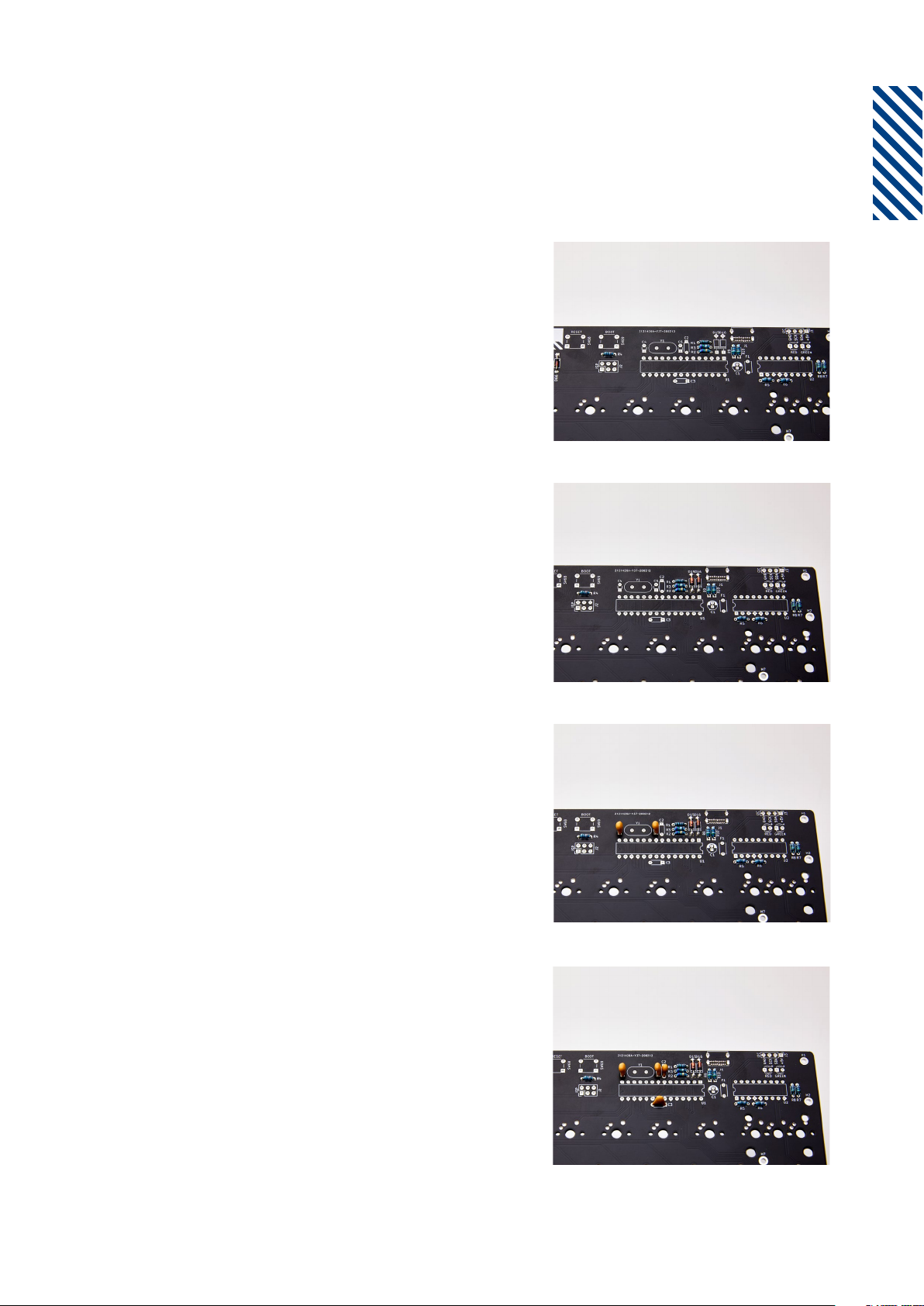
Solder the x3 10k Ohm resistors; R4,
R5, and R6. Those components have no
specific orientation.
Step 3
Solder the x3 1.5k Ohm resistors; R1,
R7, and R8. Those components have no
specific orientation.
Step 4
Solder the x2 75 Ohm resistors; R2 and
R3. Those components have no specific
orientation.
4
Assembly Instructions
Step 5
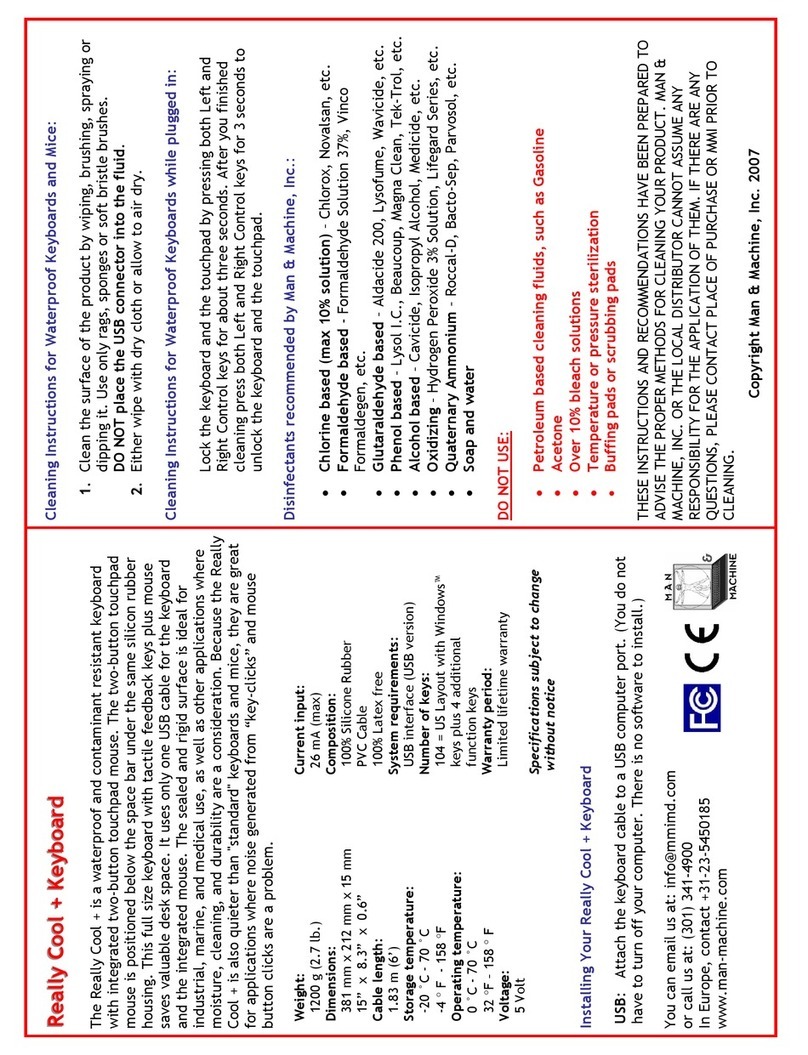
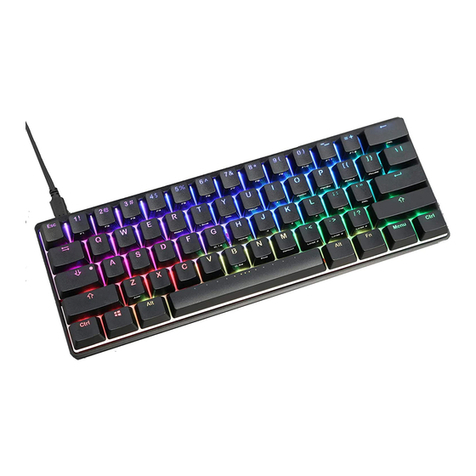
Solder the x2 5.1k Ohm resistors; R9 and
R10. These components have no specific
orientation.
Step 6
Solder the x2 Zener diodes; D15 and D16.
The black line is at the bottom.
Step 7
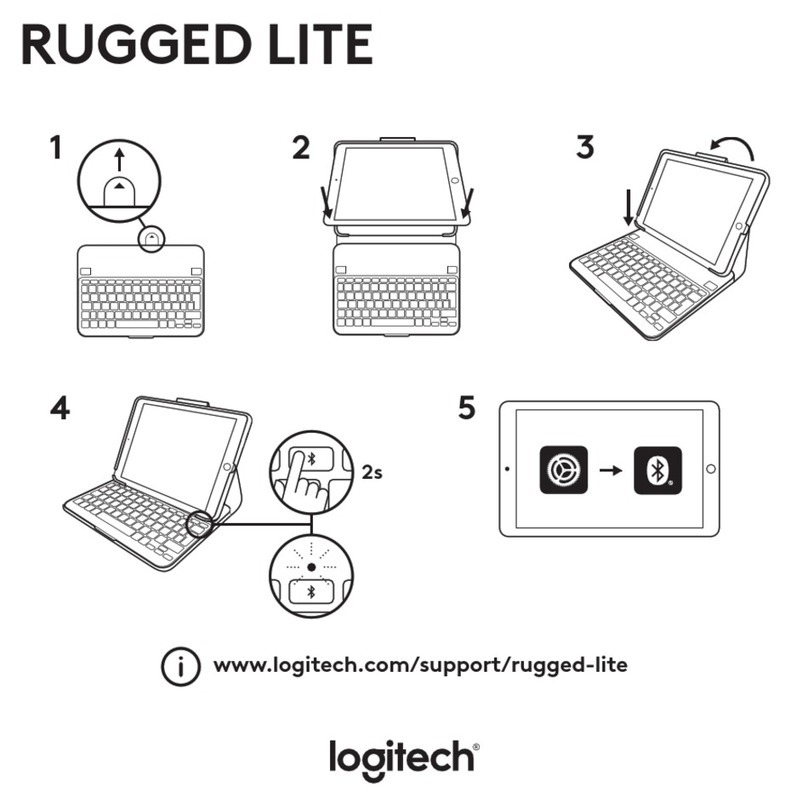
Solder the x2 22pF capacitors; C4 and C5.
Note: Do not over-pull the legs through
the PCB. These capacitors are very fragile
and can crack. These components have no
specific orientation.
Step 8
Solder the x2 100nF capacitors; C2 and
C3. These components have no specific
orientation.
5
Assembly Instructions
Step 9
Solder the fuse, F1. This component has no
specific orientation.
Step 10
Solder the x2 switches; SW68 and SW69.
These components have no specific
orientation.
Step 11
Solder the Crystal Y1. These components
have no specific orientation.
Step 12
Solder the USB socket. The small pins
might not come through the PCB but still
add a small amount of solder. Solder the
shield pins last.
6
Assembly Instructions
Step 13
Solder the electrolytic capacitor, C1.
Negative (-) goes at the top.
Step 14
Solder the x2 chip sockets. The small one
goes to the U2 and the big one goes to U1,
as in the picture.
Step 15
Solder the LEDs as shown in the picture.
The long leg is the positive.
Step 16
Put the x2 chips in their sockets. The MCU
is pre-programmed with the default ANSI
keymap. Re-programming instructions are
on page 9. The U1 chip’s semi-circle mark
goes to the right. The U2 semi-circle mark
goes to the left. Bend the legs of the chips
inwards to fit in the sockets!

7
Assembly Instructions
Step 17
Solder all the switches according to your
desired layout. Add the stabilizers.
Step 18
Screw the x6 M2 screws; H5, H6, H7, H8,
H9, and H10. The screws are inserted from
the top of the top PCB.
Step 19
Screw x2 M2 nuts on each of the 6 screws
from the bottom.
Step 20
Put the x4 M2 screws from the bottom of
the bottom PCB. These screws are for the
plexiglass.
8
Assembly Instructions
Step 21
Put the x4 M2 screws from the bottom of
the bottom PCB. These screws are for the
plexiglass.
Step 22
Insert the bottom PCB and the top PCB
together. Secure the x4 plexiglass screws
with the x4 spacers.
Step 23
Place the plexiglass on top of the spacers
and secure it with x4 M2 screws.
Step 24
Turn the keyboard upside down and secure
the bottom PCB with the last x6 M2 nuts.
9
Assembly Instructions
Step 25
Place the x6 rubber feet at the bottom.
Done!
Please see below for Programming Instructions.