8
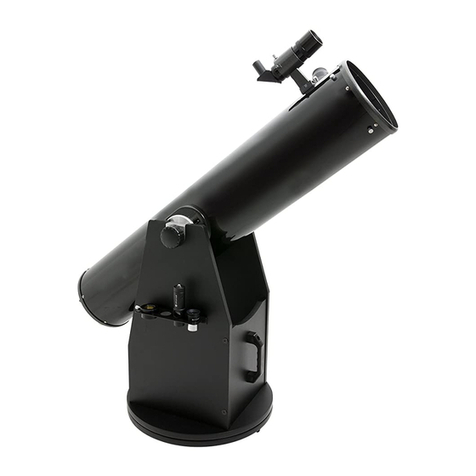
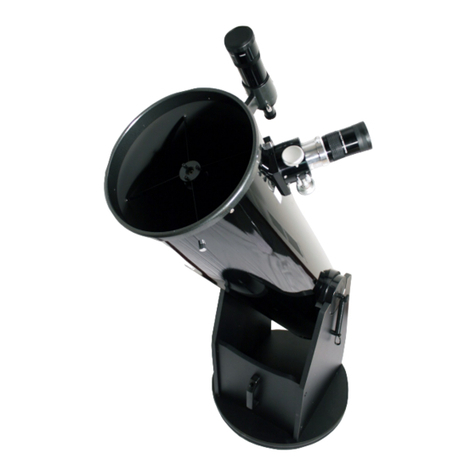
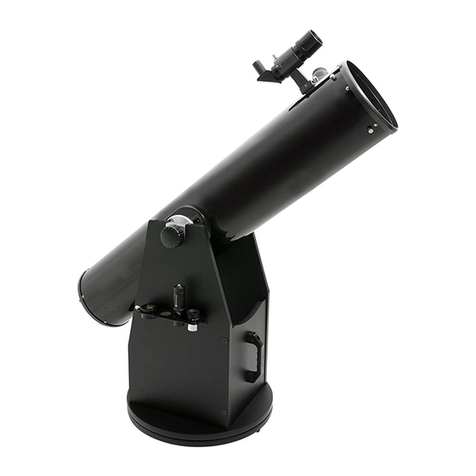
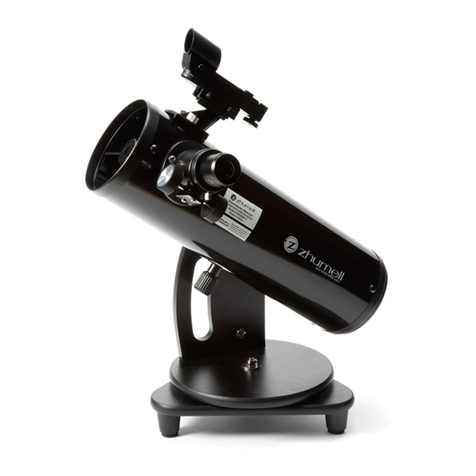
Z114, Z130 PORTABLE REFLECTOR TELESCOPE
SELECTING A VIEWING SITE
The ideal site for using your telescope is in the middle
of nowhere. Most users don’t have access to the
darkest of skies, however, so select a site that is both
far from light pollution and practical for travel. Avoid
street lights, yard lighting, rooftops, and chimneys,
and never observe through an open window indoors.
Be sure your site is out-of-town or very dark and has
clear view of a large portion of the sky.
DARK ADAPTING YOUR EYES
When you go out into the dark, your eyes need time to
adjust. You will initially be able to see only a fraction of
the stars and objects your eyes are capable of. Remain
in the dark (don’t look at any lights or cell phones) for
at least 30 minutes, and your eyes should be around
80% of their full dark-adapted sensitivity. Every time
bright light comes into your eye, the dark-adapting
process will start over.
When eyes are fully dark-adapted, you will probably
still need to see what you’re doing. Use a red-light
flashlight to maneuver around the area. A regular
flashlight covered in red cellophane will work, but red
LED lights are best.
SEEING AND TRANSPARENCY
Atmospheric conditions are of the utmost importance
when considering viewing conditions for your
astronomical binoculars. These conditions are
commonly referred to as “seeing.” When seeing is good,
star twinkling is minimal and objects appear steady
in your lenses. Seeing is best overhead, worst at the
horizon, and generally better after midnight. You can’t
see the stars without looking through the atmosphere,
so the clearer the air and the higher your altitude, the
better seeing conditions you will encounter.
DARK ADAPTING YOUR EYES
When you go out into the dark, your eyes need time to
adjust. You will initially be able to see only a fraction of
the stars and objects your eyes are capable of. Remain
in the dark (don’t look at any lights or cell phones) for
at least 30 minutes, and your eyes should be around
80% of their full dark-adapted sensitivity. Every time
bright light comes into your eye, the dark-adapting
process will start over.
When eyes are fully dark-adapted, you will probably
still need to see what you’re doing. Use a red-light
flashlight to maneuver around the area. A regular
flashlight covered in red cellophane will work, but red
LED lights are best.
TRACKING CELESTIAL OBJECTS
The Earth is always rotating about its polar axis,
completing one full rotation every 24 hours. This is
what defines our “day”, and we see it in the apparent
movement of sun and stars throughout each rotation.
In the same way that the sun rises and sets each day,
the stars in the sky rise and set each night. The motion
translates to a rate of approximately .25° per minute,
or 15 arc-seconds per second. This is commonly
referred to as the sidereal rate.
As you observe any celestial object, remember that it
is in motion. You will need to continuously update your
telescope’s position throughout a viewing session,
which is where your telescope’s fine altitude and
azimuth adjustments become useful. As an object
begins to leave your field of view, gently nudge the
OTA in the correct direction and bring it back to center.
Remember, the higher the magnification at which
you’re viewing, the smaller your field of view. Objects
will appear to move faster as you raise magnification,
and more frequent positional adjustments will need to
be made.
SELECTING AND EYEPIECE
By using eyepieces of different focal lengths, many
different magnifications can be achieved with your
Zhumell telescope. The best place to start is with
the included 9mm and 32mm Plossl eyepieces for
higher and lower magnifications, respectively. Many
astronomers own a large number of eyepieces in order
to customize their equipment based on the object being
viewed. To calculate the magnification of a telescope/
eyepiece combination, divide the focal length of the
telescope by the focal length of the eyepiece.
No matter which eyepiece you intend to use, always
start by using the lowest-power (longest focal length)
eyepiece to locate and center the object. Lower
magnification means a wider field of view, making
it easier to find an object and justify your scope in
its direction.
Once you’ve centered the desired object using
your lowest-power eyepiece, go ahead and make
the switch to a higher magnification. Make further
centering adjustments, and continue to work up if
desired. Higher magnifications are useful for small and
bright objects like planets and double stars. Viewing
the Moon with increased magnification also yields
great results.
Deep-sky objects, however, typically look best at
medium and low magnifications. This is because they
tend to be faint, yet have apparent width. Deep-sky
OBSERVATION TIPS
FOR YOUR TELESCOPE