3
PAINT AND VARNISH REMOVAL
Never use the heat gun in combination with chemical strippers.
Use in well-ventilated areas only. Peelings and residue from lead-based paints are poisonous.
Easy removal of paint and varnish requires some practice and the use of simple working techniques described here. In all cases, test results on a small section of paint before moving on to larger areas.
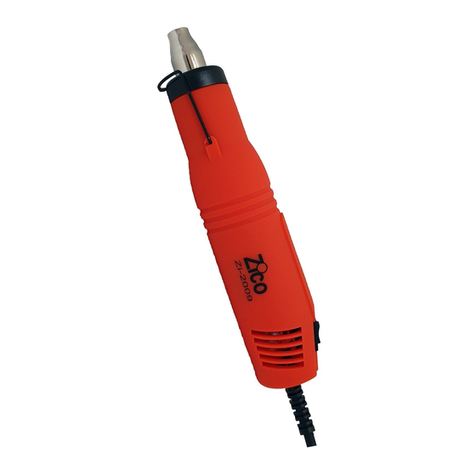
Turn on the gun and allow it reach full heating power. Hold the nozzle 3" to 4" from the paint to be removed.
After a short time, paint will soften and begin blistering. Do not overheat paint, as this will cause burning and make the finish more difficult to remove. When stripping paint overhead, always use eye protection.
Begin scraping the paint off, working from top to bottom. Use accessory scrapers. Scrape with smooth, even strokes,
warming the surface in front of the scraper by moving the gun slightly from side to side. If paint is warmed properly, even thick layers can be removed in a single pass.
Paint should come off in a strip equal in width to the scraper blade.
Clean the edge of scraper often to keep it clean and sharp and to prevent paint from building up on the blade. Scrape the paint as soon as it softens since it will quickly harden again.
Shaped or profiled surface can be stripped with a wire brush after softening with the hot air jet.
Cover all surfaces NOT to be heated with nonflammable material. Never concentrate tool's heat on a window panel or other glass surface.
Note: The heat gun is designed to remove both oil and latex-based paints and varnishes. It will not remove stains or primer coats that have impregnated the surface of wood.
CAUTION: LEAD PAINT FUMES ARE VERY HARMFUL. ALWAYS PROVIDE ADEQUATE VENTILATION WHILE WORKING INDOORS.
OTHER JOBS FOR THE HEAT GUN
1. Removing paint and varnish with hot air jet and scraper.
2. Loosening rusted or overtightened nuts and metal screws.
3. Thawing frozen pipes, frozen door locks, padlocks, etc. WARNING: Do not attempt to thaw plastic pipes!
4. Highlighting the natural woodgrain of wooden surface before staining or varnishing.
5. Fast drying of paints and varnishes. This is especially useful when color matching is required by adding several coats of the paint or varnish.
6. Softening old putty before removal and replacement.
7. Drying out wet, damaged timber prior to filling with compound and refinishing.
8. Shrinking PVC shrink-wrap sheeting for packaging protection.
9. Waxing and dewaxing skis.
10.Shrinking polyvinyl wire joints.
CARE AND MAINTENANCE
Keep the air intake and outlet opening clean and free of dirt and debris.
Use only a damp cloth and general household cleaning agent to wipe the gun clean.
Do not use turpentine, paint thinner, gasoline, or similar substances to clean the gun.
WARNING: This tool must be placed on its stand when not in use.
A fire may result if the appliance is not used with care, therefore
–be careful when using the appliance in places where there are combustible materials;
–do not apply to the same place for a long time;
–do not use in presence of an explosive atmosphere;
–be aware that heat may be conducted to combustible materials that are out of sight;
–place the appliance on its stand after use and allow it to cool down before storage;
–do not leave the appliance unattended when it is switched on.
ZI-2006 2000W
www.zicotech.com