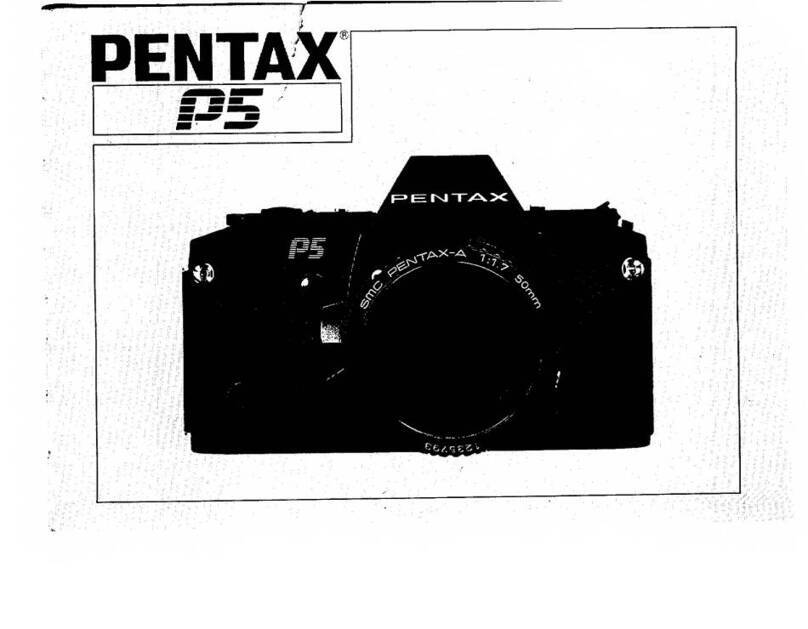
ZORKI-6 User manual, 1960 year
– 6 –
To advance the first unexposed film frame to the frame window, set and release the shutter three
times.
When the shutter is being set, film reverse take-up knob 7 should spin. If the knob fails to revolve,
check the camera for correct loading with film. However, it should be remembered that this is also
likely to take place during the first few film transport cycles if the magazine is loaded with a film
which is much shorter than the normal length. In this case, the reverse take-up knob will begin rotating
only when the film tension on the magazine spool is sufficient.
Rotate picture counting dial 1 (holding it by the knurled surface), to set its zero mark against the
index dot on the camera top surface.
This done, the camera is considered loaded.
Reverse take-up knob 7 mounts film sort dial 8. Holding the film sort dial by its knurled surface and
retaining the reverse take-up knob with the other hand, rotate the film sort dial until the film sort index
stands opposite the dial mark corresponding to the sensitivity of the film used.
The silhouette of a lamp and the sun with rays marked next to the inscription COLOUR
(ЦВЕТНАЯ) identify colour film for artificial and day-light photography. Figures 11, 22, 45, 90 and
180 denote film sensitivities according to the existing system of film sensitivity standards. If, for
instance, the camera is loaded with a black-and-white film of a 65-unit sensitivity, the index should be
set at the corresponding graduation between Figures 45 and 90.
4. Camera Optical System: Lens, Range-Finder, View-Finder (Figs. 1 and 2)
Before taking pictures, study the construction of the camera lens.
The “Industar-50” is of a sliding version; when the camera is not expected to be used, the lens is
drawn into the camera. When slide in, the lens projects from the camera but slightly. To place this lens
in the operating position, pull the lens out holding it by ring 12, and, having fitted the cams in their
recesses, turn the lens clockwise, seeing that it is fixed tight in position, without slightest play
involved.
The “Industar-26M”, “Jupiter-8” and the fixed version of the “Industar-50” do not require the above
mentioned operations, as their mounts are permanently fixed in the camera bodies.
The lens is irised by rotating diaphragm setting ring 13. The desired lens opening figure is set on the
scale provided on ring 12. The lens should be irised before focussing.
For focussing, the lens is rotated in its thread by operating lens focussing lever 14 of the sliding
“Industar-50” lens or the focussing ring of the fixed “Industar-50” lens. In the initial (“∞”) positions,
the lens mounts are locked by a spring-loaded button provided on the focussing lever. To release the
lever for operation, it is necessary to press this button.
The lens travel is limited by stops. Distances to the sharp focussing plane are read off distance scale
10. The distances are indicated by an index with graduations of depth-of-field scale 11 spaced
symmetrically on either side of the index.
Focussing is done with the aid of the optical range-finder. Observing through range-finder
eyepiece 19, lay the lens to the object to be photographed. In this event, the central part of the range-
finder field-of-view shows a yellowish field against a bluish background.
Within the borders of this square field, the object observed is seen double-imaged if the object is
not infinitely distant (any distance less than 100 m).
Objects having sharp contours should be selected for focussing. Turn the lens by the focussing lever
(or the focussing ring) to align the two images of the object.
This done, set the lens accurately for the distance to the object to be photographed, and read this
distance off distance scale 10. This focus setting is sure to produce a sharp picture if the camera is held
firm at the picture-taking moment, and the photographed object is still or moves but not very quickly.
Remember that if the object is located at a distance shorter than 1 m, it is impossible to superimpose
the double images upon each other, and it is vain to use the range-finder.
Sometimes in the photography practice it is either impossible or inconvenient make use of the
range-finder. In such cases, the lens distance setting can be done directly by the distance scale
graduated in meters. The distance to the object to be photographed should be known before or
measured on the spot.