CHAPTER 1: FUNCTIONAL DESCRIPTION
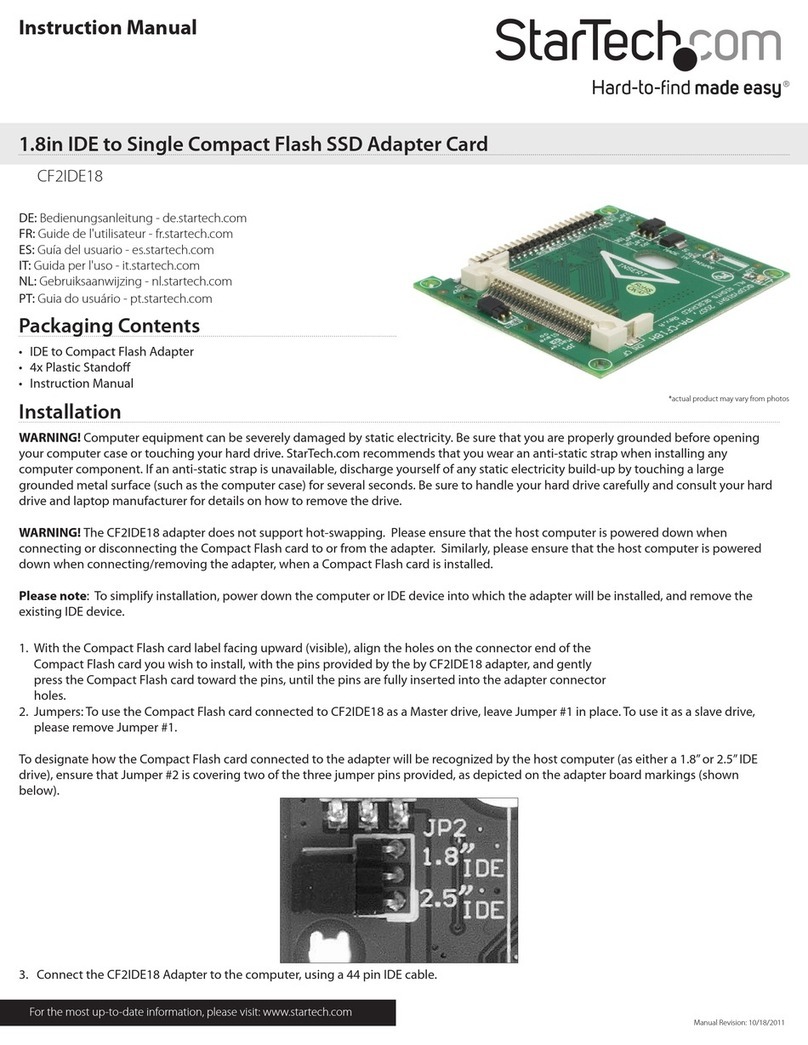
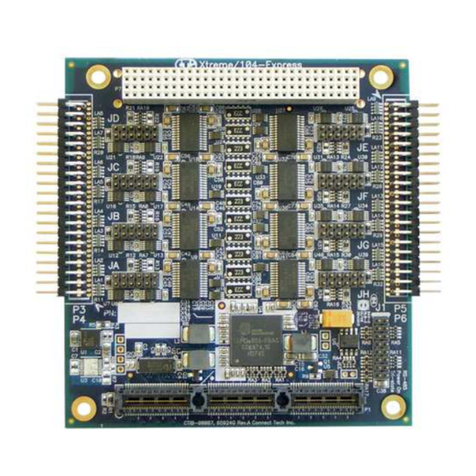
This serial Interface board contains eight independent ports and provides effective RS-485, RS-422 and RS-232
multipoint communication. The 4SM board contains four such ports and the 2SM has two ports. Each channel may
be configured to any mode. Jumpers on the board, along with the proper entries into the EEPROM, permit the
choice of configuration, including termination, for each individual channel.
This series of boards are designed in the PC/104 format. The dimensions are approximately 3.775 inches X 3.550
inches. All signal connections are made through two 40 pin connectors, mounted on edges of the board.
In RS-422 or RS-485 modes, the board can achieve speeds up to 921.6kbps per port. In RS-232 mode, the
maximum speed is 230kbps.
RS-485 BALANCED MODE OPERATION
The board supports RS-485 modes that use differential balanced drivers for increased range and noise immunity.
The RS-485 specification defines a maximum of 32 devices on a single line. The number of devices served on a
single line can be expanded by use of “repeaters”.
The board also has the capability to add load resistors to terminate the communications lines. RS-485
communications requires that one transmitter supply a bias voltage to ensure a known “zero” state when all
transmitters are off. Also, receiver inputs at each end of the network should be terminated to eliminate “ringing”. The
board supports biasing by default and supports termination by jumpers on the board. If your application requires the
transmitter to be un-biased, please contact the factory.
The driver/receiver used, type 75176B, is capable of driving extremely long communication lines at high baud rates.
It can drive up to ±60 mA on balanced lines and receive inputs as low as 200 mV differential signal superimposed
on common mode noise of +12 V or -7 V. In case of communication conflict, the driver/receivers feature thermal
shutdown.
COM PORT COMPATIBILITY
A type 16C788 octal UART is used as the Asynchronous Communication Element (ACE). Each port includes a 64-
byte transmit/receive buffer to protect against lost data in multitasking operating systems, while maintaining 100%
compatibility with the original IBM serial port. However, the ports are not restricted to the standard COM port
addresses.
Continuous address selection is available anywhere within the I/O address range 100 to 3F8 hex, and our
FINDBASE program will scan I/O Bus memory-mapped addresses in your computer for available addresses that
can be used without conflicting with other computer resources. This allows a port to be used as one of the four
“standard” COM ports (COM1 to COM4), or to coexist alongside them, in any combination.
A crystal oscillator is located on the board. This oscillator permits precise selection of baud rate from 300 to 921,600
with the standard crystal oscillator. The standard crystal oscillator is used to generate two clock rates. One is a
1.8432MHz clock. The other is the 14.7456MHz clock which may be selected by installing the “X8" jumper.
COMMUNICATION MODES
The board supports Half-Duplex communications with a 2-wire cable connection. Half-Duplex allows traffic to travel
in both directions, but only one way at a time. RS-485 communications commonly use the half-duplex mode since
they share only a single pair of wires.