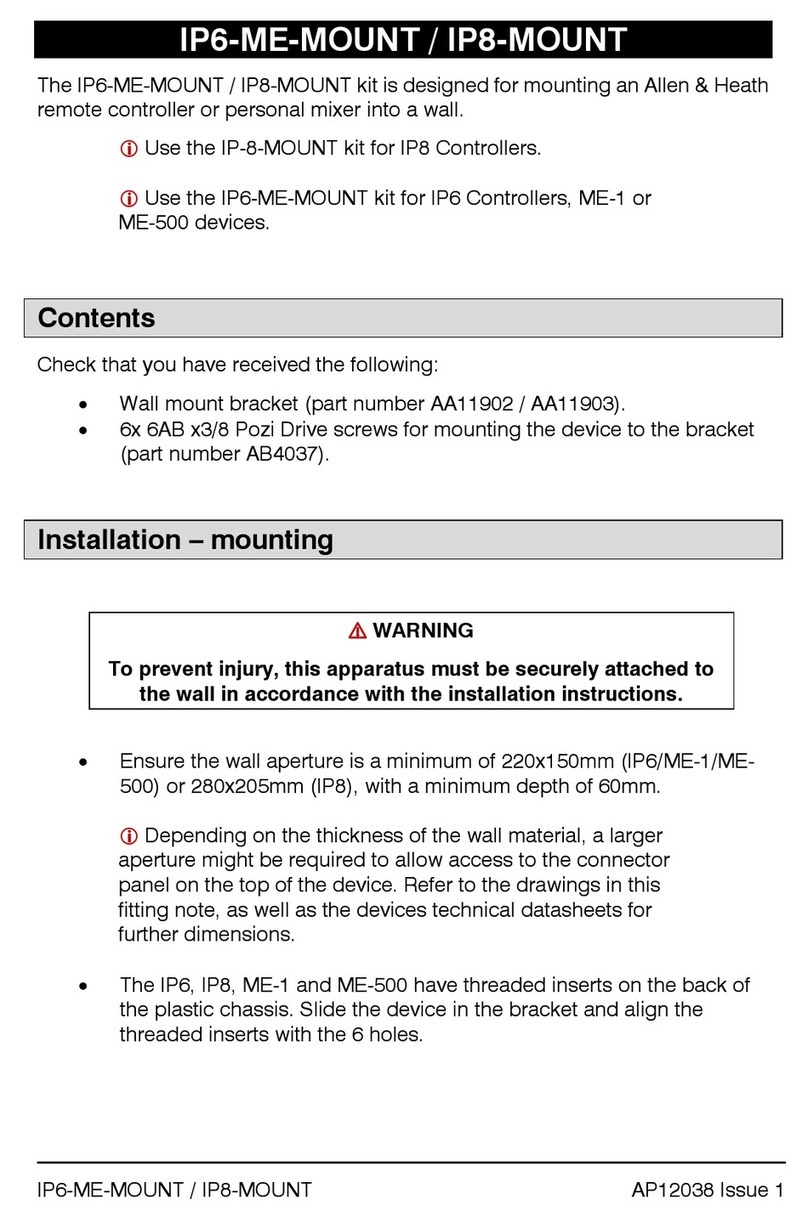
2 PL-3 User Guide AP5081 issue 3
Aligning the arrow keys The four switch
caps can be rotated so that the arrow faces up, down,
left or right. Decide which way you want them to face
according to function, for example volume or source
select.
To change them, first remove the two screws (B) and
unplug the top PCB. Remove the four screws (C) and
lift the lower PCB away. Rotate the switch caps into the
required position. Reassemble the module taking care
to correctly align the two plugs (D).
Mounting into the face plate A pre-cut
brushed aluminium UK (part number AA5029), EU
(AA5250) or US (AA5030) plate is supplied. A backing
box for the UK plate can be supplied (AA5220).
The assembled module fits into an ‘H’ shaped cutout in
the centre of the mounting plate. The module is held
using the two screws with plastic clamps provided (A).
Unscrew these from the module first. Dimensions are
in millimetres below.
Grounding a metal plate If the
face plate is metal ensure that it is correctly grounded
to ensure operator safety. The plate should be
connected to a local safety ground, not the PL-Anet
screen connection. Use a ground wire or physical
contact with a grounded back box.
Wiring standards Use flame retardent CAT5
STP (shielded twisted pair) cable. We recommend the
multi-stranded rather than solid conductor type. The
connection follows the EIA/TIA 568B wiring colour
scheme. Ensure all ports and cables in the system are
wired to this scheme.
PL-Anet wiring Screw terminal blocks are
provided for the serial port IN and OUT connections.
Use a small flat bladed screwdriver. Ensure the wires
are correctly stripped and formed to allow sufficient
service loop in the backing box. Note that some wires
are twisted together in the same terminal.
End of chain termination As with any
RS485 system, the last PL device needs to have a
terminating resistor fitted to its output port. Each PL-3
is shipped with a 100 ohm resistor already fitted. Leave
this fitted only if the unit is the last in the chain.
RJ45 wiring The PL-Anet
network plugs into the iDR unit using
an RJ45 connector. This is wired to the
568B scheme. The pinout is shown
here.
Testing the wiring Before powering
up the system make sure all the wiring is inspected and
continuity tested. This is important as wiring errors
may result in damage to the equipment.
Powering up the PL system Ensure
that the iDR PL-Anet port is active. Its green ‘active’
LED should be lit. If not, use the iDR System Manager
software Communications Option menu to activate the
port. Plug in the PL-Anet cable. The iDR System
Manager screen should display icons on the right hand
toolbar for each PL device it recognises. Refer to the
Help file for details on programming the PL functions.
Diagnostics If a fault is suspected check the
two diagnostics LEDs on the underside of the PL-3
connector PCB. Both the red and green LEDs should
be lit once communication with the iDR is established.
Also measure the PL-Anet +20V supply feed between
the blue wires (+20V) and the brown wires (0V). For
reliable operation this voltage should not drop below
+11V with all PL LEDs turned on. If a fault is found,
first check for correct wiring. If further assistance is
required contact Allen & Heath technical support.
1 WH/OR
2 OR
3 WH/GN
4 BL
5 WH/BL
6 GN
7 WH/BN
8 BN
12
16
32
16
34
20
20
DIA 6
c
TOP
16
16
INPUT OUTPUT
TERMINATION
100 ohms
CABLE SCREEN
WH/OR
OR
BN + WH/BN
BL + WH/BL
WH/GN
GN
INPUT OUTPUT
0V
+20V DC
A
A
BB
C
CD
+
-
C C
D