Battery FAQ For Lithium Ion (Li-Ion) Batteries to use with the
Backscatter Macro Wide 4300 Video Light
A catastrophic battery accident can result in re, explosion, injury, and death, even
when allprecautions have been taken. Please read the following FAQ about battery
usage and safetyprecautions to minimize that risk.
What battery should I use for the Backscatter Macro Wide 4300 Video
Light?
We recommend the Nitecore NL2150HP Li-Ion 15A 21700 batteryfor use with
the Backscatter Macro Wide 4300 Video Light. It is the battery we developed the
Macro Wide 4300 around and the only one we officially recommend for safety and
proper performance of the Macro Wide 4300. The Macro Wide 4300 comes with 2
Nitecore NL2150HP Li-Ion 21700 batteries and a charger.
What happens if I use a different battery that doesn’t conform to the same
specs as the Nitecore NL2150HP Li-Ion 15A 21700 battery?
Due to the high demands of power from the light, anything less than a battery rated
at 15A continuous current would result in performance issues, including shutting
down of the battery.The Backscatter Macro Wide 4300 Video Light is designed with
safety mechanisms to prevent over discharge of the battery and will shut down if it
detects a battery that can’t keep up with performance.
I see other 21700 batteries all over the internet selling for super cheap,
why can’t I use those? Are you guys trying to rip me off?
Those cheap batteries are unprotected and not designed for end use by consum-
ers and do not have important safety protections built in.They can sometimes be
identied by having no branding on the label, or by a plain single color battery jacket
with dot matrix printing. Unprotected batteries without safety protections are much
cheaper to produce than batteries with protection circuitry.
What is the difference between a “protected” battery and an “unprotect-
ed” battery, and why should I always use a protected battery?
Protected Lithium-Ion batteries have an electronic circuit built into the battery cell
packaging.This circuit protects the battery against overcharge, over discharge, short
circuit, over current, and temperature.Protected batteries are safer to use than
unprotected batteries that do not have these safety features built in.
Unprotected batteries have no built in safety protections forovercharge, over dis-
charge, short circuit, over current, or temperature which can result in re, explosion,
injury, or death in the case of failure even when every precaution has been taken.
Unprotected 21700 batteries are not designed for consumer use, so do not use it.
Only use protected batteries designed for consumer use.
Why are unprotected batteries sold if there are greater safety risks versus
a protected battery?
21700 batteries are a very common and popular Li-Ion battery not only made for
end use consumers but also used by manufacturers to combine multiple units into
a larger battery pack for anything from ashlights to electric cars. Did you know Tesla
electric cars are running on battery packs made up of thousands of 21700 batteries?
It is up to those manufacturers to build in their own safety precautions for their
custom designed battery packs.
I’m confused by all this battery geek terminology and I am still unsure of
what battery to get.
Simple! Just use the battery we recommend, the Nitecore NL2150HP Li-Ion 15A
21700 battery available at Backscatter and other retailers worldwide.
Why should I always charge the battery in a common area when people
are around?
Although battery failures are rare, it can be catastrophic.The charging process is a crit-
ical operation. Most Li-Ion battery failures that occur happen during charging.Never
charge in sleeping quarters, below boat decks, or in other unmonitored, or unoccu-
pied areas. In case of emergency, you want someone around to be able to take action.
While it is rare for a battery to fail when all proper safety precautions have been
taken, the consequences are too great toignore.
How do I store batteries when not in use?
Batteries should be stored in a battery storage box designed specically for 21700
batteries.A proper box will provide impact protection and keep batteries isolated so
the battery contacts cannot be bridged and cause a short.
What do I do if the battery has physical damage or water damage?
Immediately stop using the battery, as it is now a safety hazard. Immediate action
needs to be taken to safely dispose of the battery. If at home take it immediately to an
authorized battery recycling center or hazardous materials disposal site. If at a resort
or a live aboard boat, notify resort management or boat captain immediately so that
they may safely dispose of the battery. If on land and unable to take to anauthorized
battery recycling center, place it in a reproof box and store outside in an open area
away from any sources of fuel or ignition until a time when the damaged battery can
be taken to an authorized battery recycling center. Never dispose of batteries in the
garbage or trash. Never ship damaged batteries.
I suspect water has intruded the battery compartment and/or light head.
What should I do?
Immediately discontinue use of the Backscatter Macro Wide 4300 Video Light and
remove the battery as soon as practically possible. Even though the Backscatter Macro
Wide 4300 Video Light has a one way over pressure relief valve in case of overpres-
sure, take extra precaution when opening as the battery compartment may be over
pressurized. Use a damp towel to cover the Backscatter Macro Wide 4300 Video Light
before opening to protect yourself and others.
If I have water intrusion into the battery compartment can I dry it out and
use a new battery?
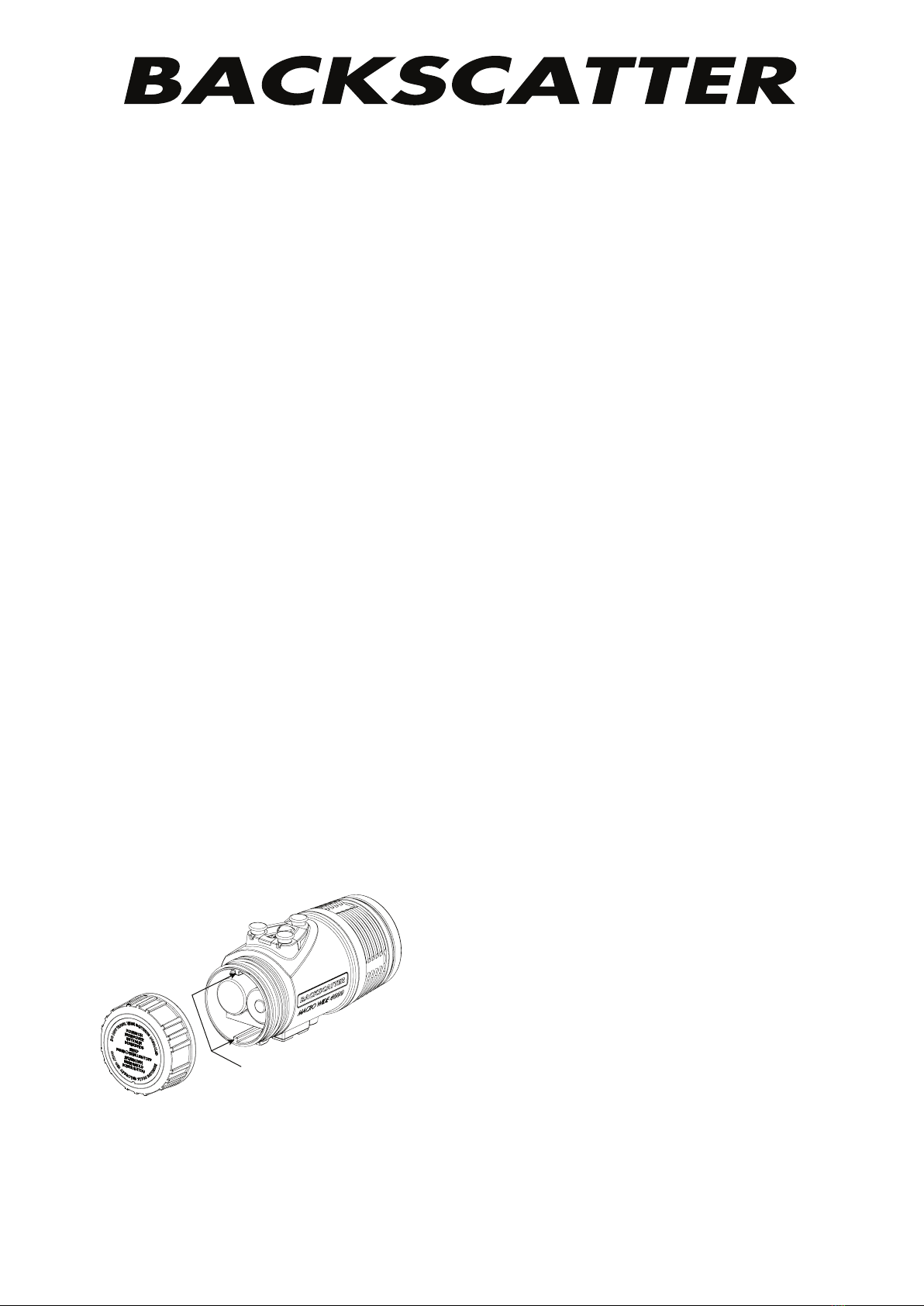
Maybe. The battery compartment is sealed from the rest of the light for safety.After
water intrusion rinse the battery cap and battery compartment of the Backscatter
Macro Wide 4300 Video Light with fresh water. When the battery cap and contacts are
completely dried and cleaned free of corrosion then a new battery may be installed
and the Backscatter Macro Wide 4300 Video Light tested for operation. However, if
there is any unusual operation of the Backscatter Macro Wide 4300 Video Light with
the new battery, immediately discontinue use, remove the battery, and contact the
Backscatter service department or your local Backscatter dealer.
Can I leave the battery installed in the Macro Wide 4300 for travel?
NEVER travel with batteries installed in the Backscatter Macro Wide 4300 Video Light.
Can I travel with the batteries in my checked luggage?
Absolutely not. It is illegal to travel with Li-Ion batteries in the cargo hold on pas-
senger aircraft.All Li-Ion batteries must be carried on aircraft in cabin luggage in an
appropriate battery box that does not allow the battery contacts to be bridged.
Never y with damaged batteries. Damaged batteries are banned from ALL
aircraft by law for good reason.Do not take chances.Your life and the lives
of others are not worth a cheap battery!! Dispose of damagedbatteries
immediately!!
All this battery safety talk has me concerned.
You should be. Following these procedures and precautions can help minimize risk
greatly, but not completely eliminate it. While battery failures that cause catastrophic
damage, injury, and death are very rare, it is your responsibility to use the best care
possible to minimize that risk to yourself and others.
Safety precautions need to be taken with Li-Ion batteries.
Never do the following:
Never charge batteries in unattended areas.
Never charge while sleeping.
Never charge below decks of a boat.
Never store batteries below decks of a boat.
Never store batteries in the light below decks of a boat.
Never use batteries without protection circuitry.
Never dispose of batteries in the garbage or trash.
Never put batteries in checked baggage when traveling.
Never walk around with bare batteries in your pocket, especially with other metal
objects than can easily bridge battery contacts.
Always do the following:
Only chargebatteries in common areas where and when others are around.
Always remove the battery from the Macro Wide 4300 light when not in use.
Only use batteries designed for end use by consumers with safety protection circuitry.
Only store batteries in a battery box designed for 21700 batteries.
Always travel with batteries in cabin baggage.
ALWAYS OBEY ALL INSTRUCTIONS FROM THE BATTERY MANUFACTURER